

Garambot"Aims to Achieve Carbon Neutrality in Livestock Industry with AI-Based Smart Barn Management Platform"
Garambot"Aims to Achieve Carbon Neutrality in Livestock Industry with AI-Based Smart Barn Management Platform"
Posted February. 27, 2026 13:27,
- Garambot is a deep-tech startup addressing the environmental impact of the livestock industry through its "dung beetle" autonomous robots, which use Vision and Physical AI to manage barn floors and reduce greenhouse gas emissions by over 90%.
- The " DungBeetle-1" robot prevents odors and methane by automatically mixing and drying manure directly within the barn bedding, while the upcoming " DungBeetle-2" will collect this dried waste to process it into eco-friendly biomass pellets.
- Led by CEO Moo-bong Lee, the company aims to establish a sustainable "Smart Barn" platform that lowers farmer costs by up to 50% and plans to expand globally, starting with Japan and then moving into North America and Europe by 2028.
The livestock industry holds significant weight in the Republic of Korea's agricultural market. According to data from the Korea Rural Economic Institute, the agricultural production value in 2025 was appraised at 62.738 trillion KRW. Within this, livestock production accounted for 25.5305 trillion KRW, representing approximately 41% of the total. However, the scale of the industry is matched by its environmental impact. Greenhouse gases and odors emitted from livestock manure trigger conflicts within local communities and are cited as major culprits of water pollution.
According to the results of the 2023 Livestock Environment Survey released by the Ministry of Agriculture, Food and Rural Affairs, cattle (including Korean beef, beef cattle, and dairy cows) account for about 45% of domestic livestock manure production, reaching approximately 22 million tons. Nevertheless, outdated manure treatment methods that rely on manual labor and heavy machinery are exacerbating the environmental burden.
The government has announced policies to improve the livestock environment with the goals of carbon neutrality and odor reduction, and is promoting measures to facilitate the conversion of livestock manure into solid fuel. A representative example is the goal set by the Ministry of Agriculture, Food and Rural Affairs to expand the conversion of livestock manure into solid fuel and reach a specific volume by 2030. However, from the perspective of local farmers, the immense costs associated with transporting and drying manure make it difficult to secure the economic viability of solid fuel conversion.
Amidst this situation, a startup has emerged with a proposal for smart livestock automation and biomass (organic waste) fuel manufacturing technology. That startup is Garambot, a deep-tech company seeking to solve barn manure issues by combining AI(Artificial Intelligence) and autonomous robot technology. How does Garambot envision innovating carbon neutrality in the livestock industry? We met with CEO Moo-bong Lee to discuss their journey.
From Water Purification Expert to Livestock Environment Specialist
Lee was a technical expert who developed autonomous driving software and remote control solutions for water purification aquatic robots. One day, while visiting a barn to help a friend who had begun operating a Hanwoo(Korean beef) farm alone, he faced an unexpected reality: the problem of handling livestock manure. Moo-bong Lee recalled, "The biggest headache I encountered at the farm was manure treatment. Not only was the smell intense, but the labor exhaustion was severe because it had to be cleared away using heavy machinery every time."
The task of drying wet bedding (the sawdust covering the barn floor) was a challenge bordering on the impossible, to the point where neighboring farmers pleaded for a machine that could dry the manure. However, Lee conceived a new idea right there at the barn. He became convinced that if the manure produced that day were mixed and dried immediately—before it could pile up and become slushy—it would prevent odors and rot at the source. He judged that this was a task he could overcome using his existing small-scale autonomous equipment technology. Based on this idea, he founded Garambot.
Subsequently, he recruited his friend, the farm operator, as a team member and commenced the development of field-oriented robots. The goal was expanded to a "Smart Barn Floor Management Service" that maintains a pleasant environment by managing the barn floor daily, rather than just clearing manure as a one-time task.
Garambot shares the philosophy that technology is meaningless if it does not function in the field. What the members pursue is not advanced technology confined to a laboratory. They concentrated their capabilities on creating intuitive, robust robots that operate daily without breakdown in actual farms.
There were many trials and errors in the early stages. The first prototype was a cone-shaped robot that looked like a horn. It was built sturdily to be around cattle, but the cows ended up treating it as a toy. When a powerful cow gave it a nudge, the robot would flip over, leading to frequent malfunctions. Garambot then reconsidered how to manage the bedding while remaining as inconspicuous as possible to the cattle. Ultimately, they moved forward with technical refinements by shifting the design toward a low, wide-profile robot.
Managing Hanwoo Barns by Rolling Bedding like a Dung Beetle
Garambot developed DungBeetle-1, a robot that roams the barn floor to automatically mix and aerate manure and bedding to maintain a dry state. Since management begins the moment the bedding is laid, it can block odors and methane gas, which typically arise when wet manure is left unattended, to the maximum extent.
The distinguishing feature of DungBeetle-1 is its optimization for CBP(Composting Poultry Bedding) barns. Barn management robots developed overseas based on water cleaning require the construction of liquid manure storage tanks or separate post-processing facilities, which imposes a heavy burden on farmers. In contrast, Garambot's barn management solution allows for the drying and post-processing of manure within the barn, eliminating the need to build separate treatment facilities.
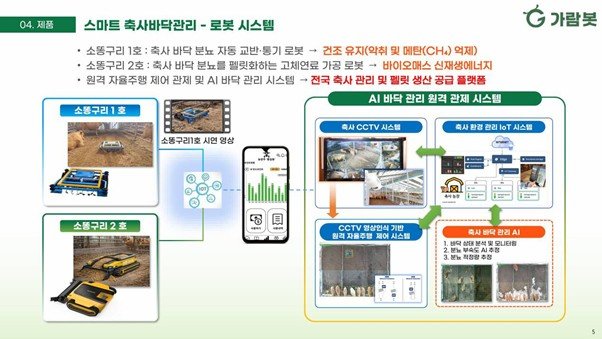
A CCTV(Closed-Circuit Television) system installed on the ceiling takes charge of the robot and barn management. According to Moo-bong Lee, the system combines Vision AI(image analysis based on artificial intelligence) and Physical AI(artificial intelligence for physical interaction) to control remote autonomous driving, enabling stable operation even in highly contaminated barn environments. The CCTV image recognition-based remote autonomous control system manages the robot, while the AI Floor Management System analyzes the barn floor condition in real-time to optimize the number of mixing cycles and the driving route. This is because drying speeds vary between sunny and shaded areas, as well as between breezy and stagnant spots within the barn.
"Soil dries quickly when you turn it over. In the same way, if you shake and scatter wet sawdust, the moisture escapes. By immediately drying the manure accumulated on the day of emission, the initial state can always be maintained."
Through a one-month field demonstration at a barn, Garambot confirmed that the bedding did not clump and remained in a fine flooring state. This means the anaerobic environment, which is the primary cause of ammonia and methane production, is never created in the first place. Moo-bong Lee emphasized, "We can reduce greenhouse gases generated during the manure treatment process by more than 90%."
DungBeetle-1 patrols the barn floor according to a set schedule, mixing the manure produced that day into the bedding. The moment the moisture trapped in the bedding is mixed, it evaporates naturally, maintaining the dryness of the floor. As driving data accumulates, customized operation becomes possible. It is designed to learn optimized driving patterns based on each farm's Hanwoo headcount, feed type, and barn structure.
Following DungBeetle-1, Garambot is also developing DungBeetle-2. While the first model's role is to keep the floor dry, DungBeetle-2 will collect the sufficiently dried manure and bedding to process them into biomass (pellets).
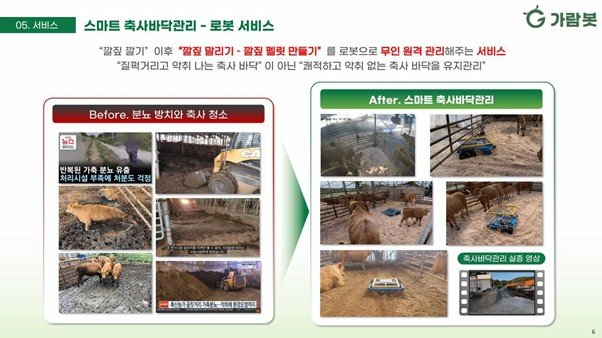
Currently, a major obstacle in the solid fuel conversion of manure is that transport and drying costs account for the majority of production costs. Garambot envisioned an ecosystem where DungBeetle-1 dries the bedding and manure, and DungBeetle-2 converts them into pellets and collects them. This structure ensures the economic viability of solid fuel because there are no separate drying costs or collection processes for biomass treatment. Garambot expects this to not only reduce farmers' manure treatment costs by 30% to 50% but also resolve odor complaints and improve the health and productivity of the cattle.
Moo-bong Lee explained that once the smart barn management platform is completed with DungBeetle-1 and DungBeetle-2, the burden on farmers will be significantly reduced. Farmers can lower the barrier to adopting the platform through a subscription service, while Garambot generates revenue by supplying the dried cow manure pellets produced in the barns to cogeneration plants.
Persuading Conservative Hanwoo Farmers is a Hurdle to Growth
The concern for Garambot, having built a smart barn management platform, is persuading farmers who have worked by hand for decades to accept the unfamiliar method of AI robots. However, since the sustainable growth of the company is impossible if the adoption rate of the platform by Hanwoo farmers remains slow, Garambot is focusing its efforts on persuading them.
Rather than reckless business expansion, Garambot has chosen a strategic and stepped approach. They are focused on instilling trust that the service works perfectly by accumulating successful demonstration cases. To alleviate the financial burden on farmers during initial adoption, they plan to accelerate the process of registering with the Public Procurement Service as an "Innovative Product" and as agricultural machinery. This is because utilizing livestock odor improvement subsidies from the government and local municipalities can significantly lower the investment costs for farmers.
The expansion strategy is also meticulously planned. The idea is to build success stories centered around testbeds in Yeongi-myeon, Sejong City, and other key hubs, and then expand through word-of-mouth to regional distribution. They also plan to expedite market entry by attracting venture capital investment related to agriculture and collaborating with large-scale feed manufacturing companies.
The achievements Garambot has steadily built are also weapons to persuade farmers and the investment market. In 2025, they filed four domestic patent applications, one PCT international patent application, and registered one patent for a "Barn Management Robot and Control Method Thereof." In February 2026, they also obtained ISO 9001(Quality Management System Standard) and ISO 14001(Environmental Management System) certifications.
Their history of selection for government support projects is also extensive. In 2024, they received the K-Global Startup Mentoring from the Ministry of Science and ICT and the Startup Growth Technology Development Project (Stepping Stone) from the Ministry of SMEs and Startups. In 2025, they were selected for the Ministry of SMEs and Startups' Initial Startup Package in the Deep-tech field and the "Net Zero Challenge X" hosted by the 2050 carbon Neutral Green Growth Committe. In February 2026, they were chosen as an outstanding company for the Gyeonggi Startup Booster by the Gyeonggi Business & Science Accelerator.
Goal: To Become a Global Agricultural Platform Company
The assistance from the Korea University Crimson Startup Support Foundation played a major role in Garambot's steady growth. Selected for the Initial Startup Package program, Garambot enhanced the completeness of its smart barn management platform by approaching it from various angles, including market fit, revenue generation structures, and global scalability, in addition to technical maturity.
Mentoring necessary for corporate activities, such as IR(Investor Relations) presentation materials, marketing strategies, and PR plans, was also provided. They were also able to address trademark rights and branding through the program's support. By participating in global IR, they gained the opportunity to validate their business model through the eyes of international investors.
Lee said, "There were things that hadn't been organized while running the business. With the help of the Korea University Crimson Startup Support Foundation, I received help in building actual business strategies. I believe it was a turning point that gave the members of Garambot strong confidence to move forward without stopping."
DungBeetle-1 in 2026 and begin a pilot project targeting about 30 farms in Yeongi-myeon, Sejong City. They also aim to finish the development of DungBeetle-2, the pellet-processing robot, within 2026. Subsequently, they presented a blueprint to enter the biomass pellet market in 2027 and lay the foundation for global expansion in 2028 by completing the automation of smart barn management AI and solid fuel production.
Garambot is also paying attention to overseas markets. The reason is that the CBPComposting Poultry Barn/Bedding) method is rapidly spreading, particularly in North America and Europe. While this is partly due to improvements in animal welfare, lifespan, and productivity, the pressure to change existing methods that rely on manure storage tanks and liquid manure tanks due to strengthening environmental regulations is also a factor. Lee's analysis is that as the introduction of CBP barns expands overseas, interest in smart barn management platforms will also grow.
The global market entry of the smart barn management platform will proceed in stages. First, they plan to build demonstration data in Japan, which has a livestock environment similar to the Republic of Korea, characterized by aging populations, odor regulations, and bedding-based barn structures. Afterward, they plan to enter Europe and North America sequentially. Lee concluded, "We will not stop our challenge to present a new paradigm for a sustainable livestock industry and transform livestock manure, once a nuisance, into an energy resource."
By Hyung-seok Kang (redbk@itdonga.com)
- The " DungBeetle-1" robot prevents odors and methane by automatically mixing and drying manure directly within the barn bedding, while the upcoming " DungBeetle-2" will collect this dried waste to process it into eco-friendly biomass pellets.
- Led by CEO Moo-bong Lee, the company aims to establish a sustainable "Smart Barn" platform that lowers farmer costs by up to 50% and plans to expand globally, starting with Japan and then moving into North America and Europe by 2028.
The livestock industry holds significant weight in the Republic of Korea's agricultural market. According to data from the Korea Rural Economic Institute, the agricultural production value in 2025 was appraised at 62.738 trillion KRW. Within this, livestock production accounted for 25.5305 trillion KRW, representing approximately 41% of the total. However, the scale of the industry is matched by its environmental impact. Greenhouse gases and odors emitted from livestock manure trigger conflicts within local communities and are cited as major culprits of water pollution.
According to the results of the 2023 Livestock Environment Survey released by the Ministry of Agriculture, Food and Rural Affairs, cattle (including Korean beef, beef cattle, and dairy cows) account for about 45% of domestic livestock manure production, reaching approximately 22 million tons. Nevertheless, outdated manure treatment methods that rely on manual labor and heavy machinery are exacerbating the environmental burden.
The government has announced policies to improve the livestock environment with the goals of carbon neutrality and odor reduction, and is promoting measures to facilitate the conversion of livestock manure into solid fuel. A representative example is the goal set by the Ministry of Agriculture, Food and Rural Affairs to expand the conversion of livestock manure into solid fuel and reach a specific volume by 2030. However, from the perspective of local farmers, the immense costs associated with transporting and drying manure make it difficult to secure the economic viability of solid fuel conversion.
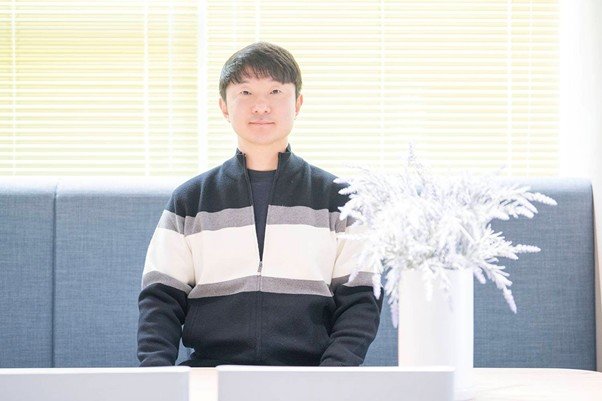
Moo-bong Lee, CEO of Garambot / Source = IT dongA
Amidst this situation, a startup has emerged with a proposal for smart livestock automation and biomass (organic waste) fuel manufacturing technology. That startup is Garambot, a deep-tech company seeking to solve barn manure issues by combining AI(Artificial Intelligence) and autonomous robot technology. How does Garambot envision innovating carbon neutrality in the livestock industry? We met with CEO Moo-bong Lee to discuss their journey.
From Water Purification Expert to Livestock Environment Specialist
Lee was a technical expert who developed autonomous driving software and remote control solutions for water purification aquatic robots. One day, while visiting a barn to help a friend who had begun operating a Hanwoo(Korean beef) farm alone, he faced an unexpected reality: the problem of handling livestock manure. Moo-bong Lee recalled, "The biggest headache I encountered at the farm was manure treatment. Not only was the smell intense, but the labor exhaustion was severe because it had to be cleared away using heavy machinery every time."
The task of drying wet bedding (the sawdust covering the barn floor) was a challenge bordering on the impossible, to the point where neighboring farmers pleaded for a machine that could dry the manure. However, Lee conceived a new idea right there at the barn. He became convinced that if the manure produced that day were mixed and dried immediately—before it could pile up and become slushy—it would prevent odors and rot at the source. He judged that this was a task he could overcome using his existing small-scale autonomous equipment technology. Based on this idea, he founded Garambot.
Subsequently, he recruited his friend, the farm operator, as a team member and commenced the development of field-oriented robots. The goal was expanded to a "Smart Barn Floor Management Service" that maintains a pleasant environment by managing the barn floor daily, rather than just clearing manure as a one-time task.
Garambot shares the philosophy that technology is meaningless if it does not function in the field. What the members pursue is not advanced technology confined to a laboratory. They concentrated their capabilities on creating intuitive, robust robots that operate daily without breakdown in actual farms.
There were many trials and errors in the early stages. The first prototype was a cone-shaped robot that looked like a horn. It was built sturdily to be around cattle, but the cows ended up treating it as a toy. When a powerful cow gave it a nudge, the robot would flip over, leading to frequent malfunctions. Garambot then reconsidered how to manage the bedding while remaining as inconspicuous as possible to the cattle. Ultimately, they moved forward with technical refinements by shifting the design toward a low, wide-profile robot.
Managing Hanwoo Barns by Rolling Bedding like a Dung Beetle
Garambot developed DungBeetle-1, a robot that roams the barn floor to automatically mix and aerate manure and bedding to maintain a dry state. Since management begins the moment the bedding is laid, it can block odors and methane gas, which typically arise when wet manure is left unattended, to the maximum extent.
The distinguishing feature of DungBeetle-1 is its optimization for CBP(Composting Poultry Bedding) barns. Barn management robots developed overseas based on water cleaning require the construction of liquid manure storage tanks or separate post-processing facilities, which imposes a heavy burden on farmers. In contrast, Garambot's barn management solution allows for the drying and post-processing of manure within the barn, eliminating the need to build separate treatment facilities.
Garambot has built a smart barn floor management platform by integrating Vision AI and Physical AI technologies / Source = Garambot
A CCTV(Closed-Circuit Television) system installed on the ceiling takes charge of the robot and barn management. According to Moo-bong Lee, the system combines Vision AI(image analysis based on artificial intelligence) and Physical AI(artificial intelligence for physical interaction) to control remote autonomous driving, enabling stable operation even in highly contaminated barn environments. The CCTV image recognition-based remote autonomous control system manages the robot, while the AI Floor Management System analyzes the barn floor condition in real-time to optimize the number of mixing cycles and the driving route. This is because drying speeds vary between sunny and shaded areas, as well as between breezy and stagnant spots within the barn.
"Soil dries quickly when you turn it over. In the same way, if you shake and scatter wet sawdust, the moisture escapes. By immediately drying the manure accumulated on the day of emission, the initial state can always be maintained."
Through a one-month field demonstration at a barn, Garambot confirmed that the bedding did not clump and remained in a fine flooring state. This means the anaerobic environment, which is the primary cause of ammonia and methane production, is never created in the first place. Moo-bong Lee emphasized, "We can reduce greenhouse gases generated during the manure treatment process by more than 90%."
DungBeetle-1 patrols the barn floor according to a set schedule, mixing the manure produced that day into the bedding. The moment the moisture trapped in the bedding is mixed, it evaporates naturally, maintaining the dryness of the floor. As driving data accumulates, customized operation becomes possible. It is designed to learn optimized driving patterns based on each farm's Hanwoo headcount, feed type, and barn structure.
Following DungBeetle-1, Garambot is also developing DungBeetle-2. While the first model's role is to keep the floor dry, DungBeetle-2 will collect the sufficiently dried manure and bedding to process them into biomass (pellets).
Garambot aims to create a sustainable livestock industry environment / Source = Garambot
Currently, a major obstacle in the solid fuel conversion of manure is that transport and drying costs account for the majority of production costs. Garambot envisioned an ecosystem where DungBeetle-1 dries the bedding and manure, and DungBeetle-2 converts them into pellets and collects them. This structure ensures the economic viability of solid fuel because there are no separate drying costs or collection processes for biomass treatment. Garambot expects this to not only reduce farmers' manure treatment costs by 30% to 50% but also resolve odor complaints and improve the health and productivity of the cattle.
Moo-bong Lee explained that once the smart barn management platform is completed with DungBeetle-1 and DungBeetle-2, the burden on farmers will be significantly reduced. Farmers can lower the barrier to adopting the platform through a subscription service, while Garambot generates revenue by supplying the dried cow manure pellets produced in the barns to cogeneration plants.
Persuading Conservative Hanwoo Farmers is a Hurdle to Growth
The concern for Garambot, having built a smart barn management platform, is persuading farmers who have worked by hand for decades to accept the unfamiliar method of AI robots. However, since the sustainable growth of the company is impossible if the adoption rate of the platform by Hanwoo farmers remains slow, Garambot is focusing its efforts on persuading them.
Rather than reckless business expansion, Garambot has chosen a strategic and stepped approach. They are focused on instilling trust that the service works perfectly by accumulating successful demonstration cases. To alleviate the financial burden on farmers during initial adoption, they plan to accelerate the process of registering with the Public Procurement Service as an "Innovative Product" and as agricultural machinery. This is because utilizing livestock odor improvement subsidies from the government and local municipalities can significantly lower the investment costs for farmers.
The expansion strategy is also meticulously planned. The idea is to build success stories centered around testbeds in Yeongi-myeon, Sejong City, and other key hubs, and then expand through word-of-mouth to regional distribution. They also plan to expedite market entry by attracting venture capital investment related to agriculture and collaborating with large-scale feed manufacturing companies.
The achievements Garambot has steadily built are also weapons to persuade farmers and the investment market. In 2025, they filed four domestic patent applications, one PCT international patent application, and registered one patent for a "Barn Management Robot and Control Method Thereof." In February 2026, they also obtained ISO 9001(Quality Management System Standard) and ISO 14001(Environmental Management System) certifications.
Their history of selection for government support projects is also extensive. In 2024, they received the K-Global Startup Mentoring from the Ministry of Science and ICT and the Startup Growth Technology Development Project (Stepping Stone) from the Ministry of SMEs and Startups. In 2025, they were selected for the Ministry of SMEs and Startups' Initial Startup Package in the Deep-tech field and the "Net Zero Challenge X" hosted by the 2050 carbon Neutral Green Growth Committe. In February 2026, they were chosen as an outstanding company for the Gyeonggi Startup Booster by the Gyeonggi Business & Science Accelerator.
Goal: To Become a Global Agricultural Platform Company
The assistance from the Korea University Crimson Startup Support Foundation played a major role in Garambot's steady growth. Selected for the Initial Startup Package program, Garambot enhanced the completeness of its smart barn management platform by approaching it from various angles, including market fit, revenue generation structures, and global scalability, in addition to technical maturity.
Mentoring necessary for corporate activities, such as IR(Investor Relations) presentation materials, marketing strategies, and PR plans, was also provided. They were also able to address trademark rights and branding through the program's support. By participating in global IR, they gained the opportunity to validate their business model through the eyes of international investors.
Lee said, "There were things that hadn't been organized while running the business. With the help of the Korea University Crimson Startup Support Foundation, I received help in building actual business strategies. I believe it was a turning point that gave the members of Garambot strong confidence to move forward without stopping."
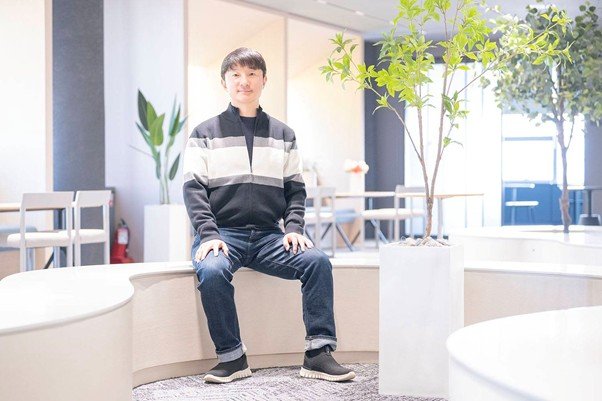
Moo-bong Lee, CEO of Garambot / Source = IT dongA
DungBeetle-1 in 2026 and begin a pilot project targeting about 30 farms in Yeongi-myeon, Sejong City. They also aim to finish the development of DungBeetle-2, the pellet-processing robot, within 2026. Subsequently, they presented a blueprint to enter the biomass pellet market in 2027 and lay the foundation for global expansion in 2028 by completing the automation of smart barn management AI and solid fuel production.
Garambot is also paying attention to overseas markets. The reason is that the CBPComposting Poultry Barn/Bedding) method is rapidly spreading, particularly in North America and Europe. While this is partly due to improvements in animal welfare, lifespan, and productivity, the pressure to change existing methods that rely on manure storage tanks and liquid manure tanks due to strengthening environmental regulations is also a factor. Lee's analysis is that as the introduction of CBP barns expands overseas, interest in smart barn management platforms will also grow.
The global market entry of the smart barn management platform will proceed in stages. First, they plan to build demonstration data in Japan, which has a livestock environment similar to the Republic of Korea, characterized by aging populations, odor regulations, and bedding-based barn structures. Afterward, they plan to enter Europe and North America sequentially. Lee concluded, "We will not stop our challenge to present a new paradigm for a sustainable livestock industry and transform livestock manure, once a nuisance, into an energy resource."
By Hyung-seok Kang (redbk@itdonga.com)








 About Dong-A Ilbo