

3DMem will mass-produce eco-friendly and high-performance membranes through nano 3D printing
3DMem will mass-produce eco-friendly and high-performance membranes through nano 3D printing
Posted February. 26, 2026 12:53,
Updated February. 26, 2026 12:54
- 3DMem is a South Korean startup disrupting the global membrane filter market by using Nano 3D Printing Technology to overcome the technical limitations of traditional manufacturing methods.
- The technology allows for precise control of pore diameter, depth, and spacing at a 70nm resolution, resulting in an 800% increase in filtration efficiency and reducing active substance loss to nearly 0%.
- Led by veteran researcher Kwang-jin Lee, the company is currently scaling for mass production and plans to deliver samples to top-tier global pharmaceutical partners in 2026 after attracting significant Pre-A investment.
-
Membrane Filters, which filter out substances of specific sizes through microscopic pores, are essential materials for research and development in the bio/pharmaceutical sectors, eco-friendly water treatment, and hydrogen technology—a next-generation energy source. They are particularly active in the bio/pharmaceutical field. Most pharmaceutical companies, both in Korea and globally, utilize Membrane Filters in filtering processes to precisely separate and purify proteins, RNA, and DNA. Consequently, the market size is expanding daily. The market research firm Markets and Markets projected that the global bio/pharmaceutical Membrane Filter market will grow from $8.03 billion (approx. 11.61 trillion KRW) in 2024 to $15.04 billion (approx. 21.75 trillion KRW) by 2029.
The problem lies in the fact that most Membrane Filter manufacturers are foreign companies, leading to a localization rate in Korea of nearly 0%, and further innovation across the entire process is difficult due to the technical limitations of current manufacturing methods. The South Korean startup 3DMem (3DMem, Inc.) aims to solve these two issues by utilizing its Nano 3D Printing Technology, which handles materials with extreme precision.
CEO Kwang-jin Lee, who leads 3DMem, is an expert who worked as a Membrane Filter researcher for 21 years and a business leader for 5 years at a major Korean chemical materials corporation. He has long pondered how to solve the problems within the Membrane Filter industry. The clue was the "Smart Factory." The principle involves finding a core technology suitable for creating Membrane Filters with uniform quality and characteristics, and then building a smart factory that utilizes this technology to perform manufacturing tasks without error.
Subsequently, he turned his attention to 3D printing as the central technology for the smart factory. However, at the time he conceived this principle, there was no 3D printing technology sophisticated enough to produce Membrane Filters. Continuing his search for technology, Lee discovered a foundational Nano 3D Printing Technology in 2023 capable of expressing a resolution of 70nm (nanometers; 1 nanometer is 1/100,000th the thickness of a human hair). After receiving the transfer of this original Nano 3D Printing Technologyfrom POSTECH, he underwent research and development to create the first Membrane Filter production equipment unit (Unit No. 1) in early 2025.
What advantages do the Membrane Filters produced by 3DMem using Nano 3D Printing Technology offer? To understand these benefits, one must know the structure and characteristics of a Membrane Filter. A Membrane Filter is made by densely perforating a porous film with microscopic pores. The diameter of these pores determines the filtration of substances of a specific size, while the spacing of the pores affects the process time. In the case of Membrane Filters used for new drug development, large impurities are removed by a Depth Filter, smaller microorganisms and bacteria by a Sterile Filter, and the smallest viruses by a Virus Filter.
However, due to the limitations of existing manufacturing processes, the diameter, depth, spacing, and quantity per unit area of the pores were all inconsistent. If pore diameters are inconsistent, it becomes impossible to precisely filter out specific substances. If a substance with a diameter of 3 needs to be completely filtered, but the pore diameter of the Membrane Filter is 3.1 or 4 instead of 3, it cannot perform its role effectively. The same applies to pore depth. If this is not uniform, it leads to "tortuosity," where pores are formed in a winding shape, unnecessarily lengthening the filtration time.
The same issues occur if the spacing and the number of pores per unit area are inconsistent. If pore spacing varies, the process speed changes every time. Assuming the same area, the processing speed of a Membrane Filter with 100 pores due to dense spacing will differ from one with 70 pores due to wider spacing. In other words, using a Membrane Filter with many pores speeds up the process, while one with fewer pores slows it down.

By utilizing Nano 3D Printing Technology, it is possible to control not only the diameter of the Membrane Filter pores but also their depth, shape, and spacing. 3DMem stated that, based on its own research, manufacturing Membrane Filters with its technology can reduce both the time to filter specific substances and the overall filtration time, increasing the overall process speed efficiency by more than 800% while reducing loss during the filtration process to near 0%. The company also introduced the utility a bio-pharmaceutical firm—performing 100 batches a year and spending 10 billion KRW per batch—would gain by using 3DMem’s Membrane Filters. By reducing filtration time, they could achieve cost savings of approximately 90 billion KRW annually, and by maintaining uniform pore sizes to minimize the loss of active substances, they could save an additional 30 billion KRW per year.
The value of 3DMem’s technology goes further. Existing Membrane Filters use chemicals and cleaning water during production. Wastewater, chemicals, and cleaning water containing solvents generated after manufacturing are all environmental pollutants. Since Nano 3D Printing creates Membrane Filters by printing them, it does not produce environmental pollutants. Lee has garnered market attention with the Nano 3D Printing Technology and the first Membrane Filter production equipment. Having completed pilot production and aiming to expand to mass production, 3DMem has built its foundation by carrying out government support projects and R&D research tasks based on its technology. It has also secured patents to protect its Nano 3D Printing Technology and increase productivity.
The Korea University Crimson Startup Support Foundation also joined forces to help 3DMem grow. They provided a wide range of support necessary for an early-stage company, including participation in Demoday, accompanying the firm to the ILS 2025 exhibition in Japan, matching with investors, supporting patent applications, and assisting with BI/CI production, as well as the DeepTech Bridge Program and overseas expansion education and networking. Thanks to this, 3DMem has met with global investors and partners.
3DMem recently achieved significant results. By participating in exhibitions both within and outside of Korea, it received "love calls" from several of the world's top-tier Membrane Filter production companies. Lee plans to deliver Membrane Filter samples to them within 2026 and determine the scope and nature of their collaboration. A productivity-securing strategy to meet their demands is also under construction.
Based on this, 3DMem is addressing the challenges of securing cost competitiveness and expanding mass production scale. The goal is to simultaneously increase the production volume and quality of Membrane Filters to satisfy customer demand. ee stated that he has already identified a significant portion of customer demand and revealed plans to secure both cost competitiveness and mass production scale by utilizing Multi-Nozzle Blocks and High-Speed Nozzle Technology. To this end, the company has begun attracting Pre-A Series investment and is expected to close it soon after drawing interest from global FI(Financial Investors) and SI(Strategic Investors).
Lee stated, “ 3DMem’s goal is to be the first in the world to commercialize Nano 3D Printing Technology, changing the landscape of the Membrane Filter market and establishing ourselves as the industry leader. We will continue to grow so that Korea’s technology becomes the global standard and exerts a positive influence on all sectors utilizing membrane technology, such as water treatment and hydrogen.”
By Joo-kyung Cha (racingcar@itdonga.com)
- The technology allows for precise control of pore diameter, depth, and spacing at a 70nm resolution, resulting in an 800% increase in filtration efficiency and reducing active substance loss to nearly 0%.
- Led by veteran researcher Kwang-jin Lee, the company is currently scaling for mass production and plans to deliver samples to top-tier global pharmaceutical partners in 2026 after attracting significant Pre-A investment.
-
Membrane Filters, which filter out substances of specific sizes through microscopic pores, are essential materials for research and development in the bio/pharmaceutical sectors, eco-friendly water treatment, and hydrogen technology—a next-generation energy source. They are particularly active in the bio/pharmaceutical field. Most pharmaceutical companies, both in Korea and globally, utilize Membrane Filters in filtering processes to precisely separate and purify proteins, RNA, and DNA. Consequently, the market size is expanding daily. The market research firm Markets and Markets projected that the global bio/pharmaceutical Membrane Filter market will grow from $8.03 billion (approx. 11.61 trillion KRW) in 2024 to $15.04 billion (approx. 21.75 trillion KRW) by 2029.
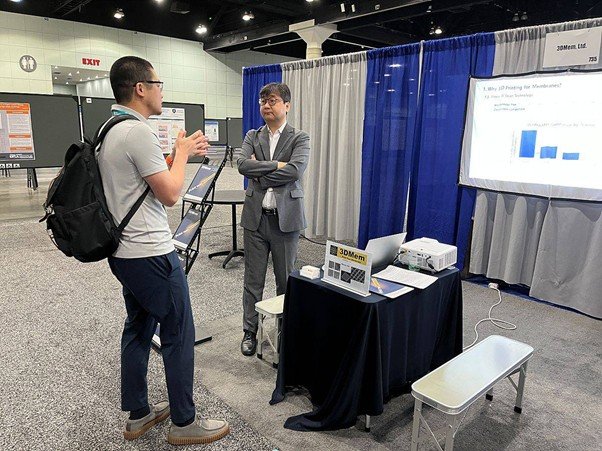
Kwang-jin Lee, CEO of 3DMem(right), introducing the technology at ASM Microbe 2025/ source=3DMem
The problem lies in the fact that most Membrane Filter manufacturers are foreign companies, leading to a localization rate in Korea of nearly 0%, and further innovation across the entire process is difficult due to the technical limitations of current manufacturing methods. The South Korean startup 3DMem (3DMem, Inc.) aims to solve these two issues by utilizing its Nano 3D Printing Technology, which handles materials with extreme precision.
CEO Kwang-jin Lee, who leads 3DMem, is an expert who worked as a Membrane Filter researcher for 21 years and a business leader for 5 years at a major Korean chemical materials corporation. He has long pondered how to solve the problems within the Membrane Filter industry. The clue was the "Smart Factory." The principle involves finding a core technology suitable for creating Membrane Filters with uniform quality and characteristics, and then building a smart factory that utilizes this technology to perform manufacturing tasks without error.
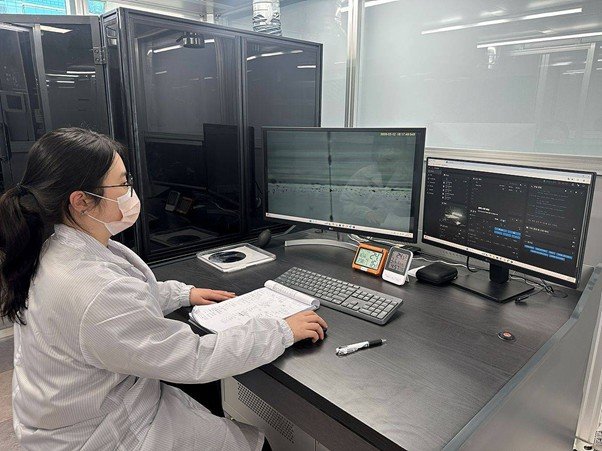
3DMem employees checking the Nano 3D Printing process / source=3DMem
Subsequently, he turned his attention to 3D printing as the central technology for the smart factory. However, at the time he conceived this principle, there was no 3D printing technology sophisticated enough to produce Membrane Filters. Continuing his search for technology, Lee discovered a foundational Nano 3D Printing Technology in 2023 capable of expressing a resolution of 70nm (nanometers; 1 nanometer is 1/100,000th the thickness of a human hair). After receiving the transfer of this original Nano 3D Printing Technologyfrom POSTECH, he underwent research and development to create the first Membrane Filter production equipment unit (Unit No. 1) in early 2025.
What advantages do the Membrane Filters produced by 3DMem using Nano 3D Printing Technology offer? To understand these benefits, one must know the structure and characteristics of a Membrane Filter. A Membrane Filter is made by densely perforating a porous film with microscopic pores. The diameter of these pores determines the filtration of substances of a specific size, while the spacing of the pores affects the process time. In the case of Membrane Filters used for new drug development, large impurities are removed by a Depth Filter, smaller microorganisms and bacteria by a Sterile Filter, and the smallest viruses by a Virus Filter.
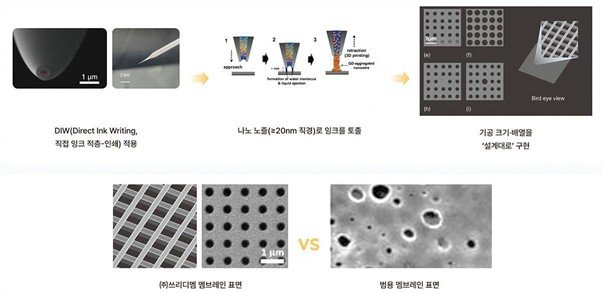
Advantages of 3DMem’s 3D Printed Membrane Filter/ source=3DMem
However, due to the limitations of existing manufacturing processes, the diameter, depth, spacing, and quantity per unit area of the pores were all inconsistent. If pore diameters are inconsistent, it becomes impossible to precisely filter out specific substances. If a substance with a diameter of 3 needs to be completely filtered, but the pore diameter of the Membrane Filter is 3.1 or 4 instead of 3, it cannot perform its role effectively. The same applies to pore depth. If this is not uniform, it leads to "tortuosity," where pores are formed in a winding shape, unnecessarily lengthening the filtration time.
The same issues occur if the spacing and the number of pores per unit area are inconsistent. If pore spacing varies, the process speed changes every time. Assuming the same area, the processing speed of a Membrane Filter with 100 pores due to dense spacing will differ from one with 70 pores due to wider spacing. In other words, using a Membrane Filter with many pores speeds up the process, while one with fewer pores slows it down.
3DMem employees researching the Nano 3D Printing Nozzle/ source=3DMem
By utilizing Nano 3D Printing Technology, it is possible to control not only the diameter of the Membrane Filter pores but also their depth, shape, and spacing. 3DMem stated that, based on its own research, manufacturing Membrane Filters with its technology can reduce both the time to filter specific substances and the overall filtration time, increasing the overall process speed efficiency by more than 800% while reducing loss during the filtration process to near 0%. The company also introduced the utility a bio-pharmaceutical firm—performing 100 batches a year and spending 10 billion KRW per batch—would gain by using 3DMem’s Membrane Filters. By reducing filtration time, they could achieve cost savings of approximately 90 billion KRW annually, and by maintaining uniform pore sizes to minimize the loss of active substances, they could save an additional 30 billion KRW per year.
The value of 3DMem’s technology goes further. Existing Membrane Filters use chemicals and cleaning water during production. Wastewater, chemicals, and cleaning water containing solvents generated after manufacturing are all environmental pollutants. Since Nano 3D Printing creates Membrane Filters by printing them, it does not produce environmental pollutants. Lee has garnered market attention with the Nano 3D Printing Technology and the first Membrane Filter production equipment. Having completed pilot production and aiming to expand to mass production, 3DMem has built its foundation by carrying out government support projects and R&D research tasks based on its technology. It has also secured patents to protect its Nano 3D Printing Technology and increase productivity.
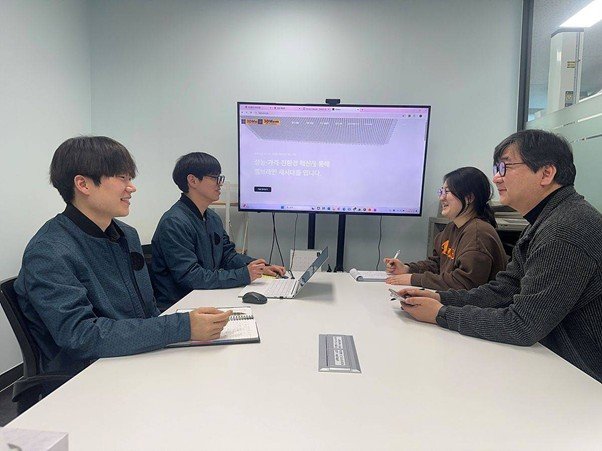
3DMem employees / source=3DMem
The Korea University Crimson Startup Support Foundation also joined forces to help 3DMem grow. They provided a wide range of support necessary for an early-stage company, including participation in Demoday, accompanying the firm to the ILS 2025 exhibition in Japan, matching with investors, supporting patent applications, and assisting with BI/CI production, as well as the DeepTech Bridge Program and overseas expansion education and networking. Thanks to this, 3DMem has met with global investors and partners.
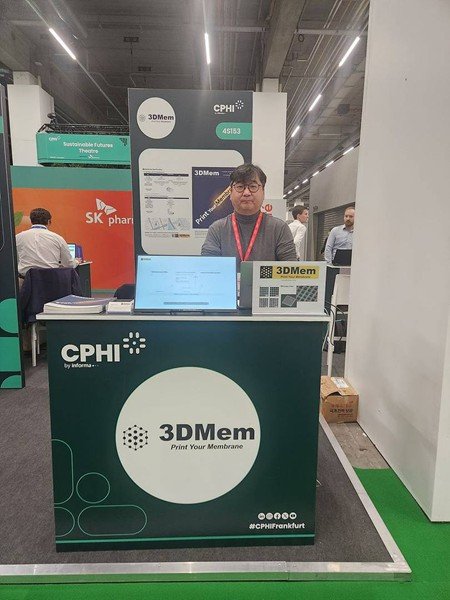
3DMem recently achieved significant results. By participating in exhibitions both within and outside of Korea, it received "love calls" from several of the world's top-tier Membrane Filter production companies. Lee plans to deliver Membrane Filter samples to them within 2026 and determine the scope and nature of their collaboration. A productivity-securing strategy to meet their demands is also under construction.
3DMem and CEO Kwang-jin Lee participating in CPHI Frankfurt 2025/ source=3DMem
Based on this, 3DMem is addressing the challenges of securing cost competitiveness and expanding mass production scale. The goal is to simultaneously increase the production volume and quality of Membrane Filters to satisfy customer demand. ee stated that he has already identified a significant portion of customer demand and revealed plans to secure both cost competitiveness and mass production scale by utilizing Multi-Nozzle Blocks and High-Speed Nozzle Technology. To this end, the company has begun attracting Pre-A Series investment and is expected to close it soon after drawing interest from global FI(Financial Investors) and SI(Strategic Investors).
Lee stated, “ 3DMem’s goal is to be the first in the world to commercialize Nano 3D Printing Technology, changing the landscape of the Membrane Filter market and establishing ourselves as the industry leader. We will continue to grow so that Korea’s technology becomes the global standard and exerts a positive influence on all sectors utilizing membrane technology, such as water treatment and hydrogen.”
By Joo-kyung Cha (racingcar@itdonga.com)








 About Dong-A Ilbo