

Pyongyang unveils KN-25 as Seoul moves on pact
Pyongyang unveils KN-25 as Seoul moves on pact
Posted February. 20, 2026 09:32,
Updated February. 20, 2026 09:32
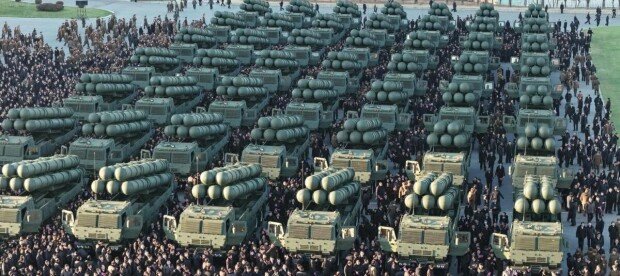
North Korean leader Kim Jong Un attended a ceremony marking the transfer of the “super-large multiple rocket launcher,” known as the KN-25, a tactical nuclear strike system aimed at South Korea, and declared that Pyongyang would continue unveiling defense technologies that would leave its geopolitical adversaries deeply unsettled, state media reported Wednesday.
The public display of a nuclear-capable delivery platform targeting the South came a day after South Korean Unification Minister Chung Dong-young said Seoul would move to restore the Sept. 19 inter-Korean military agreement in advance, including reinstating no-fly zones.
According to the Korean Central News Agency, Kim delivered the remarks at the KN-25 presentation ceremony held in Pyongyang the previous day. He characterized the system as a formidable offensive asset that fuses the accuracy and destructive power of a tactical ballistic missile with the rapid-launch capability of a multiple rocket launcher. He added that the weapon is designed to carry out “special attacks,” a reference to strategic missions. Kim’s reference to “strategic missions” is widely seen as an indication that the KN-25 could function as a nuclear delivery platform.
North Korea released photographs showing 50 newly developed KN-25 launchers, each with a 600-millimeter caliber, arrayed in the plaza of the April 25 House of Culture, the site of the upcoming Ninth Party Congress. The variant on display was equipped with five launch tubes, one more than earlier models. Previous KN-25 systems are believed to have a range of up to 400 kilometers, placing the entire Korean Peninsula within striking distance. With Kim personally attending the ceremony, inspecting the launch vehicles and even taking the wheel of one, observers say the system could soon enter active service.
In a separate statement issued the same day, Kim Yo Jong, vice department director of the ruling Workers’ Party and Kim’s sister, said she highly appreciated Chung’s expression of regret over the alleged incursion of South Korean drones into the North. On Tuesday, Chung reiterated Seoul’s regret over the drone episode and said the government would seek to restore the Sept. 19 inter-Korean military accord, including the reestablishment of no-fly zones, as a preventive step.
However, Kim Yo Jong continued to issue pointed warnings, referring to inter-Korean border areas as the “southern border” and labeling South Korea a “hostile state.” She said North Korea’s military authorities would heighten vigilance along the republic’s entire southern frontier adjoining the South, stressing that a boundary with a hostile country must be firmly secured.
Against this backdrop, analysts say Pyongyang may move to codify its “two hostile states” doctrine more explicitly at the upcoming Ninth Party Congress. Lim Eul-chul, a professor at the Institute for Far Eastern Studies at Kyungnam University, said Kim Yo Jong’s use of the phrase “southern border” reflects a deliberate linguistic strategy designed to recast South Korea not as a counterpart in reunification but as an adversarial foreign state.
In response, South Korea’s Unification Ministry said it had taken note of North Korea’s swift reaction to Seoul’s expression of regret over the drone incident and its stated steps to prevent a recurrence.
이윤태 oldsport@donga.com

![북한군 간호사에서 세계 누비는 사업가 되기까지[주성하의 북에서 온 이웃]](https://dimg.donga.com/c/138/175/90/1/wps/NEWS/IMAGE/2026/05/24/133981366.1.jpg)



 About Dong-A Ilbo