

Police face spike in drunken disturbances
Police face spike in drunken disturbances
Posted February. 19, 2026 08:32,
Updated February. 19, 2026 08:32
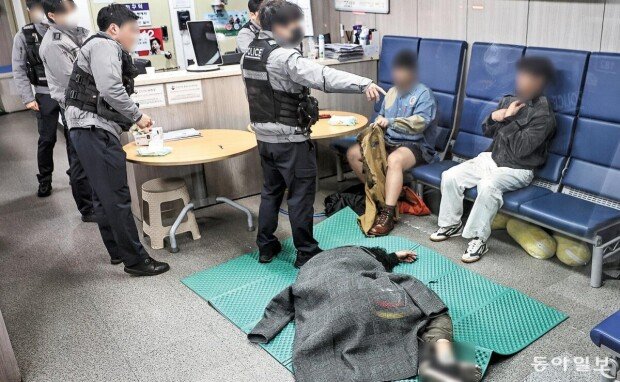
Chaos broke out at the Itaewon Police Substation in Seoul’s Yongsan District at 1 a.m. Feb. 14, the first day of the Lunar New Year holiday. A heavily intoxicated man, pulled from a patrol car with his pants down, shouted, “Let go of me,” as he kicked at three officers attempting to restrain him. Inside the substation, a woman repeatedly vomited while another man, who had urinated, fell asleep, compounding the disorder caused by drunken detainees.
During the roughly 90 minutes around midnight, six intoxicated individuals were brought to the substation. Many were unable to stand and required two or three officers each, leaving the 11 officers on duty with little capacity to handle other calls. “If we include minor on-site interventions, we cannot even count how many intoxicated people we deal with each night,” one officer said.
According to the National Police Agency, police handled 908,543 reports requiring protective custody for intoxicated individuals last year, an average of about 2,500 cases a day. Under the Act on the Performance of Duties by Police Officers, intoxicated individuals are treated not as criminal suspects but as subjects of protection. Unless they pose an immediate physical threat, officers are responsible for safeguarding them.
Officers say the mounting strain is affecting frontline policing. Local substations, already operating with limited personnel, are consumed each night by the need to manage intoxicated individuals, potentially compromising the critical initial response window in serious crimes. “Handling one intoxicated person typically requires at least two officers for more than two hours,” a police official said. “That inevitably reduces our capacity to prevent incidents and respond quickly.”
Preventive measures exist. In cases classified as “public office disturbance by intoxication,” which refers to disruptive behavior at police substations or other government offices, a police chief may seek a summary judgment carrying a fine of up to 600,000 won. In 2024, however, only 123 such cases were processed, representing just 0.01 percent of all protective custody cases involving intoxicated individuals. Officers must complete written reports and related procedures to pursue a fine, a process that can be burdensome when another intoxicated person may arrive at any time.
As a result, many intoxicated individuals are released without further action, fueling repeat offenses. Data from the National Police Agency show that the number of intoxicated suspects booked on charges of obstruction of official duties increased from 6,126 in 2021 to 7,482 in 2024, a 22.1 percent rise over three years. A team leader at a Seoul police substation said officers typically pursue obstruction charges only in serious cases, such as assaults on officers. “If we use even minimal physical force, we risk being accused of excessive force, so it often feels as though our hands are tied,” he said.
Experts say summary penalty procedures for intoxication-related disturbances should be streamlined to allow fines to be imposed immediately at the scene. Lee Yoon-ho, an emeritus professor of police administration at Dongguk University, said financial accountability should also be strengthened, including seeking reimbursement from individuals for costs incurred during police responses.
권구용 기자 9dragon@donga.com







 About Dong-A Ilbo