

Hanwha Ocean advances robotics at Geoje shipyard
Hanwha Ocean advances robotics at Geoje shipyard
Posted February. 19, 2026 08:34,
Updated February. 19, 2026 08:34
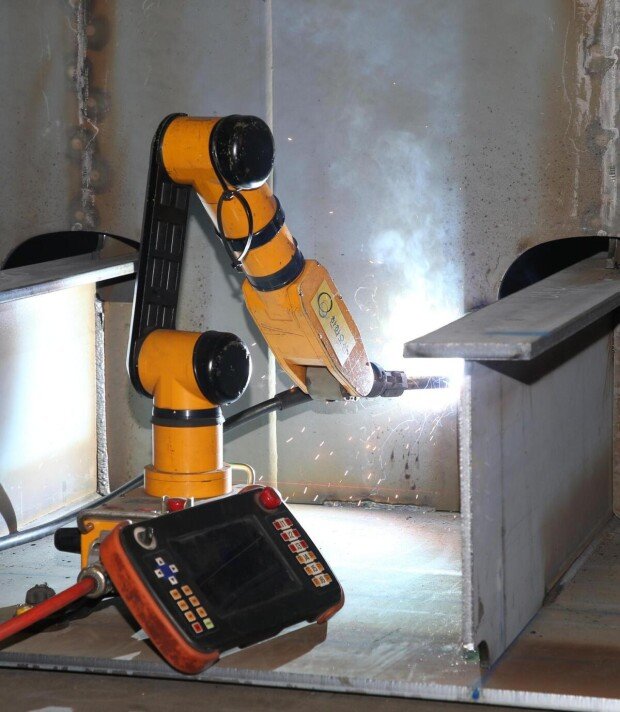
At Hanwha Ocean’s shipyard in Geoje, South Gyeongsang Province, a 17-kilogram mobile welding robot known as Rondi sent bright electric sparks flying inside a hull assembly plant. The sparks can reach temperatures of up to 5,000 degrees Celsius, comparable to the surface of the sun. At that heat, even thick steel plates can be fused in an instant.
The welding robot continued operating amid the blaze. As its mechanical arm moved without pause, on-site workers focused on supervising the machine. “At shipyards, workers’ roles are shifting from welding amid flying sparks to serving as operators who manage and direct robots,” said Kim Tae-gon, head of Hanwha Ocean’s Smart Production Promotion Team. “As robots take over repetitive and hazardous tasks, working conditions improve. Because the machines can operate 24 hours a day, output can more than double,” he said.
Hanwha Ocean is accelerating automation at its Geoje shipyard through artificial intelligence and robotics. A company official said the initiative aims to counter the aging workforce and reduce the risk of musculoskeletal disorders from physically demanding tasks. The automation rate for indoor welding processes stands at about 67 percent, and the company aims to achieve full automation in welding by 2030. It also plans to expand robotic applications to cover 50 percent of pre-treatment painting processes and 60 percent of cable installation work.
The robot deployed at the Geoje yard is scheduled for introduction around the end of 2027 at the U.S. Philly Shipyard, a key symbol of the South Korea-U.S. shipbuilding cooperation project known as MASGA. It can weld from inside steel structures, including confined spaces that are difficult for workers to access, and is considered capable of performing at the level of a welder with three years of experience. Hanwha Ocean plans to introduce intelligent robots at the U.S. yard in stages, aligned with its expansion and modernization schedule, starting with this model.
Among shipyard tasks once carried out by workers at significant risk, draft measurement, which determines how deeply a vessel sits in the water, has now been fully automated. Accurate draft measurement is essential for identifying issues related to a ship’s center of gravity and overall weight before delivery. In the past, three or four workers would board a small boat and approach the hull on choppy waters to take measurements, constantly facing safety hazards. Now drones circle the vessel to capture images, and vision-based AI analyzes the data to calculate the draft. Since AI was introduced, the task time has dropped from about two hours to less than 30 minutes, and workers no longer need to operate on unstable waters.
Hanwha Ocean’s ultimate goal is to build a smart shipyard that alleviates labor shortages and enhances safety through AI and robotics. Beyond replacing dangerous tasks with automated systems, the company aims to ensure that even newly hired, less experienced workers maintain consistent quality on site, helping offset the aging of skilled labor. A company official said that by advancing the intelligence of robots and converting the work patterns and decision-making criteria of veteran workers into data, AI could support judgments related to processes, quality, and safety.
이민아 기자 omg@donga.com



![국비 지원받아 무료로 중장비 면허 딴 60대 女농사꾼[은퇴 레시피]](https://dimg.donga.com/c/138/175/90/1/wps/NEWS/IMAGE/2026/06/13/134102134.5.jpg)




 About Dong-A Ilbo