

Lamda innoVision, FMCW LiDAR Companies for Space, Aviation, and Self-Driving
Lamda innoVision, FMCW LiDAR Companies for Space, Aviation, and Self-Driving
Posted January. 29, 2026 09:14,
Updated February. 03, 2026 14:17
- Lamda innoVision has developed high-precision FMCW LiDAR technology that simultaneously detects distance and velocity using the Doppler effect, overcoming the weather and interference limitations of traditional pulse-based systems.
- The company's solution uses a eye-safe 1550nm low-power laser and Photonic Integrated Circuit (PIC) technology to achieve superior detection resolution (down to nanometers) and stability in extreme conditions like fog, rain, and smoke.
- Led by CEO Jongpil La, a renowned expert in precision laser control, the firm has secured strategic investments and global partnerships—including satellite docking projects with ISRO—to provide cost-competitive, miniaturized LiDAR for the autonomous mobility and aerospace industries.
Precise distance measurement through LiDAR technology is taking center stage. Once reserved for aerospace, metrology, and military hardware, it has recently emerged as a cornerstone of autonomous mobility. To date, Pulse LiDAR, which utilizes high-speed pulses, has been the industry standard. While its principles are simple and concise, it often loses its efficacy in rain or fog due to laser scattering.
As an alternative, the industry is turning its gaze toward Frequency Modulated Continuous Wave(FMCW) LiDAR. This technology measures distance by precisely analyzing differences in light frequency. It operates with extreme precision and remains undisturbed by interference from rain, fog, or even direct sunlight. Furthermore, it boasts the advantage of measuring long distances even at low power outputs.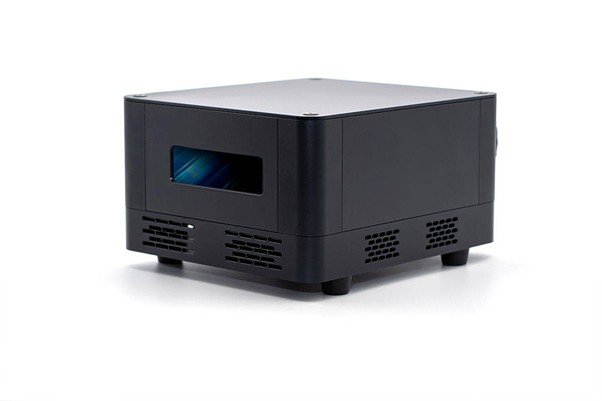 In fact, the aerospace industry has long researched laser interference and phase-based distance measurement. The concept of precision measurement using lasers was utilized as far back as the Apollo Program, NASA’s lunar mission, which paved the way for the development of Pulse Laser-based technology. However, due to the limitations of laser, electronic, and signal processing technologies at the time, systems capable of precise frequency control and phase utilization were restricted to large, expensive setups. Amidst this landscape, the South Korea-based firm Lamda innoVisionis leading the charge in downsizing and optimizing modern FMCW LiDAR for industrial distribution, leveraging years of accumulated precision laser control expertise.
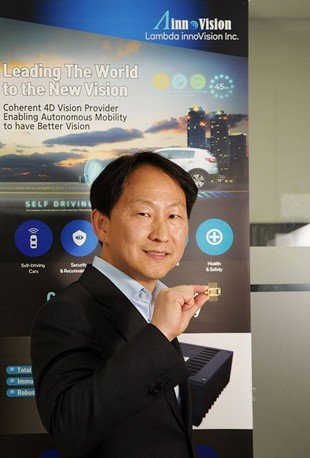
Jongpil La, CEO of Lamda innoVision, dedicated years to LiDAR research at major corporations. He awarded the President's Award from the Institute of Science and Technology for developing Korea's first Laser Doppler Vibrometer. Subsequently, he received the President’s Award from the Ministry of Science and ICT of ‘Top 100 National R&D Achievements’ for developing an FMCW LiDAR system capable of smoke penetration and visibility enhancement in disaster scenarios. Having developed the nation's first military-grade LiDAR, La now aims to bring FMCW LiDAR to the broader market by leveraging Photonic Integrated Circuit(PIC) technology to achieve both performance and price competitiveness.
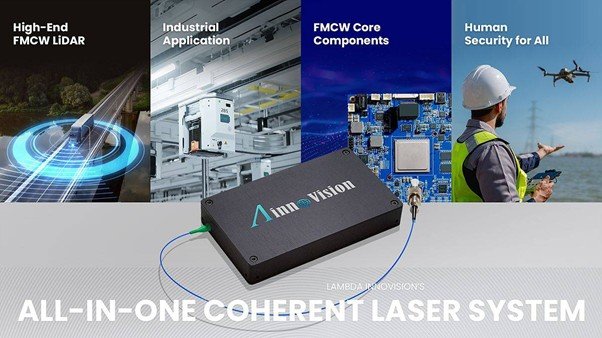
A team of experts with Ph.D. and Master’s degrees—specializing in geometric optics, physical optics, lasers, FMCW signal processing, high-speed parallel computing, and PIC design and packaging—has joined La. This team holds 28 LiDAR-related patents (21 granted, 7 pending) both within South Korea and abroad. Consequently, Lamda innoVision possesses the in-house capability to manage the entire lifecycle—from component and system development to verification—while simultaneously increasing performance and reducing unit costs.
The FMCW LiDAR developed by this team offers numerous advantages. While Pulse LiDAR requires high-power lasers, FMCW LiDAR uses a low-power continuous wave laser in the 1550nm band. The wavelength of this laser does not reach the human retina, making it safe for use in autonomous mobility environments where pedestrians and drivers mingle.
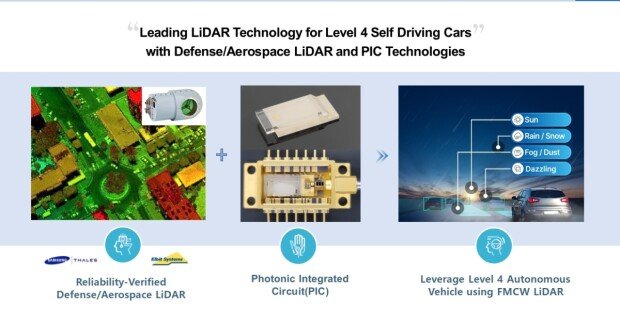
The low-power continuous wave laser also proves its strength in rain, snow, fog, or smoke. Its inherent permeability and high signal-to-noise ratio result in superior detection performance. To this, Lamda innoVision adds Coherent Detection technology, which utilizes both frequency and phase information simultaneously. This prevents reductions in detection range and eliminates false detections caused by intense sunlight, ambient lighting, or interference from other LiDAR units. La emphasizes that because FMCW LiDAR can detect signals as minute as a single photon, it brings high reliability and predictability to the aerospace and autonomous driving sectors.
Another key advantage of Lamda innoVision’s FMCW LiDAR is its ability to detect distance and velocity using the Doppler Effect (the change in frequency when either the source or observer is moving). For autonomous mobility, precise velocity detection is as crucial as distance. Since Pulse LiDAR cannot directly detect velocity, it must estimate speed by tracking objects across 3D images, a process that consumes time and computational resources and is prone to errors..
In contrast, Lamda innoVision’s FMCW LiDAR utilizes the Doppler Effect to simultaneously detect distance and velocity for every point. This allows for easy differentiation between moving and stationary objects, significantly enhancing the object recognition capabilities of autonomous vehicles. The resolution is also superior; while Pulse LiDAR achieves centimeter-level resolution, FMCW LiDAR reaches scales from millimeters down to tens of nanometers. Indeed, this capability makes FMCW LiDAR suitable for the delicate manufacturing of large-aperture optical systems for space applications.
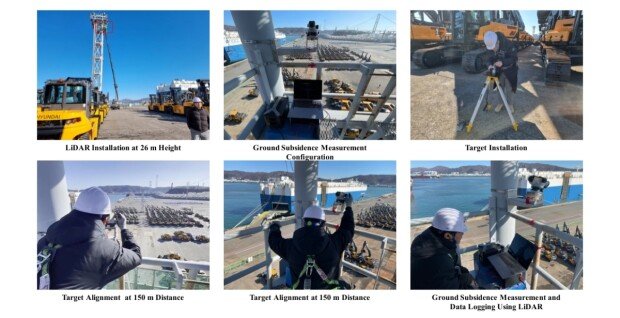
Based on these strengths, Lamda innoVision has achieved significant milestones. The company has internally developed core components such as frequency-modulated lasers and transceiver modules for FMCW LiDAR and completed several field demonstrations. These include ground subsidence and road damage detection systems at the Yeosu Gwangyang New Port container yard, joint development of a helicopter collision avoidance sensor for the military, and Proof-of-Concept(PoC) projects with autonomous vehicle companies. Notably, the company’s collaboration with the Indian Space Research Organisation(ISRO) for satellite docking assistance is particularly striking. By applying FMCW LiDAR—which handles velocity and distance with extreme precision—to satellite docking, they have significantly improved efficiency over conventional optical technologies. Recognizing this growth potential, Lamda innoVision secured a 2 billion KRW Pre-A investment from the Innovation Growth Materials, Components and Equipment Fund managed by Yuanta Investment.
Building on these achievements, La and Lamda innoVision are methodically tackling future challenges. Their primary focus is cost reduction and miniaturization—the biggest hurdles to the mass production of FMCW LiDAR. Their "secret weapon" is the ability to internally develop and produce core components like PICs and laser transceiver modules. After addressing these challenges through partnerships with small and medium-sized South Korean foundries, Lamda innoVision plans to eventually bring the entire production of core components in-house.
The rigorous reliability testing demanded by global industries is seen as an opportunity by Lamda innoVision, given their experience passing numerous tests in the defense and aerospace sectors. They aim to expand their reach by offering FMCW LiDAR that operates seamlessly in extreme environments, including areas with severe temperature fluctuations and vibrations. La expects that this process will naturally bridge the gap between current technology and market demand.
Lamda innoVision is set to distribute FMCW LiDAR across various industrial and scientific sectors. While solidifying their position in aerospace and industrial metrology, they plan to supply high-performance FMCW LiDAR to challenging applications. Leveraging this track record, the company aims to enter the autonomous mobility market and establish itself as a specialist provider of FMCW LiDAR that offers reliability, mass-producibility, and cost-competitiveness.
“We intend to supply FMCW LiDAR to all areas of advanced industry and science, including aerospace,” stated La. “By providing Lamda innoVision’s technology to all autonomous objects, such as mobility systems and robots, we will grow into a key technology provider for the global industrial ecosystem.”
By Joo-kyung Cha (racingcar@itdonga.com)
- The company's solution uses a eye-safe 1550nm low-power laser and Photonic Integrated Circuit (PIC) technology to achieve superior detection resolution (down to nanometers) and stability in extreme conditions like fog, rain, and smoke.
- Led by CEO Jongpil La, a renowned expert in precision laser control, the firm has secured strategic investments and global partnerships—including satellite docking projects with ISRO—to provide cost-competitive, miniaturized LiDAR for the autonomous mobility and aerospace industries.
Precise distance measurement through LiDAR technology is taking center stage. Once reserved for aerospace, metrology, and military hardware, it has recently emerged as a cornerstone of autonomous mobility. To date, Pulse LiDAR, which utilizes high-speed pulses, has been the industry standard. While its principles are simple and concise, it often loses its efficacy in rain or fog due to laser scattering.
As an alternative, the industry is turning its gaze toward Frequency Modulated Continuous Wave(FMCW) LiDAR. This technology measures distance by precisely analyzing differences in light frequency. It operates with extreme precision and remains undisturbed by interference from rain, fog, or even direct sunlight. Furthermore, it boasts the advantage of measuring long distances even at low power outputs.
Lamda innoVision's FMCW LiDAR / source=Lamda innoVision
Jongpil La, CEO of Lamda innoVision, dedicated years to LiDAR research at major corporations. He awarded the President's Award from the Institute of Science and Technology for developing Korea's first Laser Doppler Vibrometer. Subsequently, he received the President’s Award from the Ministry of Science and ICT of ‘Top 100 National R&D Achievements’ for developing an FMCW LiDAR system capable of smoke penetration and visibility enhancement in disaster scenarios. Having developed the nation's first military-grade LiDAR, La now aims to bring FMCW LiDAR to the broader market by leveraging Photonic Integrated Circuit(PIC) technology to achieve both performance and price competitiveness.
Laser module and main application of Lamda innoVision FMCW LiDAR, an essential part of Lamda innoVision / source=Lamda innoVision
A team of experts with Ph.D. and Master’s degrees—specializing in geometric optics, physical optics, lasers, FMCW signal processing, high-speed parallel computing, and PIC design and packaging—has joined La. This team holds 28 LiDAR-related patents (21 granted, 7 pending) both within South Korea and abroad. Consequently, Lamda innoVision possesses the in-house capability to manage the entire lifecycle—from component and system development to verification—while simultaneously increasing performance and reducing unit costs.
The FMCW LiDAR developed by this team offers numerous advantages. While Pulse LiDAR requires high-power lasers, FMCW LiDAR uses a low-power continuous wave laser in the 1550nm band. The wavelength of this laser does not reach the human retina, making it safe for use in autonomous mobility environments where pedestrians and drivers mingle.
Areas of activity and major technologies of Lamda innoVision / source=Lamda innoVision
The low-power continuous wave laser also proves its strength in rain, snow, fog, or smoke. Its inherent permeability and high signal-to-noise ratio result in superior detection performance. To this, Lamda innoVision adds Coherent Detection technology, which utilizes both frequency and phase information simultaneously. This prevents reductions in detection range and eliminates false detections caused by intense sunlight, ambient lighting, or interference from other LiDAR units. La emphasizes that because FMCW LiDAR can detect signals as minute as a single photon, it brings high reliability and predictability to the aerospace and autonomous driving sectors.
Another key advantage of Lamda innoVision’s FMCW LiDAR is its ability to detect distance and velocity using the Doppler Effect (the change in frequency when either the source or observer is moving). For autonomous mobility, precise velocity detection is as crucial as distance. Since Pulse LiDAR cannot directly detect velocity, it must estimate speed by tracking objects across 3D images, a process that consumes time and computational resources and is prone to errors..
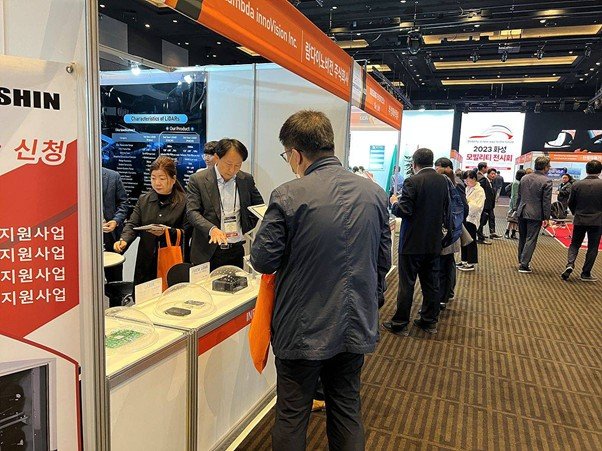
Lamda innoVision to introduce technology at the 2023 Hwaseong Mobility Exhibition / source=Lamda innoVision
In contrast, Lamda innoVision’s FMCW LiDAR utilizes the Doppler Effect to simultaneously detect distance and velocity for every point. This allows for easy differentiation between moving and stationary objects, significantly enhancing the object recognition capabilities of autonomous vehicles. The resolution is also superior; while Pulse LiDAR achieves centimeter-level resolution, FMCW LiDAR reaches scales from millimeters down to tens of nanometers. Indeed, this capability makes FMCW LiDAR suitable for the delicate manufacturing of large-aperture optical systems for space applications.
Based on these strengths, Lamda innoVision has achieved significant milestones. The company has internally developed core components such as frequency-modulated lasers and transceiver modules for FMCW LiDAR and completed several field demonstrations. These include ground subsidence and road damage detection systems at the Yeosu Gwangyang New Port container yard, joint development of a helicopter collision avoidance sensor for the military, and Proof-of-Concept(PoC) projects with autonomous vehicle companies. Notably, the company’s collaboration with the Indian Space Research Organisation(ISRO) for satellite docking assistance is particularly striking. By applying FMCW LiDAR—which handles velocity and distance with extreme precision—to satellite docking, they have significantly improved efficiency over conventional optical technologies. Recognizing this growth potential, Lamda innoVision secured a 2 billion KRW Pre-A investment from the Innovation Growth Materials, Components and Equipment Fund managed by Yuanta Investment.
Lamda InnoVision Demonstrates a LiDAR-Based Detection System for Monitoring Ground Subsidence in Smart Ports / source=Lamda innoVision
Building on these achievements, La and Lamda innoVision are methodically tackling future challenges. Their primary focus is cost reduction and miniaturization—the biggest hurdles to the mass production of FMCW LiDAR. Their "secret weapon" is the ability to internally develop and produce core components like PICs and laser transceiver modules. After addressing these challenges through partnerships with small and medium-sized South Korean foundries, Lamda innoVision plans to eventually bring the entire production of core components in-house.
The rigorous reliability testing demanded by global industries is seen as an opportunity by Lamda innoVision, given their experience passing numerous tests in the defense and aerospace sectors. They aim to expand their reach by offering FMCW LiDAR that operates seamlessly in extreme environments, including areas with severe temperature fluctuations and vibrations. La expects that this process will naturally bridge the gap between current technology and market demand.
CEO Jongpil La introducing FMCW LiDAR core components / source=Lamda innoVision
Lamda innoVision is set to distribute FMCW LiDAR across various industrial and scientific sectors. While solidifying their position in aerospace and industrial metrology, they plan to supply high-performance FMCW LiDAR to challenging applications. Leveraging this track record, the company aims to enter the autonomous mobility market and establish itself as a specialist provider of FMCW LiDAR that offers reliability, mass-producibility, and cost-competitiveness.
“We intend to supply FMCW LiDAR to all areas of advanced industry and science, including aerospace,” stated La. “By providing Lamda innoVision’s technology to all autonomous objects, such as mobility systems and robots, we will grow into a key technology provider for the global industrial ecosystem.”
By Joo-kyung Cha (racingcar@itdonga.com)



![레이더 비웃는 ‘하늘의 암살자’… 스텔스기가 바꾼 현대戰 양상[글로벌 포커스]](https://dimg.donga.com/c/138/175/90/1/wps/NEWS/IMAGE/2026/04/03/133673453.1.jpg)



 About Dong-A Ilbo