

Court rules Dec. 3 martial law was insurrection
Court rules Dec. 3 martial law was insurrection
Posted January. 22, 2026 11:09,
Updated January. 22, 2026 11:09
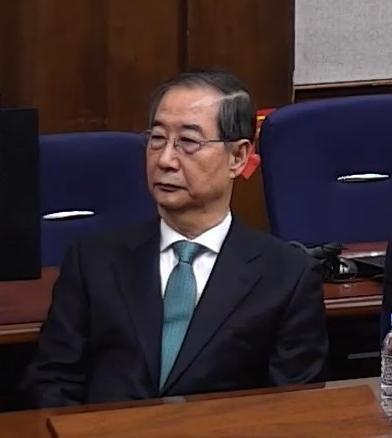
A South Korean court has issued its first ruling that the Dec. 3 declaration of martial law constituted an insurrection, 414 days after former President Yoon Suk Yeol proclaimed emergency rule. The decision came as a trial court found former Prime Minister Han Duck-soo guilty of playing a central role in carrying out the insurrection.
The court sentenced Han to 23 years in prison, a term exceeding the 15-year sentence sought by Special Prosecutor Cho Eun-seok. The punishment is also six months longer than the sentence imposed by a trial court 30 years ago on former President Roh Tae-woo for the same offense. The ruling suggests the court viewed the Dec. 3 martial law episode as more serious than the Dec. 12 coup, and legal observers say it could serve as an important reference for the forthcoming verdict in Yoon’s own insurrection case, scheduled for Feb. 19.
● Court’s first ruling that “Dec. 3 martial law was an insurrection”
At the sentencing hearing on Jan. 21, the Seoul Central District Court’s Criminal Division 33, presided over by Judge Lee Jin-gwan, defined the Dec. 3 declaration of martial law as “an insurrection from above carried out by former President Yoon, a leader elected by the people, and his followers, a so-called palace coup.” The ruling marked the judiciary’s first determination that the Dec. 3 martial law constituted an act of insurrection.
Under Article 87 of the Criminal Act, an insurrection requires both the intent to undermine the constitutional order and the use of violence or intimidation sufficient to disrupt public peace in a specific area. The court found that the Dec. 3 martial law satisfied all of these elements. It said Yoon and others, including former Defense Minister Kim Yong-hyun, issued the proclamation with the intent to dismantle parliamentary democracy guaranteed by the Constitution, thereby undermining the constitutional order. The court also found that they mobilized large numbers of military and police personnel to occupy the National Assembly and restrict access, constituting the use of force capable of disturbing public peace.
The court further criticized Han, saying that instead of seeking to uncover the truth behind the Dec. 3 insurrection and assuming appropriate responsibility as prime minister, he concealed documents related to the martial law, fabricated official records and committed perjury to shield himself from accountability.
The judges also rejected Yoon’s claim that the declaration of martial law was intended as an educational or warning measure. They said invoking emergency powers, which are meant to be exercised only in extreme circumstances, as a form of warning effectively justified the denial of the constitutional and legal order and encouraged supporters to embrace that view. Referring to a riot at the Seoul Western District Court, the court noted that some individuals readily violate the Constitution and laws for political purposes, adding that the Dec. 3 insurrection generated and reinforced such misguided beliefs.
● 'An insurrection from above is a palace coup and more dangerous than past uprisings'
The court said the Dec. 3 martial law insurrection was particularly dangerous even when compared with the Dec. 12 coup of 1979, which it described as an insurrection from below. It said that when a leader elected by the people disregards and violates the Constitution and the law, such actions fundamentally undermine public trust in democracy and the rule of law.
The judges emphasized that South Korea’s heightened international standing means the economic and political shock of a palace coup would be far greater than that of past insurrections. They said that if an insurrection from above were to succeed, the ruler would inevitably become a dictator and citizens’ basic rights, including the right to life, would be inherently violated, plunging the country into turmoil that would be difficult to reverse. Although there were no large-scale casualties and martial law was lifted relatively quickly, the court said the attempt itself warranted severe punishment. It added that Supreme Court rulings in previous insurrection cases cannot serve as binding sentencing standards in this case.
Thirty years ago, former President Roh Tae-woo was sentenced by a trial court to 22 years and six months in prison for playing a key role in an insurrection. His sentence was later reduced to 17 years on appeal and finalized by the Supreme Court. The sentence imposed on Han exceeds even that initial ruling against Roh, who was convicted of assisting former President Chun Doo-hwan in carrying out the Dec. 12 military coup. One senior judge said the greater danger lay in the fact that the insurrection was aimed at consolidating and perpetuating power already in hand. Another senior judge said that aside from Supreme Court precedents established three decades ago, there are few comparable cases, adding that sentencing outcomes could still change through appellate review.
Han, 77, graduated from the economics department of Seoul National University and has served as vice minister of trade and industry, chief trade negotiator at the Ministry of Foreign Affairs and Trade, head of the Office for Government Policy Coordination, deputy prime minister and finance minister, prime minister, and South Korean ambassador to the United States. He served as prime minister under both progressive and conservative administrations, earning a reputation as a career prime minister. Despite being regarded as having led a clean public life with no prior criminal record, he was taken into custody after being sentenced to 23 years in prison for his role in the insurrection.
송혜미 기자 1am@donga.com · 여근호 기자 yeoroot@donga.com




 About Dong-A Ilbo