

Korea, Japan startups join forces in AI push
Korea, Japan startups join forces in AI push
Posted January. 21, 2026 08:41,
Updated January. 21, 2026 08:41
“If a clothing company CEO asks, ‘Sales of women’s leggings are rising sharply this year. How should we respond?’ it would have triggered dozens of internal meetings in the past. In the era of AX, or artificial intelligence transformation, that is no longer necessary.”
Speaking on the morning of Jan. 20 at Tokyo Innovation Base in Tokyo, Ryohei Matsuda, CEO of Ryuten Japan, the Japanese unit of South Korea-based generative AI startup Ryuten Technologies, said companies that succeed in transforming their operations through AI are now impossible to catch up with.
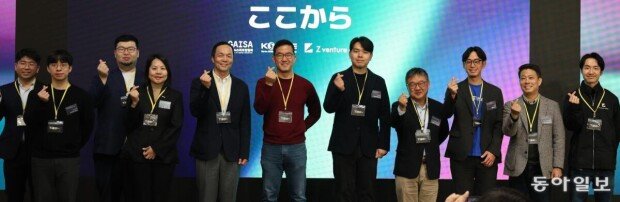
As AX, a sweeping shift toward AI-driven business transformation, emerges as a pressing challenge for companies worldwide, Tokyo Innovation Base hosted a joint gathering of South Korean and Japanese AI startups. Coming shortly after the South Korea-Japan summit on Jan. 13, the event served as a platform for private-sector discussions on AX cooperation. Startup representatives stressed that South Korea and Japan must work together in the generative AI market, which is currently dominated by the United States and China.
The South Korea-Japan AI Startup Meetup Day, titled “The Future of AX Starts Here,” was jointly organized by the Generative AI Startup Association, the Tokyo office of the Small and Medium Business Corporation, and Japanese venture capital firm Z Venture Capital, with support from South Korea’s Ministry of SMEs and Startups. The event brought together eight AI startups from the two countries. South Korean participants included Ryuten Technologies, Scionic AI, SnapTag, CoxWave and Friendly AI. Japanese startups in attendance included Dewire, which operates a global AI-based credit assessment platform, as well as FineD and Queryfy AI.
During the meeting, startups discussed how AX could help address challenges shared by both societies, including aging populations. Lee Se-young, CEO of Ryuten Technologies and chair of the Generative AI Startup Association, said the size of the U.S. and Chinese markets and their access to capital pose a formidable challenge. “If South Korea and Japan combine their markets, we can take the lead in AX innovation,” he said.
The event also explored concrete collaboration opportunities through technology sharing. Matsuda demonstrated an agent-to-agent, or A2A, system in which a so-called mother agent identifies the intent of a business operator’s query and automatically assigns tasks to specialized agents. In one example, a finance agent was tasked with handling accounting and bookkeeping functions. Dewire, meanwhile, introduced its AI-based credit assessment platform, which has been adopted by card companies and rental guarantee firms in 62 countries.
Participants agreed that smaller startups play a key role in accelerating AX adoption. Lee said that while large corporations and governments often spend time deliberating over AI transformation, startups with hands-on experience are better positioned to deliver practical solutions. “For startups, AX has been a matter of survival,” he said. "South Korea and Japan are home to teams that have embraced AI transformation faster and more deeply than most." Hwang In-jun, CEO of Z Venture Capital, said his firm plans to support AX-driven innovation by leveraging the data accumulated by startups in both countries over the years.
전혜진 sunrise@donga.com








 About Dong-A Ilbo