

Hyunmoo-5 missile enters operational deployment
Hyunmoo-5 missile enters operational deployment
Posted January. 19, 2026 08:38,
Updated January. 19, 2026 08:38
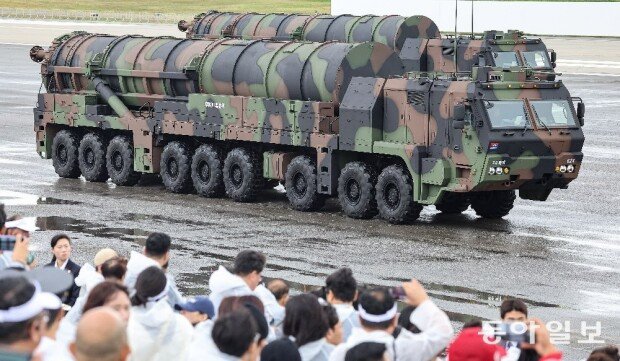
South Korea’s Hyunmoo-5 surface-to-surface ballistic missile, often described as a “monster missile,” is believed to have entered operational deployment late last year. The Hyunmoo-5 is a key component of Korea Massive Punishment and Retaliation, part of South Korea’s three-axis defense system designed to counter North Korea’s nuclear and missile threats.
According to the military on Jan. 17, the Hyunmoo-5 has been deployed in phases to frontline units since late last year. A military official said the government plans to complete full operational deployment during the term of President Lee Jae-myung. The total number of missiles slated for deployment is reportedly at least several dozen.
The Hyunmoo-5 is a high-powered, heavyweight ballistic missile developed to strike North Korean command leadership as well as nuclear and missile facilities in the event of a contingency. Equipped with a warhead weighing up to 8 tons, the missile is assessed to have among the strongest destructive capabilities of any conventional ballistic missile worldwide. Its effective explosive power is said to be comparable to that of an 11-ton warhead, reflecting advances in warhead materials. The missile has a maximum range of 300 kilometers and is capable of destroying underground bunkers at depths of up to 100 meters.
A military official said that when the Hyunmoo-5, equipped with an 8-ton warhead, strikes a target after traveling at more than 10 times the speed of sound, its destructive force is comparable to that of a small tactical nuclear weapon. As a result, even heavily fortified or deeply buried targets, including North Korean command centers and nuclear and missile facilities, would be unable to escape catastrophic damage. A military source said that if North Korea were to attempt a full-scale invasion or launch a nuclear attack against the South, dozens of Hyunmoo-5 missiles would be fired simultaneously, devastating command leadership targets in Pyongyang.
Details of the Hyunmoo-5 remained undisclosed for years before the missile was first revealed to the public in 2024. It was unveiled during the 76th Armed Forces Day ceremony marking the founding of the South Korean military, held at Seoul Air Base in Seongnam, Gyeonggi Province. The missile was displayed mounted inside a cylindrical launch canister on a nine-axle transporter erector launcher equipped with 18 wheels.
The South Korean military is also developing next-generation surface-to-surface ballistic missiles to succeed the Hyunmoo-5. The future systems, expected to be designated the Hyunmoo-6 and Hyunmoo-7, are reported to feature extended range, improved accuracy and enhanced warhead penetration capabilities. Analysts both inside and outside the military say that large-scale deployment of high-powered conventional missiles could provide a strong deterrent against North Korea. Another source said the military is pursuing a plan to secure several hundred so-called monster missiles, including the Hyunmoo-5 and its next-generation successors.
Sang-Ho Yun ysh1005@donga.com








 About Dong-A Ilbo