

Digital Netset: "Hybrid Security for the Quantum Era Starts with Us"
Digital Netset: "Hybrid Security for the Quantum Era Starts with Us"
Posted December. 15, 2025 09:33,
Updated December. 15, 2025 09:46
- Digital Netset is pioneering quantum-era security by developing a unique 'Hybrid PQC' technology that combines Post-Quantum Cryptography (PQC) with Physically Unclonable Function (PUF) to protect digital devices against future quantum threats.
- The company is gaining more traction overseas, especially in Indonesia, due to the lack of robust local security certification systems and urgent demand for advanced encryption solutions.
- Support from SBA and collaboration with domestic and international partners have been crucial for their growth and market entry.
The quantum computing era is fast approaching. Quantum computers are powerful enough to complete calculations that would take today's supercomputers decades, in mere minutes. The problem is that this immense computational power could instantly neutralize currently used encryption systems. This is why it is essential to prepare now for future security threats.
Digital Netset is a startup developing security solutions tailored for this quantum age. Their core innovation is the proprietary 'Hybrid PQC' technology, which combines Post-Quantum Cryptography (PQC) with physical security technology (PUF, Physically Unclonable Function). Interestingly, the company is gaining attention in overseas markets, such as Indonesia, even more so than domestically. Our press team met with Digital Netset CEO Young-min Lee to hear about the present and future of next-generation security technology.
We heard that you originally worked in the education sector. We are curious about the background that led you to found a startup dealing with quantum cryptography technology.
I originally worked in the education business, specifically in the smart school infrastructure field, for over 20 years. Starting in 1998 with video-centric educational infrastructure, it evolved into utilizing computer sharing and networking functions. I also worked for a subsidiary of the Hyundai Group and participated in digital textbook and infrastructure development projects in Sejong City.
From 2018, I broadened my perspective to AI-driven educational infrastructure. I also pursued educational content projects using VR (Virtual Reality) equipment in partnership with Indonesia. Digital Netset was founded in October 2019, initially focusing on educational solutions utilizing XR (eXtended Reality).
However, I felt the XR market was not yet mature. A turning point came as the new capital city development project in Indonesia began in earnest. Our agent requested we find suitable items for Indonesia. While reviewing various IT-based design projects, we found a common necessity: a robust security system for the information infrastructure. This led us to become seriously interested in quantum cryptography technology starting in 2022.
What is Digital Net's core solution? We are also curious about the specific characteristics of your security system designed to counter the quantum computing era.
There are various technologies for quantum security, and they can be highly sophisticated. However, what was more important to us was differentiation. The core point is object recognition.
Every IT device contains SRAM. We developed a method to recognize the digital "fingerprint" of an object using its SRAM. This is called PUF (Physically Unclonable Function). It utilizes the principle that just as every person has a unique fingerprint, every digital device has unique physical characteristics.
The problem with conventional PUF was its susceptibility to temperature and humidity. Our key proprietary technology is the know-how to extract a unique invariant intersection—the part that does not change amid variations in temperature and humidity. After recognizing the object this way, the technology that secures the data transmitted over the network is PQC (Post-Quantum Cryptography).
PQC refers to a new encryption framework designed to counteract the inevitable neutralization of existing cryptographic systems once the quantum computing era fully arrives. The U.S. NIST (National Institute of Standards and Technology) has completed its standardization work, and South Korea is also preparing its standards this year. We combined this PQC technology with PUF technology. The fusion of a physical encryption framework and logical encryption technology is precisely what we call 'Hybrid PQC.'
What are the advantages of this hybrid approach compared to existing systems?
Quantum encryption fundamentally aims to make the cipher too complex for a quantum computer to solve. However, no matter how complex the encryption is, security threats can arise if the object (device) is not accurately verified. A problem occurs if the data is sent to the wrong object.
SRAM is installed in most digital devices, and the digital fingerprints it contains have unique values. To fully leverage the high performance of PQC, it must be combined with PUF to maximize its advantages.
Our research indicates that this combined form is not currently found domestically or internationally. There are companies specializing in PUF and companies specializing in PQC, but we are the first to combine the two. We targeted that niche.
If so, why haven't other companies attempted this fusion?
: It is due to the nature of the encryption market. To utilize both PQC and PUF in South Korea, a certification system must be in place. Currently, however, such a system is absent. While the development of Post-Quantum Cryptography technology is active, the market environment is not yet mature for commercialization outside of research purposes. It will likely be activated once the certification system is established.
In South Korea, major corporations like LG U+ are actively developing technology and conducting PoCs (Proof of Concept), but they are still in the testing phase. We are striving to pioneer the market one step ahead of others, and we have high expectations for the overseas market, particularly Indonesia. We are, in a sense, the 'First Penguin.'
What is the current status of commercialization? We heard you are receiving more attention abroad than domestically.
: Indonesia, in particular, lacks its own robust security certification system, leading to many security incidents. Just this year, an issue arose where a significant amount of government data became unusable due to a ransomware infection.
Our findings indicated that Indonesia lacked sufficient domestic technological development capacity and urgently needed a strong encryption framework. Since 2023, we have been targeting the public security sector there with our local partner, Tams Global. The main product is precisely this Hybrid PQC technology.
While South Korea has various security certification frameworks, Indonesia does not have such a system properly established. We judged that this very fact presented a high possibility for market entry. They have an understanding of quantum technology but are only now beginning to prepare their own technology, presenting an opportunity to preempt the market.
Although dealing with next-generation technology, Digital Netset is still a startup. What were the biggest difficulties you experienced during the business process?
The biggest issue is business funding. Since a stable revenue structure is not yet in place, we secure funds through various service contracts, and I, as CEO, must continue to invest. The second issue is the lower brand recognition and marketing capability inherent to a startup.
Regarding the funding problem, the SBA's (Seoul Business Agency) R&D support program was immensely helpful. Being selected for the 2024 Quantum Technology Development Support Program allowed us to cover personnel costs, marketing activities, and technical support expenses. To put it dramatically, we might have had to give up the business if we hadn't been selected for that support. These support programs are truly vital for startups like ours.
We are solving the brand weakness through consortiums. Currently, we are cooperating in a consortium format with leading domestic quantum technology companies and institutions, including EYL, Kookmin University's Center for Information Security Research, and AXGate. Through this, we are collectively addressing our weaknesses.
You mentioned that the support programs from Seoul City and the SBA were greatly helpful. What parts were particularly impressive?
The systematic support system, which links up with global market entry support programs, was impressive. It was structured to initially provide development support and then continue support if the development results were positive.
Since SBA is headquartered in the Seoul area, they have an excellent understanding of the necessary technological fields and the elements required for commercialization in the region. The solutions and assistance we needed were already custom-designed. I would strongly recommend it to startups that have the technology and passion but lack recognition or capital.
What are your future plans? Do you have specific revenue targets or market expansion plans?
We are aiming for about 1 billion Won (KRW) in revenue in 2026 through the Indonesia project. This lays the groundwork for generating revenue. As we are entering in the form of industry-academia collaboration, we can penetrate the market with entry-level technology without significant restrictions.
Although the market is not yet fully open, the significance lies in pioneering the market. We plan to establish a strong reference point through Indonesia and then gradually expand the market to other rapidly growing countries. We hope to live up to expectations with positive results.
Quantum technology still has a long way to go. Do you have any message you would like to convey regarding this?
It is not easy to target an immature market before anyone else. But someone must pave the way so that others can follow, right?
The important thing is that this is not a task that can be done alone. It is the result of support from the government, cooperation with our partners who are also developing quantum technology, and collaboration with local overseas agents. This is not a path we can travel on our own.
We aim to join hands with these partners to open a new door. We are pioneering a new industry. The quantum age will surely come. We want to become a company recognized globally, beyond South Korea, for providing the essential security technology to prepare for that era. We ask for your continued anticipation.
By Young-woo Kim (pengo@itdonga.com)
* This article was written with support from SBA and Seoul City
- The company is gaining more traction overseas, especially in Indonesia, due to the lack of robust local security certification systems and urgent demand for advanced encryption solutions.
- Support from SBA and collaboration with domestic and international partners have been crucial for their growth and market entry.
The quantum computing era is fast approaching. Quantum computers are powerful enough to complete calculations that would take today's supercomputers decades, in mere minutes. The problem is that this immense computational power could instantly neutralize currently used encryption systems. This is why it is essential to prepare now for future security threats.
Digital Netset is a startup developing security solutions tailored for this quantum age. Their core innovation is the proprietary 'Hybrid PQC' technology, which combines Post-Quantum Cryptography (PQC) with physical security technology (PUF, Physically Unclonable Function). Interestingly, the company is gaining attention in overseas markets, such as Indonesia, even more so than domestically. Our press team met with Digital Netset CEO Young-min Lee to hear about the present and future of next-generation security technology.
We heard that you originally worked in the education sector. We are curious about the background that led you to found a startup dealing with quantum cryptography technology.
I originally worked in the education business, specifically in the smart school infrastructure field, for over 20 years. Starting in 1998 with video-centric educational infrastructure, it evolved into utilizing computer sharing and networking functions. I also worked for a subsidiary of the Hyundai Group and participated in digital textbook and infrastructure development projects in Sejong City.
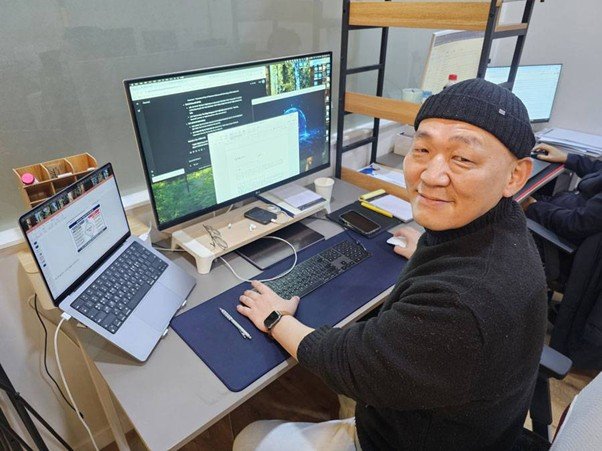
Young-min Lee, CEO of Digital Netset / source=IT dongA
From 2018, I broadened my perspective to AI-driven educational infrastructure. I also pursued educational content projects using VR (Virtual Reality) equipment in partnership with Indonesia. Digital Netset was founded in October 2019, initially focusing on educational solutions utilizing XR (eXtended Reality).
However, I felt the XR market was not yet mature. A turning point came as the new capital city development project in Indonesia began in earnest. Our agent requested we find suitable items for Indonesia. While reviewing various IT-based design projects, we found a common necessity: a robust security system for the information infrastructure. This led us to become seriously interested in quantum cryptography technology starting in 2022.
What is Digital Net's core solution? We are also curious about the specific characteristics of your security system designed to counter the quantum computing era.
There are various technologies for quantum security, and they can be highly sophisticated. However, what was more important to us was differentiation. The core point is object recognition.
Every IT device contains SRAM. We developed a method to recognize the digital "fingerprint" of an object using its SRAM. This is called PUF (Physically Unclonable Function). It utilizes the principle that just as every person has a unique fingerprint, every digital device has unique physical characteristics.
The problem with conventional PUF was its susceptibility to temperature and humidity. Our key proprietary technology is the know-how to extract a unique invariant intersection—the part that does not change amid variations in temperature and humidity. After recognizing the object this way, the technology that secures the data transmitted over the network is PQC (Post-Quantum Cryptography).
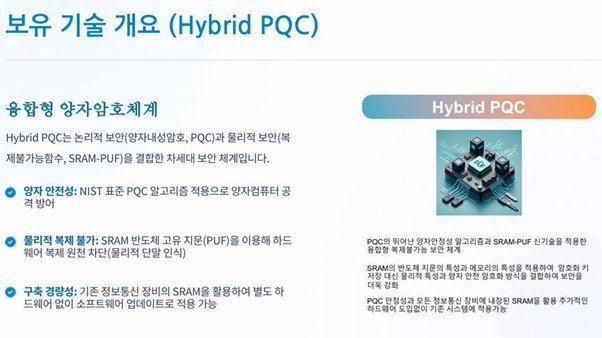
Overview of the Hybrid PQC, core solution of Digital Netset / source=Digital Netset
PQC refers to a new encryption framework designed to counteract the inevitable neutralization of existing cryptographic systems once the quantum computing era fully arrives. The U.S. NIST (National Institute of Standards and Technology) has completed its standardization work, and South Korea is also preparing its standards this year. We combined this PQC technology with PUF technology. The fusion of a physical encryption framework and logical encryption technology is precisely what we call 'Hybrid PQC.'
What are the advantages of this hybrid approach compared to existing systems?
Quantum encryption fundamentally aims to make the cipher too complex for a quantum computer to solve. However, no matter how complex the encryption is, security threats can arise if the object (device) is not accurately verified. A problem occurs if the data is sent to the wrong object.
SRAM is installed in most digital devices, and the digital fingerprints it contains have unique values. To fully leverage the high performance of PQC, it must be combined with PUF to maximize its advantages.
Our research indicates that this combined form is not currently found domestically or internationally. There are companies specializing in PUF and companies specializing in PQC, but we are the first to combine the two. We targeted that niche.
If so, why haven't other companies attempted this fusion?
: It is due to the nature of the encryption market. To utilize both PQC and PUF in South Korea, a certification system must be in place. Currently, however, such a system is absent. While the development of Post-Quantum Cryptography technology is active, the market environment is not yet mature for commercialization outside of research purposes. It will likely be activated once the certification system is established.
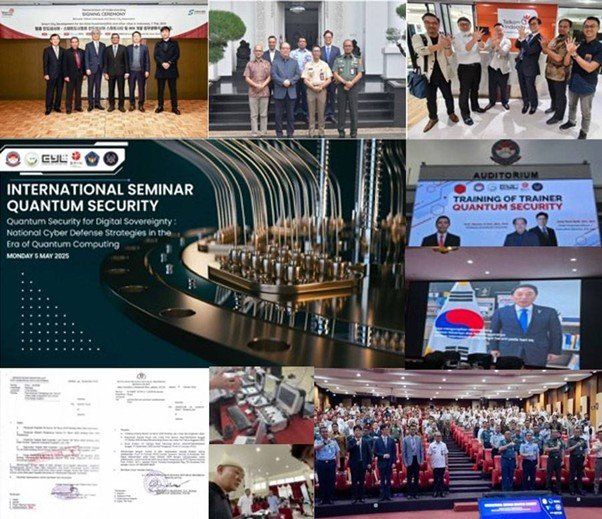
Digital Netset is focusing on overseas marketing, including in Indonesia / source=Digital Netset
In South Korea, major corporations like LG U+ are actively developing technology and conducting PoCs (Proof of Concept), but they are still in the testing phase. We are striving to pioneer the market one step ahead of others, and we have high expectations for the overseas market, particularly Indonesia. We are, in a sense, the 'First Penguin.'
What is the current status of commercialization? We heard you are receiving more attention abroad than domestically.
: Indonesia, in particular, lacks its own robust security certification system, leading to many security incidents. Just this year, an issue arose where a significant amount of government data became unusable due to a ransomware infection.
Our findings indicated that Indonesia lacked sufficient domestic technological development capacity and urgently needed a strong encryption framework. Since 2023, we have been targeting the public security sector there with our local partner, Tams Global. The main product is precisely this Hybrid PQC technology.
While South Korea has various security certification frameworks, Indonesia does not have such a system properly established. We judged that this very fact presented a high possibility for market entry. They have an understanding of quantum technology but are only now beginning to prepare their own technology, presenting an opportunity to preempt the market.
Although dealing with next-generation technology, Digital Netset is still a startup. What were the biggest difficulties you experienced during the business process?
The biggest issue is business funding. Since a stable revenue structure is not yet in place, we secure funds through various service contracts, and I, as CEO, must continue to invest. The second issue is the lower brand recognition and marketing capability inherent to a startup.
Regarding the funding problem, the SBA's (Seoul Business Agency) R&D support program was immensely helpful. Being selected for the 2024 Quantum Technology Development Support Program allowed us to cover personnel costs, marketing activities, and technical support expenses. To put it dramatically, we might have had to give up the business if we hadn't been selected for that support. These support programs are truly vital for startups like ours.
We are solving the brand weakness through consortiums. Currently, we are cooperating in a consortium format with leading domestic quantum technology companies and institutions, including EYL, Kookmin University's Center for Information Security Research, and AXGate. Through this, we are collectively addressing our weaknesses.
You mentioned that the support programs from Seoul City and the SBA were greatly helpful. What parts were particularly impressive?
The systematic support system, which links up with global market entry support programs, was impressive. It was structured to initially provide development support and then continue support if the development results were positive.
Since SBA is headquartered in the Seoul area, they have an excellent understanding of the necessary technological fields and the elements required for commercialization in the region. The solutions and assistance we needed were already custom-designed. I would strongly recommend it to startups that have the technology and passion but lack recognition or capital.
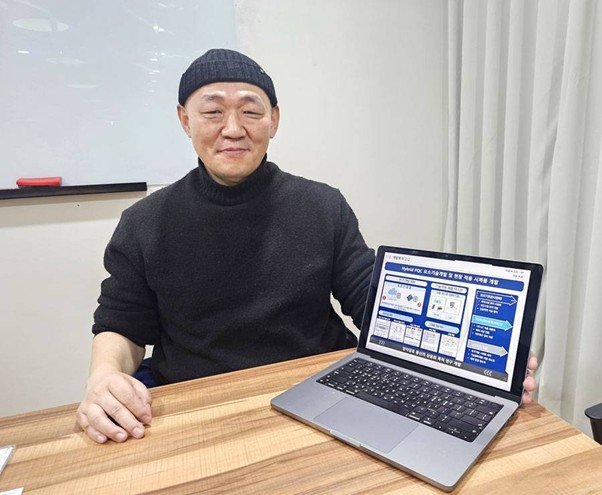
Young-min Lee, CEO of Digital Netset / source=IT dongA
What are your future plans? Do you have specific revenue targets or market expansion plans?
We are aiming for about 1 billion Won (KRW) in revenue in 2026 through the Indonesia project. This lays the groundwork for generating revenue. As we are entering in the form of industry-academia collaboration, we can penetrate the market with entry-level technology without significant restrictions.
Although the market is not yet fully open, the significance lies in pioneering the market. We plan to establish a strong reference point through Indonesia and then gradually expand the market to other rapidly growing countries. We hope to live up to expectations with positive results.
Quantum technology still has a long way to go. Do you have any message you would like to convey regarding this?
It is not easy to target an immature market before anyone else. But someone must pave the way so that others can follow, right?
The important thing is that this is not a task that can be done alone. It is the result of support from the government, cooperation with our partners who are also developing quantum technology, and collaboration with local overseas agents. This is not a path we can travel on our own.
We aim to join hands with these partners to open a new door. We are pioneering a new industry. The quantum age will surely come. We want to become a company recognized globally, beyond South Korea, for providing the essential security technology to prepare for that era. We ask for your continued anticipation.
By Young-woo Kim (pengo@itdonga.com)
* This article was written with support from SBA and Seoul City








 About Dong-A Ilbo