

MEDIRULE: "We Will Scale the FDA's High Wall with AI SaaS"
MEDIRULE: "We Will Scale the FDA's High Wall with AI SaaS"
Posted December. 09, 2025 09:45,
- The rise of AI in medical devices has led to higher recall rates, making regulatory management and risk mitigation more critical, and MEDIRULE aims to streamline compliance and document management for startups and SMEs through its service.
- Supported by the SeoulTech Startup Support Foundation, MEDIRULE plans to launch its service next year, targeting both domestic and international markets.
The U.S. Food and Drug Administration (FDA) is an agency under the U.S. Department of Health and Human Services, tasked with ensuring the safety and effectiveness of food, drugs, medical devices, and cosmetics distributed within the U.S. While commonly known in Korea through marketing phrases like 'FDA Certified,' it is, strictly speaking, a regulatory agency, not a certification body. The term 'certification' is often used domestically to help consumers understand that a product has received marketing authorization or approval from the FDA.
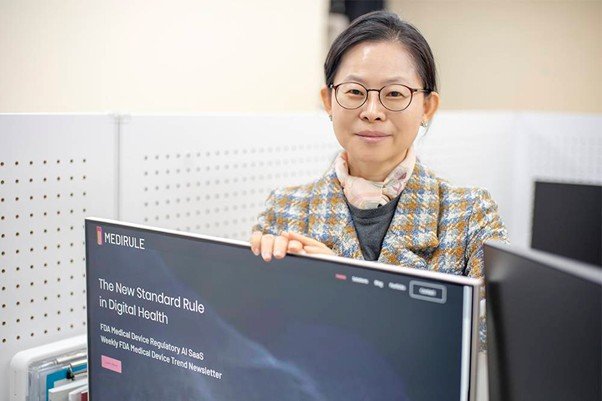
Mi-kyung Ahn, CEO of MEDIRULE, has accumulated over 20 years of experience in medical device planning and big data construction. / source = IT dongA
As one might expect, passing the FDA's rigorous standards is not easy. Emergo by UL, a regulatory consulting firm for medical devices, estimated that only 5,564 submissions were cleared out of approximately 15,100 total submissions to the FDA's Center for Devices and Radiological Health (CDRH) in 2024. In 2023, 5,807 were cleared from 19,100 submissions, and 5,731 were cleared in 2022. Even without considering the approval rates for specific categories, less than 30% of all submissions successfully pass the FDA's barrier.
AI-Integrated Devices Have Higher Recall Probability. Active Management for AI is Necessary
Ahn brings a wealth of experience related to the FDA and medical device planning, spanning nearly two decades. "I've worked as a planner in the medical device field for almost 20 years, and while managing regulations, I also obtained the ISO 13485 certification (the international standard for quality management systems for the medical device industry)," Ahn explained. "In the field, I primarily handled FDA certification processes for medical devices, mainly evaluating development suitability. I also collaborated with Korea University Anam Hospital to develop medical services and created a remote healthcare platform with The Catholic University of Korea."

Ahn published a paper suggesting that errors in medical devices would increase due to AI. Indeed, as these cases proliferate, the FDA approval industry is being forced to change. / source = IT dongA
The impetus for establishing MEDIRULE was the winds of change blowing across the FDA market due to the proliferation of AI. "While planning, I noticed that medical devices incorporating recent advancements in artificial intelligence and machine learning tended to have more errors. I believed this issue would be further exacerbated with the shift to digital submissions," she stated. In 2021, Ahn investigated the recall potential of AI-based medical devices through her study, "Research dynamics in medical errors and design types using text mining of FDA medical device recall data," a finding that is proving true in numerous subsequent studies.
AI-applied medical devices exhibit a peculiar pattern in recall rates relative to the total number of devices approved. According to a 2025 study in the Journal of the American Medical Association (JAMA), AI devices developed by publicly traded companies account for only 53% of all devices but are responsible for 92% of recalls. AI device recalls tend to be concentrated within the first one to two years, with major causes being errors stemming from software, data processing, and algorithm performance degradation. Devices lacking sufficient clinical validation data showed an even higher risk of recall. As AI medical devices multiply, the risk of recalls rises in parallel, creating a need for an intermediary like MEDIRULE to manage risk and support companies as the FDA expands its digital submission platform.
FDA Mandates Electronic Submission for 510(k), PMA, and De Novo Starting October of This Year
A significant change is anticipated in both submission and clearance rates, as the FDA has expanded its online application and electronic submission system for medical devices, effective from October 1st of this year. The FDA made eSTAR electronic submission mandatory for 510(k) submissions in October 2023 and is mandating the same for De Novo submissions starting October 2025. This means that submissions can no longer be made via paper or email; only the eSTAR electronic format will be accepted. In contrast, PMA submissions are currently voluntary for eSTAR, and paper submissions are still accepted.
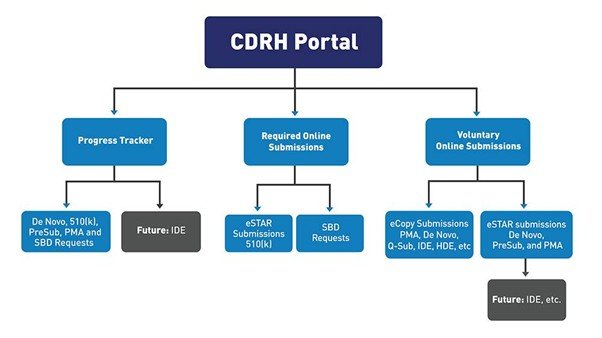
The structural diagram of the FDA's medical device review and management portal. PMA and De Novo recently moved toward mandatory eSTAR submission, and the scope of PDF-based electronic submission has also broadened. / source = FDA
• The 510(k) pathway is for devices deemed substantially equivalent to a legally marketed predicate device (e.g., blood glucose monitors).
• PMA (Premarket Approval) is required for high-risk devices that necessitate clinical trials (e.g., pacemakers).
• De Novo is for novel, low-to-moderate-risk devices with no existing predicate on the market. This category includes technologies like AI-powered imaging diagnosis software and app-based health management systems.
While the digitalization of PMA and De Novo submissions opens the door for small and medium-sized enterprises (SMEs) and startups, the practical hurdles remain high. Ahn noted, "The proportion of startups currently submitting to the FDA is very low." She added, "Now that the FDA has opened the door to online submissions, the situation could rapidly accelerate. MEDIRULE's goal is to assist companies with their FDA submissions and alleviate their regulatory burden through an AI-powered SaaS approach to regulatory management."
Total 21-Step Procedure... Subsidized by Government Support Programs in Korea
How does one obtain FDA clearance? Ahn explained, "If a similar device exists, you apply through the 510(k) path. For life-sustaining devices, you apply through the PMA path, which requires clinical trial data. The De Novo path allows direct classification requests for new technology categories without existing equivalent devices on the market, and there's also the Humanitarian Device Exemption (HDE) for devices targeting limited patient populations." Once the submission pathway is determined, necessary data, such as test results and conformity tests, must be uploaded sequentially to the eSTAR program across the 21 steps. The FDA's review goals are 90 days for 510(k), 150 days for De Novo, and 180 days for PMA, which represents a significant reduction from the several months or more the process used to take.
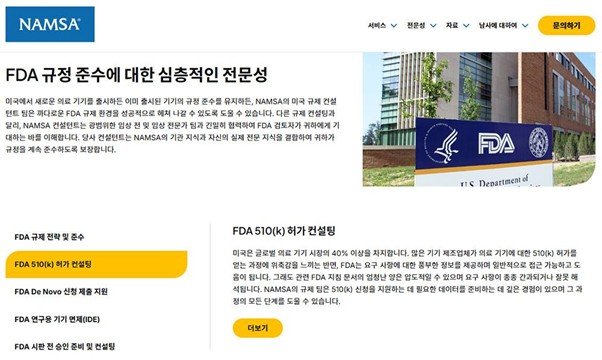
Many companies, like NAMSA, operate specialized consulting teams for FDA clearance. / source = NAMSA
In Korea, it is common practice for companies to maintain dedicated internal personnel or seek assistance through government support programs, such as the Overseas Regulatory Clearance Acquisition Support Program or the Export Voucher Program. In the U.S., however, the FDA clearance process has become an industrialized service. Companies like Enzium offer AI SaaS focused on FDA regulation automation, while others like Greenlight Guru or Master Control Solutions concentrate on quality management systems for medical devices. Companies such as NAMSA even have a dedicated 'US FDA Consulting' team that designs and manages the entire FDA clearance process on behalf of their clients.
Regardless of the country, large corporations typically employ dedicated FDA compliance personnel, and mid-sized companies also prioritize hiring FDA expertise. Conversely, the FDA's threshold is more challenging for startups and SMEs burdened by the cost of personnel and capital. Even upon receiving difficult-won FDA clearance, systemizing the management for the long term is no easy task. However, the advent of digital submissions necessitates alternatives that allow startups and SMEs to apply for the FDA more easily and systematically, and MEDIRULE aims to seize this market opportunity.
SaaS Optimized for Rapid Change, FDA Certification and Management
MEDIRULE has completed the Minimum Viable Product (MVP) of its AI SaaS and plans to formally launch the service next year. What are the advantages of using the AI SaaS? Ahn noted, "The majority of professionals, including FDA certification personnel and consultants, would welcome a faster certification process. Relying on government programs or external agencies often leads to delays due to data exchange and raises security concerns. Furthermore, managing multiple certified devices adds to the difficulty."
She continued, "Managing the process as a SaaS platform ensures data protection with the latest security policies and makes project-based document management simpler, whether dealing with internal or external stakeholders. In fact, document supplementation is the biggest time sink in the FDA certification process, and handling this within the service will definitely speed things up." Moreover, as records are accumulated per company, the platform offers advantages in terms of handover and data protection, even if the person in charge changes.
While companies can utilize the SaaS themselves, MEDIRULE also directly handles the FDA registration process. Ahn stated, "We leverage our FDA registration know-how to assist our client companies with their FDA registration. In this scenario, client companies only need to manage documents without the overhead of hiring dedicated FDA personnel, saving both labor and time. We plan to set the costs at a level the market deems reasonable, aiming to be lower than competitors like Enzium."
"Support from SeoulTech Foundation Paved the Way... Business to Scale Next Year"
While developing the MEDIRULE AI SaaS, Ahn also publishes a weekly newsletter on FDA trends. She shared, "According to medical device industry reports, 85% of companies that receive FDA clearance state that regulatory compliance is difficult. It's often harder to align with compliance than to secure funding for approval. To enable rapid market response, I personally review FDA announcements daily and process the information into a newsletter. We plan to transition to a paid subscription next year, and readers are already saying it helps them with fast regulatory responses." She recommended the newsletter for stakeholders in medical device development and regulation, especially with the FDA's current staff reduction and eSTAR expansion.
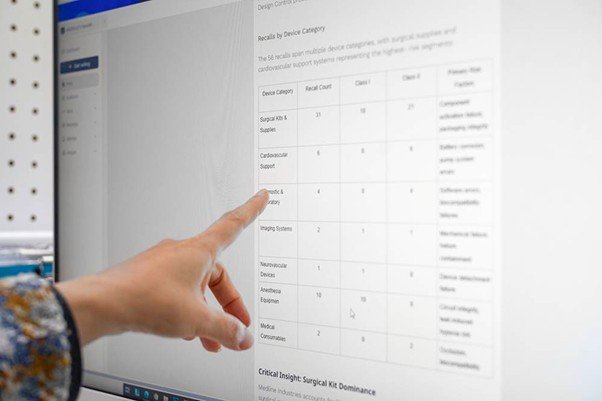
A portion of the newsletter, compiled and published by Ahn, will transition to paid subscription next year / source = IT dongA
Next year, the company plans to solidify its business through corporate support programs, refine the MVP into a formal service, and explore direct integration with eSTAR within the service. Ahn Mi-kyung mentioned, "The MEDIRULE service can be utilized by companies not only in South Korea but also in the U.S. and other countries outside the U.S. We will also research ways to directly submit applications to the FDA for enhanced service convenience."
Ahn expressed her gratitude to the Seoul National University of Science and Technology (SeoulTech) Startup Support Foundation for the assistance that allowed her to focus on the business. "Currently, we are in the pre-startup phase and preparing the groundwork for corporate registration next year. We applied for and received assistance through the Preliminary Startup Package from the SeoulTech Startup Support Foundation. As this is my first startup, there were many difficulties, but I received comprehensive support, including legal mentoring, operational management suggestions, promotion, and funding."
She concluded, "I also participated in networking days with companies expanding globally. Talking with other solo founders in similar situations helped me share methods for overcoming challenges and identify clues for solving key problems. Next year, I will lay the foundation for MEDIRULE to become an AI SaaS company sought out by medical device manufacturers worldwide."
By Si-hyeon Nam (sh@itdonga.com)

![[속보]靑 “李 지시로 소방청장 감찰 착수”…개인 비위 추정](https://dimg.donga.com/c/138/175/90/1/wps/NEWS/IMAGE/2026/05/22/133979048.2.jpg)


![[단독]조부 살해 20대女 “피 엄청 많이…빨리 와주세요” 119 신고](https://dimg.donga.com/c/138/175/90/1/wps/NEWS/IMAGE/2026/05/22/133978390.1.jpg)



 About Dong-A Ilbo