

Uptempo claims D3 Seoul basketball championship convincingly
Uptempo claims D3 Seoul basketball championship convincingly
Posted December. 09, 2025 08:13,
Updated December. 09, 2025 08:13
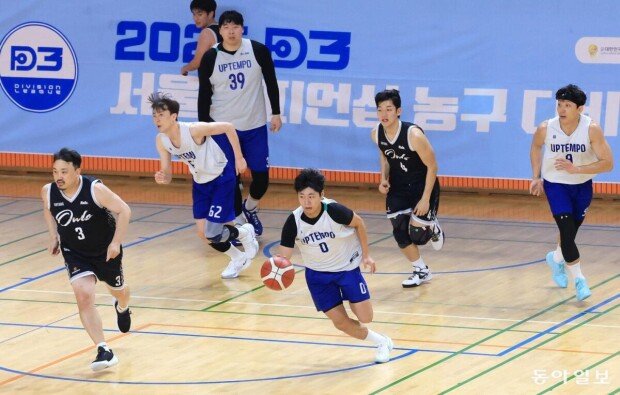
"No matter how big the score gap is, we never take it easy on the court."
That was the message from Lee Yong-jin, senior vice president of the Seoul Basketball Association, during the 2025 D3 Seoul Championship Basketball Division League final on Nov. 16 at Seoul National University’s gym in Dongdaemun District, Seoul, where Uptempo faced Owls. From the opening minutes, the game tilted decisively in Uptempo’s favor. Uptempo entered halftime with a commanding 48–11 lead, then widened the gap to 76–24 by the end of the third quarter. The team never let up and sealed the championship with a dominant 97–41 victory.
This year, the Korea Basketball Association launched the nationwide consolidation of amateur tournaments under the new “K-Division system.” Under this structure, the top professional league is classified as D1, the second-tier professional league as D2, and amateur basketball as D3 through D5, which includes independent leagues. In other words, the D3 league marks the highest level achievable for hobbyist players. During D3 games, no more than two former elite athletes may be on the court at the same time.
For Uptempo, the registered elite players were center Bang Deok-won, 37, and guard Kim Hyun-jun, 22. Bang, who stands 207 centimeters, entered the professional ranks when KT selected him 14th overall in the 2011–2012 Korean Basketball League rookie draft. Kim, meanwhile, earned the game’s Most Valuable Player honors after posting 16 points, seven rebounds, five assists, and five steals. His résumé reflects a traditional elite pipeline as well, progressing through Samseon Elementary School, Samseon Middle School, and Kyungbock High School in Seoul.
Non-elite players must also complete a formal registration process to participate in the division league. Kim Soo-bin, vice president of the Seoul Basketball Association and a key figure behind the creation of the division system, said the original aim was to “register and manage every neighborhood basketball player.” He added that the D3 Seoul Basketball Division League, which also served as the Seoul Mayor’s Cup, held its round of 16 matches at Jamsil Student Gym, the home court of professional KBL team SK, and noted that playing on a professional court was a meaningful experience for D3 athletes.
Individual and team records are systematically tracked. “Now that I’m in my 40s, I spend more time directing plays from the bench than running on the court,” said Jeong Jun-ho, 43, a playing coach for Uptempo. With a laugh, he added, “I really envy today’s players. When we were in our prime, records were not well kept. Now, with the division system in place, the association posts detailed stats for every tournament on its website, and most games are available on YouTube.”
The Ministry of Culture, Sports and Tourism introduced the division league in 2017 to expand participation in recreational sports. In a traditional tournament format, non-elite teams had limited opportunities to gain real-game experience. By contrast, the division league, structured as a league rather than a knockout tournament, allows teams to play regularly while fostering ambitions to advance to higher levels.
Bo-Mi Im bom@donga.com


![[이진영 칼럼]정청래 장동혁 좋은 일 시킬까봐](https://dimg.donga.com/c/138/175/90/1/wps/NEWS/IMAGE/2026/05/12/133909968.1.jpg)
![[속보]안규백 “美에 호르무즈 단계적 기여 방안 검토 얘기했다”](https://dimg.donga.com/c/138/175/90/1/wps/NEWS/IMAGE/2026/05/13/133910561.1.jpg)



 About Dong-A Ilbo