

Japanese singer abruptly exits China stage amid tensions
Japanese singer abruptly exits China stage amid tensions
Posted December. 01, 2025 08:23,
Updated December. 01, 2025 08:23
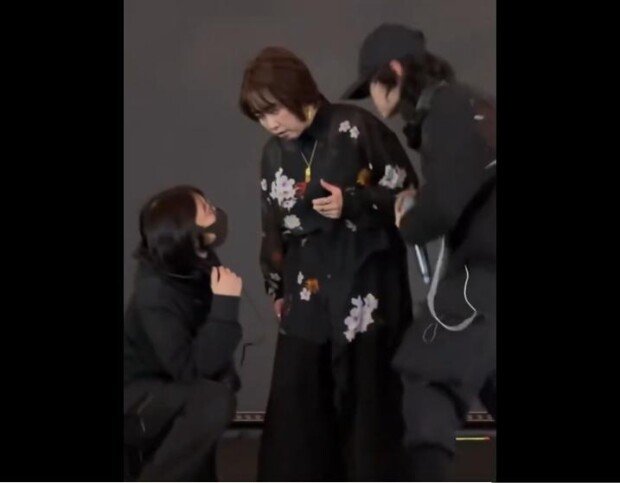
Tensions between China and Japan escalated after Japanese Prime Minister Sanae Takaichi made remarks on November 7 about intervening in a potential Taiwan contingency. During this period, a Japanese singer performing in China was abruptly removed from the stage. Analysts say China’s so-called “restricted Japan order” is spreading across the cultural industry, affecting pop music, classical performances, musicals, and film releases.
According to Kyodo News on November 30, during the “Bandai Namco Festival 2025” held in Shanghai on November 28, Japanese singer Maki Otsuki was interrupted mid-performance when the lights suddenly went out and the music stopped. Several staff members then approached the stage and spoke to Otsuki, who left without finishing her song.
Otsuki is known for singing the theme song of the popular Japanese anime “One Piece.” Her agency said, “Due to unavoidable circumstances during the performance, it was necessary to interrupt the show.” Otsuki’s next scheduled performance on November 29 was also canceled. The festival, which showcased Japanese anime works and included performances by Japanese idol groups through November 30, was entirely called off.
Videos showing Otsuki leaving the stage quickly circulated on Chinese social media. The Yomiuri Shimbun reported that critics viewed forcing a singer off the stage during a performance as a humiliating measure.
Popular Japanese singer Ayumi Hamasaki’s Shanghai concert on November 29 was also canceled. The Chinese organizer announced the previous day that the cancellation was due to “unavoidable circumstances.” In response, Hamasaki wrote on social media, “I was suddenly asked to stop the performance on the morning of the 28th. It is unbelievable and makes no sense.”
In addition, performances by pianist Hiromi Uehara and the duo Yuzu, as well as the “Sailor Moon” musical and other Japan-related cultural events, were consecutively canceled in China. Japanese films, including “Cells at Work” and the “Crayon Shin-chan” series, also had their releases postponed. Pop culture expert Soichiro Matsutani told Kyodo News, “China restricted the broadcast of Korean dramas in 2016 in response to South Korea’s THAAD deployment. The situation surrounding Japan’s cultural industry may become even more difficult.”
Earlier, the Chinese government demanded that Prime Minister Sanae Takaichi retract her remarks and issued advisories on November 14 and 16, urging citizens to refrain from traveling to or studying in Japan. On November 19, China suspended imports of Japanese seafood. As a result, visits by Chinese nationals to Japan have sharply declined. The Nihon Keizai Shimbun reported on November 29 that Chinese airlines canceled 904 of the 5,548 flights to Japan scheduled for this month, representing 16 percent of planned operations.
Chul-Jung Kim tnf@donga.com

![[단독]선관위, 결재없이 55억 써도 견책… “솜방망이 징계에 기강 해이”](https://dimg.donga.com/c/138/175/90/1/wps/NEWS/IMAGE/2026/06/19/134138827.4.jpg)



 About Dong-A Ilbo