

USFK commander highlights South Korea’s strategic role in Asia
USFK commander highlights South Korea’s strategic role in Asia
Posted November. 18, 2025 08:34,
Updated November. 18, 2025 08:34
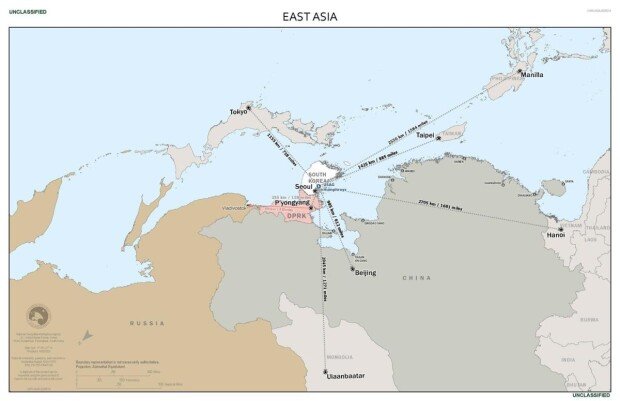
Gen. Xavier Brunson, commander of U.S. Forces Korea, said on Nov. 17 that South Korea serves as a strategic pivot capable of deterring not only North Korea but also China and Russia, referencing an inverted map of East Asia he presented.
Brunson made the remarks in an explanatory note posted on the U.S. Forces Korea website, where he shared the inverted map. He said the forces stationed in South Korea provide the most concrete and tangible deterrent and form a central foundation for stability in Northeast Asia. He added that Camp Humphreys in Pyeongtaek is about 158 miles from Pyongyang, 612 miles from Beijing and 500 miles from Vladivostok, placing the base close to potential threats.
He said South Korea’s strategic value becomes even clearer from Beijing’s perspective. For example, he explained that Osan Air Base is viewed from Beijing not as a distant threat but as a nearby one.
Brunson added that the inverted map highlights the need for strategic cooperation among South Korea, Japan and the Philippines. He said the most important insight from the map is the existence of a strategic triangle connecting the three nations. If each country is seen as a vertex of the triangle and all are bound to the United States through mutual defense treaties, their collective potential becomes clear. In the inverted view, the three nations appear not as separate bilateral relationships but as a single interconnected network. His comments suggest the need for a four-way cooperation framework among the United States, South Korea, Japan and the Philippines to counter North Korea, China and Russia.
Regarding the Lee Jae-myung administration’s plan to transfer wartime operational control during its term, Brunson said the basic foundation of combined defense will remain unchanged even if positions and roles within the Combined Forces Command shift as the conditions-based transition of OPCON moves forward.
Sang-Ho Yun ysh1005@donga.com

![[단독]선관위, 결재없이 55억 써도 견책… “솜방망이 징계에 기강 해이”](https://dimg.donga.com/c/138/175/90/1/wps/NEWS/IMAGE/2026/06/19/134138827.4.jpg)


 About Dong-A Ilbo