

Smithsonian opens Korean treasures exhibition
Smithsonian opens Korean treasures exhibition
Posted November. 17, 2025 08:31,
Updated November. 17, 2025 08:31
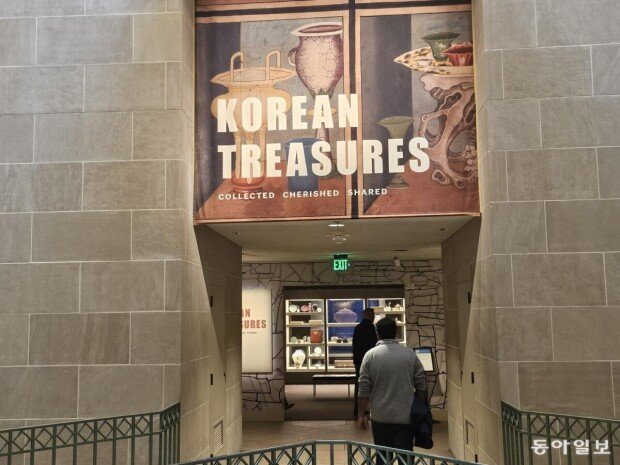
"It's as if the porcelain is breathing."
At the Smithsonian National Museum of Asian Art in Washington, D.C., on Nov. 15, a visitor named Shannon stood before a Goryeo celadon designated as a National Treasure and could not hide her awe. She said she became interested in Korean culture after visiting South Korea several years ago and was seeing traditional Korean cultural heritage in person for the first time.
She seemed completely captivated by the celadon’s delicate surface. She told a reporter that the piece looked so alive she felt as if she could press her ear against it and hear it breathe, adding that the artisan who crafted it must have possessed extraordinary skill. Another visitor, Mike, said Korean cultural relics may appear modest at first glance but reveal a majestic beauty upon closer inspection.
The museum opened a special exhibition titled “Korean Treasures: Collected, Cherished, Shared,” a traveling showcase of artworks donated by the late Samsung Chairman Lee Kun-hee. The exhibition was originally scheduled to open on Nov. 8 but was briefly delayed due to a U.S. federal government shutdown. It finally welcomed visitors on Nov. 15, just three days after the shutdown ended on Nov. 12.
The exhibition features more than 330 works, including 297 pieces of cultural heritage such as Goryeo celadon and Joseon white porcelain, with seven designated as National Treasures and 15 as Treasures. It also includes 24 modern and contemporary artworks. Among the exhibits are pieces owned by the National Museum of Korea, including Jeong Seon’s Inwang Jesaekdo and Kim Hong-do’s Chuseong Budo. Modern works from the National Museum of Modern and Contemporary Art, including Park Soo-keun’s Nongak and Kim Whanki’s Sanullim, are also on display. The artworks are arranged by theme, including royal art, Buddhist art, Korean ceramics and Joseon-era painting, and presented under soft lighting that highlights the subtle beauty of Korean art.
Jae Lee, a Korean American who visits the Smithsonian nearly every week, said he has a deep appreciation for Korean antiquities. He said their harmony and balance give him a sense of peace as he views them.
The exhibition is especially significant because it marks the first time Lee’s donated works have been shown overseas. After closing on Feb. 1, it will move to the Art Institute of Chicago, where it will run from March 7 to July 5. It is then scheduled to travel to the British Museum in London, where it will be on view from Sept. 10, 2026, to Jan. 10, 2027.
Jin-Woo Shin niceshin@donga.com

![팔순 노인 전세금까지 빨아먹은 ‘악마의 통장’[히어로콘텐츠/히든①-上]](https://dimg.donga.com/c/138/175/90/1/wps/NEWS/IMAGE/2026/06/22/134153615.1.jpg)
![“1000만원 줄 테니 나가달라”…집주인 제안, 받아도 될까 [집과법]](https://dimg.donga.com/c/138/175/90/1/wps/NEWS/IMAGE/2026/06/19/134130634.3.jpg)

![‘월급 50만원, 아파트는 4억’ 베트남…청년들 “그냥 평생 월세 살란다”[딥다이브]](https://dimg.donga.com/c/138/175/90/1/wps/NEWS/IMAGE/2026/06/19/134141662.1.png)


 About Dong-A Ilbo