

PLAYTAG's 'StoryLine' Analyzes Early Childhood Behavior Using a 'Behavior Foundation Model'.
PLAYTAG's 'StoryLine' Analyzes Early Childhood Behavior Using a 'Behavior Foundation Model'.
Posted October. 22, 2025 14:24,
Updated October. 22, 2025 14:27
- PLAYTAG developed 'StoryLine,' an AI-based solution that uses classroom
cameras and proprietary algorithms to analyze young children's behavior,
providing teachers with objective data on activity levels, play preferences,
and social interactions.
- Since its commercial launch in September 2024, StoryLine has been adopted in
over 520 classrooms, receiving positive feedback from both teachers and
parents for its ability to support child development and reduce teachers'
administrative workload.
- PLAYTAG plans to refine its metrics, expand content offerings, and accelerate its
entry into the US market, aiming to broaden its impact in early childhood
education and beyond.
PLAYTAG has developed 'StoryLine', an artificial intelligence (AI)-based behavior analysis solution for infants and young children. Using 'PlayLens' cameras installed in classrooms, the system observes children's activities—who they play with, what toys they use, and for how long. It then analyzes this data via a proprietary algorithm to provide metric data on activity levels, play preferences, and social interactions. As evidence for these metrics, photos and videos are also provided. PLAYTAG explains that implementing StoryLine can lessen the administrative burden on teachers and improve efficiency while simultaneously enhancing the quality of education and childcare.
StoryLine launched its first commercial service in September 2024 and is currently being used by over 7,000 children across approximately 520 classrooms in early childhood education institutions. According to PLAYTAG, the solution is receiving positive responses from teachers as well as parents. PLAYTAG is also pursuing expansion into the US market, with a service launch scheduled for this November at early childhood education institutions in the Eastern United States.
I met with PLAYTAG CEO Hyun-soo Park to discuss PLAYTAG and StoryLine.
Founding to Apply 15 Years of Research to Real Life
Mr. Park, please introduce yourself.
I am Hyun-soo Park from PLAYTAG. I earned my undergraduate degree in Mechanical Engineering from Pohang University of Science and Technology (POSTECH), followed by a Ph.D. and post-doctoral research at Carnegie Mellon University and the University of Pennsylvania. Afterward, I served as a professor in the Department of Computer Science at the University of Minnesota. My research focused on 3D computer vision-based behavior reconstruction and recognition, and I have published over 50 papers in computer vision-related conferences and journals. I began publishing papers in 2009, so it marks more than 15 years of research. I founded PLAYTAG in 2022.
'Behavior reconstruction and recognition' sounds a bit unfamiliar.
Images and videos are combinations of 2D pixels. However, the space we actually live in is 3D. Human behavior also occurs in three-dimensional space. Behavior reconstruction and recognition refers to combining 2D images or videos, converting them into 3D, and using this to recognize diverse human behaviors.
What motivated you to found PLAYTAG?
The most difficult subjects for behavior reconstruction and recognition are ‘children’. This is because children are often unpredictable, and their developmental stages vary widely. However, if developmental status is not properly identified and cared for during early childhood, the situation can worsen. In severe cases, individuals may live with disabilities for their entire lives. I primarily researched these aspects, but I felt a sense of disappointment that the real-world impact of my research was quite limited. Therefore, I founded PLAYTAG with the desire to apply my research to real life, help more children, and contribute to society.
You spent most of your time in the US before founding the company. Is there a reason you founded PLAYTAG in Korea?
The largest customers for behavior reconstruction and recognition are in the early childhood-related industry. Korea has a stronger enthusiasm for education and a higher interest in early childhood behavioral development than other countries. This makes it an excellent market for testing a behavior analysis solution. Naturally, I ended up founding the company in Korea.
Please tell us about PLAYTAG.
PLAYTAG is a tech company specializing in an AI-based Behavior Foundation Model. Human behavior is not just simple movement; it is an external signal expressing internal states like habits, preferences, emotions, and motivations. We developed a Behavior Foundation Model using 3D computer vision algorithms to understand this more deeply.
We are developing services under the value: 'Empower every person on earth through digitalizing human intention.'
StoryLine, the AI Observation Assistant for Early Childhood Education Institutions
Your current flagship solution is ‘StoryLine’. What kind of solution is it?
One of the roles of a kindergarten or daycare teacher is to observe children. They must observe who the child played with, what they used, and for how long, and based on this, analyze the child's tendencies to suggest customized play. This is fundamental to early childhood education. However, it's not easy in the actual field. This is because each teacher is responsible for many children, and they have many other duties.
StoryLine is a behavior analysis solution for teachers at early childhood education institutions like kindergartens and daycare centers, acting as an assistant to help teachers observe children well. Through 'PlayLens' cameras installed in the classroom, it continuously and objectively observes the children's behavior, analyzes it with our proprietary algorithm, and provides quantitative data. 'PlayLens' is a type of CCTV; depending on the classroom size, a minimum of four, but typically six to eight, are installed, allowing for comprehensive observation of the children's behavior.
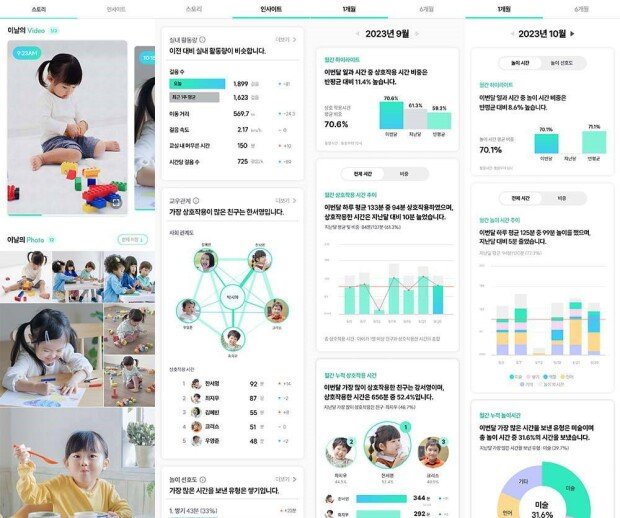
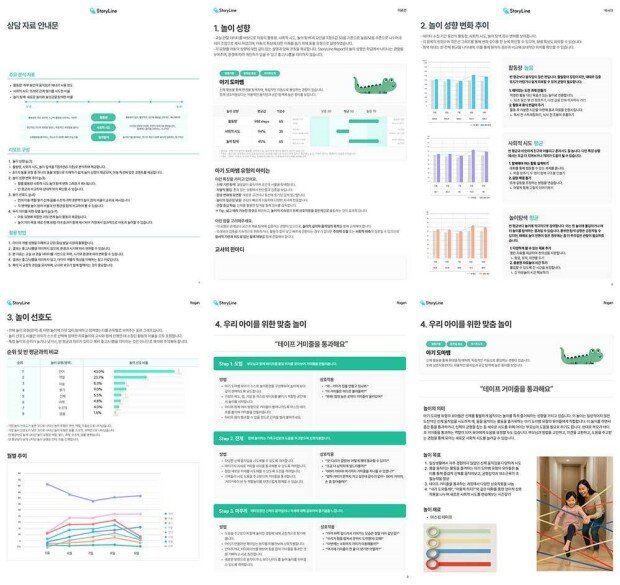
Currently, we provide metrics on activity levels, play preferences, and social relationships. We also present supporting evidence for these metrics, such as photos and videos. These metrics are provided daily. As this data accumulates, it becomes possible to classify the child's disposition or developmental status to some extent. This allows teachers to understand the child more deeply and suggest play that is right for them. They can also present objective, evidence-based data when consulting with parents. For children who may need external help, it can guide them to receive the necessary interventions. In short, it contributes to lessening the teacher's workload and improving efficiency while simultaneously enhancing the quality of education and childcare.
When did you launch StoryLine? I'm also curious about its adoption and customer reactions.
StoryLine launched its first commercial service in September 2024 and is currently being used for over 7,000 children in approximately 520 early childhood education institution classrooms. Although it has been less than a year since its launch, it is achieving meaningful results.
Customer reaction is also positive. We confirmed that StoryLine's behavior analysis largely aligns with teachers' own observations, and teacher satisfaction is high because it also measures aspects that teachers might miss. Many opinions stated it provides practical help in managing children's development. Parents are also positive. They appreciate that they can understand their children better with data they couldn't see before and have more professional, specific consultations.
You are currently receiving support from the ‘SeoulTech’ Global Corporate Collaboration Program. What kind of support did you receive?
The SeoulTech(Seoul National University of Science and Technology) Global Corporate Collaboration Program provided necessary training, networking, PR, and financial support for startups preparing for overseas expansion. We are participating in the Amazon Web Services (AWS) Jungle Program. Through this, we were able to significantly reduce operational costs by converting our AWS US account to a Korean account. We also learned about legal and technical risk factors necessary for global service operation. Thanks to this, we've laid the groundwork to provide stable service in the US market.
“Will Refine Metrics, Accelerate US Market Entry”
Lastly, please share your future plans and goals.
First, on the solution side, we plan to refine the measured metrics. We intend to add more detailed and in-depth indicators, such as the positive or negative aspects of interactions, interactions with teachers, and the types of play that primarily occur during interactions.
We are also preparing content production suitable for a child's disposition. Until now, we have only provided metrics, photos, and videos, but we've received many inquiries about how to respond to those results. Therefore, based on the behavior metrics, we are producing content on various topics, such as appropriate play methods, physical activities, and literacy that can be used at the institution or at home.
On the business side, we are actively pursuing global market expansion. We are currently piloting StoryLine at two early childhood institutions in the US and are developing a localized version reflecting customer feedback. This November, we plan to launch the official service at three to four institutions in the Eastern US. In the first half of next year, we plan to focus on market expansion in regions with high educational demand, such as New York, New Jersey, Virginia, California, and Washington.
Domestically, we are preparing sales efforts for next year's performance. We have set a sales target of providing StoryLine to 1,500-2,000 classrooms nationwide and will begin full-scale activities in October.
The behavior analysis foundation model we developed has universal applications. While we are currently focused on analyzing the behavior of infants and young children, we plan to expand into various fields such as the elderly, patients, and workers in the future. Through this, we aim to grow into a total healthcare solution that provides new forms of assistance and supports better lives in diverse fields.
By Man-hyuk Han (mh@itdonga.com)
* This article was written with support from Seoul National University of Science and Technology.
cameras and proprietary algorithms to analyze young children's behavior,
providing teachers with objective data on activity levels, play preferences,
and social interactions.
- Since its commercial launch in September 2024, StoryLine has been adopted in
over 520 classrooms, receiving positive feedback from both teachers and
parents for its ability to support child development and reduce teachers'
administrative workload.
- PLAYTAG plans to refine its metrics, expand content offerings, and accelerate its
entry into the US market, aiming to broaden its impact in early childhood
education and beyond.
PLAYTAG has developed 'StoryLine', an artificial intelligence (AI)-based behavior analysis solution for infants and young children. Using 'PlayLens' cameras installed in classrooms, the system observes children's activities—who they play with, what toys they use, and for how long. It then analyzes this data via a proprietary algorithm to provide metric data on activity levels, play preferences, and social interactions. As evidence for these metrics, photos and videos are also provided. PLAYTAG explains that implementing StoryLine can lessen the administrative burden on teachers and improve efficiency while simultaneously enhancing the quality of education and childcare.
StoryLine launched its first commercial service in September 2024 and is currently being used by over 7,000 children across approximately 520 classrooms in early childhood education institutions. According to PLAYTAG, the solution is receiving positive responses from teachers as well as parents. PLAYTAG is also pursuing expansion into the US market, with a service launch scheduled for this November at early childhood education institutions in the Eastern United States.
I met with PLAYTAG CEO Hyun-soo Park to discuss PLAYTAG and StoryLine.
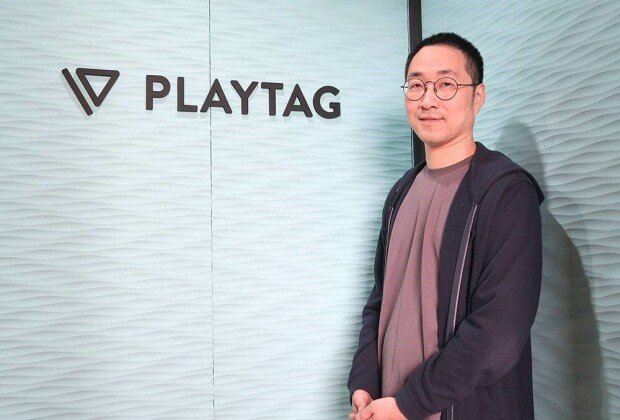
Hyun-soo Park, CEO of PLAYTAG / source=IT dongA
Founding to Apply 15 Years of Research to Real Life
Mr. Park, please introduce yourself.
I am Hyun-soo Park from PLAYTAG. I earned my undergraduate degree in Mechanical Engineering from Pohang University of Science and Technology (POSTECH), followed by a Ph.D. and post-doctoral research at Carnegie Mellon University and the University of Pennsylvania. Afterward, I served as a professor in the Department of Computer Science at the University of Minnesota. My research focused on 3D computer vision-based behavior reconstruction and recognition, and I have published over 50 papers in computer vision-related conferences and journals. I began publishing papers in 2009, so it marks more than 15 years of research. I founded PLAYTAG in 2022.
'Behavior reconstruction and recognition' sounds a bit unfamiliar.
Images and videos are combinations of 2D pixels. However, the space we actually live in is 3D. Human behavior also occurs in three-dimensional space. Behavior reconstruction and recognition refers to combining 2D images or videos, converting them into 3D, and using this to recognize diverse human behaviors.
What motivated you to found PLAYTAG?
The most difficult subjects for behavior reconstruction and recognition are ‘children’. This is because children are often unpredictable, and their developmental stages vary widely. However, if developmental status is not properly identified and cared for during early childhood, the situation can worsen. In severe cases, individuals may live with disabilities for their entire lives. I primarily researched these aspects, but I felt a sense of disappointment that the real-world impact of my research was quite limited. Therefore, I founded PLAYTAG with the desire to apply my research to real life, help more children, and contribute to society.
You spent most of your time in the US before founding the company. Is there a reason you founded PLAYTAG in Korea?
The largest customers for behavior reconstruction and recognition are in the early childhood-related industry. Korea has a stronger enthusiasm for education and a higher interest in early childhood behavioral development than other countries. This makes it an excellent market for testing a behavior analysis solution. Naturally, I ended up founding the company in Korea.
Please tell us about PLAYTAG.
PLAYTAG is a tech company specializing in an AI-based Behavior Foundation Model. Human behavior is not just simple movement; it is an external signal expressing internal states like habits, preferences, emotions, and motivations. We developed a Behavior Foundation Model using 3D computer vision algorithms to understand this more deeply.
We are developing services under the value: 'Empower every person on earth through digitalizing human intention.'
StoryLine provides analysis results of a child's behavior along with photos and videos / source=PLAYTAG
StoryLine, the AI Observation Assistant for Early Childhood Education Institutions
Your current flagship solution is ‘StoryLine’. What kind of solution is it?
One of the roles of a kindergarten or daycare teacher is to observe children. They must observe who the child played with, what they used, and for how long, and based on this, analyze the child's tendencies to suggest customized play. This is fundamental to early childhood education. However, it's not easy in the actual field. This is because each teacher is responsible for many children, and they have many other duties.
StoryLine is a behavior analysis solution for teachers at early childhood education institutions like kindergartens and daycare centers, acting as an assistant to help teachers observe children well. Through 'PlayLens' cameras installed in the classroom, it continuously and objectively observes the children's behavior, analyzes it with our proprietary algorithm, and provides quantitative data. 'PlayLens' is a type of CCTV; depending on the classroom size, a minimum of four, but typically six to eight, are installed, allowing for comprehensive observation of the children's behavior.
Currently, we provide metrics on activity levels, play preferences, and social relationships. We also present supporting evidence for these metrics, such as photos and videos. These metrics are provided daily. As this data accumulates, it becomes possible to classify the child's disposition or developmental status to some extent. This allows teachers to understand the child more deeply and suggest play that is right for them. They can also present objective, evidence-based data when consulting with parents. For children who may need external help, it can guide them to receive the necessary interventions. In short, it contributes to lessening the teacher's workload and improving efficiency while simultaneously enhancing the quality of education and childcare.
Child behavior analysis results provided to the teacher / source=PLAYTAG
When did you launch StoryLine? I'm also curious about its adoption and customer reactions.
StoryLine launched its first commercial service in September 2024 and is currently being used for over 7,000 children in approximately 520 early childhood education institution classrooms. Although it has been less than a year since its launch, it is achieving meaningful results.
Customer reaction is also positive. We confirmed that StoryLine's behavior analysis largely aligns with teachers' own observations, and teacher satisfaction is high because it also measures aspects that teachers might miss. Many opinions stated it provides practical help in managing children's development. Parents are also positive. They appreciate that they can understand their children better with data they couldn't see before and have more professional, specific consultations.
You are currently receiving support from the ‘SeoulTech’ Global Corporate Collaboration Program. What kind of support did you receive?
The SeoulTech(Seoul National University of Science and Technology) Global Corporate Collaboration Program provided necessary training, networking, PR, and financial support for startups preparing for overseas expansion. We are participating in the Amazon Web Services (AWS) Jungle Program. Through this, we were able to significantly reduce operational costs by converting our AWS US account to a Korean account. We also learned about legal and technical risk factors necessary for global service operation. Thanks to this, we've laid the groundwork to provide stable service in the US market.
“Will Refine Metrics, Accelerate US Market Entry”
Lastly, please share your future plans and goals.
First, on the solution side, we plan to refine the measured metrics. We intend to add more detailed and in-depth indicators, such as the positive or negative aspects of interactions, interactions with teachers, and the types of play that primarily occur during interactions.
We are also preparing content production suitable for a child's disposition. Until now, we have only provided metrics, photos, and videos, but we've received many inquiries about how to respond to those results. Therefore, based on the behavior metrics, we are producing content on various topics, such as appropriate play methods, physical activities, and literacy that can be used at the institution or at home.
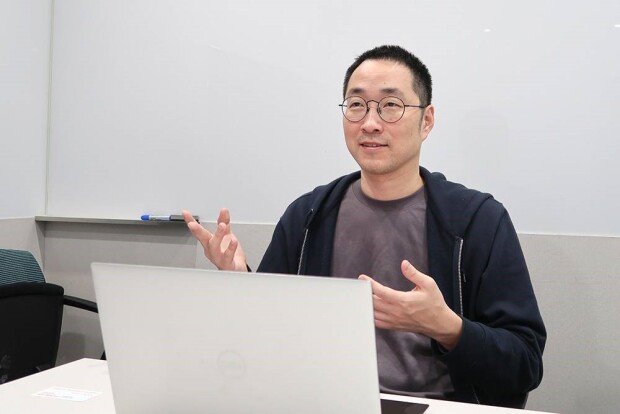
Park explaining StoryLine / source=IT dongA
On the business side, we are actively pursuing global market expansion. We are currently piloting StoryLine at two early childhood institutions in the US and are developing a localized version reflecting customer feedback. This November, we plan to launch the official service at three to four institutions in the Eastern US. In the first half of next year, we plan to focus on market expansion in regions with high educational demand, such as New York, New Jersey, Virginia, California, and Washington.
Domestically, we are preparing sales efforts for next year's performance. We have set a sales target of providing StoryLine to 1,500-2,000 classrooms nationwide and will begin full-scale activities in October.
The behavior analysis foundation model we developed has universal applications. While we are currently focused on analyzing the behavior of infants and young children, we plan to expand into various fields such as the elderly, patients, and workers in the future. Through this, we aim to grow into a total healthcare solution that provides new forms of assistance and supports better lives in diverse fields.
By Man-hyuk Han (mh@itdonga.com)
* This article was written with support from Seoul National University of Science and Technology.








 About Dong-A Ilbo