

WYHIL, “The Secret Weapon That Turns Every Employee into an AI Expert Lies Here”
WYHIL, “The Secret Weapon That Turns Every Employee into an AI Expert Lies Here”
Posted October. 01, 2025 14:34,
Updated October. 01, 2025 14:46
- WYHIL is an AI platform company that helps organizations standardize and
secure their use of artificial intelligence, making it easier for all employees
to become AI experts.
- Their main product, crux:SINGLEPOINT, integrates various AI technologies and
focuses on on-premises deployment to prevent data leakage, while
supporting advanced features like Retrieval-Augmented Generation (RAG) for
internal data search.
- WYHIL has successfully implemented its solutions in public, financial, and
educational sectors, and is expanding globally through partnerships and
technical collaborations.
Introducing artificial intelligence (AI) services to enhance corporate competitiveness is no longer optional—it is essential. Yet bringing AI into companies is not straightforward. Differences in employees’ AI proficiency often create gaps, while security concerns sometimes stall adoption altogether. If results vary widely depending on how each employee writes prompts, or if using external AI services risks leaking confidential information, companies face serious challenges.
WYHIL, founded in 2015 with Internet of Things (IoT) services, is an AI platform company created to solve precisely these problems. Today it provides a generative AI–based integrated business platform that strengthens both corporate AI utilization and security. In an interview, CEO Hunter Shin discussed the company’s technologies and vision.
– You worked at several major companies in Korea and abroad before founding WYHIL in 2015. What made you leave a stable career and start your own business?
I was originally an engineer and technology consultant. While working at Oracle Korea and LG Electronics, I noticed the biggest problem was the lack of collaboration between electronics and software. Decision-making was painfully slow. Having experienced both the field and management sides, I wanted to address this.
I started with IoT technology, aiming to integrate IoT, electronics, and software into new solutions. Later, we expanded into AI, where my field experience and know-how proved invaluable.
– Why did you shift from IoT in the early days to AI later on?
We did begin with IoT, but our core now is AI—especially generative AI. That doesn’t mean we’ve abandoned IoT. We continue experimenting with combining IoT infrastructure and AI at the edge, preparing for the coming era of “physical AI,” such as robotics.
– WYHIL emphasizes its range of technologies and services for applying AI in business. Could you explain this in detail?
Our flagship product is a unified platform that integrates multiple AI technologies. It is called crux, named after the Southern Cross constellation. Just as sai
lors once navigated by it, crux symbolizes guidance in AI. The core solution is crux:SINGLEPOINT.
This solution tackles the security issues companies face when using external services like ChatGPT or Copilot. The idea is to unify all related processes through a single point of management.
While developing AI agents to automate corporate tasks, we saw how widely employees’ AI proficiency varied. Results depended heavily on which language model was used, how prompts were written, and what reference data was provided.
For instance, when reviewing contracts, a weaker model sometimes misinterpreted terms in the opposite way. Entrusting such critical tasks to individual skill was too risky.
That’s why crux:SINGLEPOINT embeds the right models, optimized prompts, and essential data so all employees can produce results of consistent quality. Its core value is raising and standardizing AI use across the organization.
– I hear crux can be expanded flexibly. What other functions stand out?
One of the most important is RAG (Retrieval-Augmented Generation). It enables AI to search and generate documents based on internal company data. To support this, we built vector and similarity search capabilities and even developed crux:SEARCH as a separate product.
Unlike traditional index or keyword-based searches, it analyzes query intent and delivers semantically relevant results, while supporting multimedia such as video, image, and audio. This is a major driver for corporate digital transformation (DX).
– Cloud environments are convenient, while on-premises offers stronger security. Which does crux support?
Both are possible, but our current focus is on on-premises environments. Our goal is to install crux within secure corporate intranets, completely isolated from the cloud.
Many companies worry about data leakage when using AI. With crux, language models, platforms, and data handling all run internally, eliminating that risk. At the same time, we’ve also built ways to connect with external global services when needed, giving companies the option to integrate outside models securely.
– Have you applied crux in real-world cases? What was the response?
Our main targets are public, financial, and educational institutions, all cautious about cloud solutions.
In education, we worked with Chosun University’s LINC+ program to develop AI-powered expert and information search, along with a platform that enhances program operations.
We’ve also carried out numerous proof-of-concept (PoC) projects in public, financial, and logistics sectors.
At the Korea Credit Guarantee Fund, results were very positive. In MRO AI services, we ranked first in performance evaluations against competitors. YTN also ran a PoC with us and gave strong feedback. These experiences will drive further expansion.
– Competition in the AI market is fierce. What sets WYHIL apart?
Our greatest differentiator is our RAG technology. Through patents and in-house development, we’ve secured a wide range of modules. Our methods for acquiring and processing data for RAG are particularly unique.
We also excel in vector database management, which directly affects answer quality and overall AI performance. Our top rankings in PoCs came largely from strengths in resource optimization and vector management.
– Startups face even tougher competition because of their size. How do you overcome this?
Even though our technology has been recognized, some still question us due to our scale and staffing. To address this, we pursue OEM/ODM partnerships with larger firms. Currently, we are supplying through major companies like H Corp. and E Corp. We provide the technology, and they handle sales.
– How was your experience with SeoulTech’s global collaboration program?
We were selected for the “MIRACLE” program with Oracle. It was our last chance, since companies older than 10 years cannot apply.
The program provided strong technical support. We gained access to Oracle DB expertise in vector management and received testing environments. SeoulTech supported us with equipment for closed-network on-premises testing, while Oracle allowed us to run our systems on Oracle Cloud.
Beyond technical support, partnering with Oracle has opened doors to overseas expansion.
– Speaking of overseas expansion, how far have you progressed?
We are actively pursuing global growth, particularly through Oracle’s networks in Japan and the U.S. We’re scheduled to visit Oracle Japan this December.
Our overseas model is SaaS-based, leveraging Oracle’s transformation into a cloud company. Alongside competitive markets like Japan and the U.S., we are also eyeing Southeast Asia, including Malaysia and Indonesia, where AI development is less advanced.
– Finally, what are your future plans and vision?
We expect further growth in the public, financial, and education markets next year. In education especially, demand is strong for solutions that improve AI understanding and effective use.
We are also pursuing GS certification and government procurement registration to supply to public institutions. With momentum for AI adoption growing in the public sector, the outlook is bright.
Though small, most of our staff are seasoned engineers. I still code myself. Today’s AI is not tomorrow’s AI—companies need partners who will evolve with them. If you’re looking for such a partner, we’d love to connect.
By Young-woo Kim (pengo@itdonga.com)
* This article was written with support from Seoul National University of Science and Technology.
secure their use of artificial intelligence, making it easier for all employees
to become AI experts.
- Their main product, crux:SINGLEPOINT, integrates various AI technologies and
focuses on on-premises deployment to prevent data leakage, while
supporting advanced features like Retrieval-Augmented Generation (RAG) for
internal data search.
- WYHIL has successfully implemented its solutions in public, financial, and
educational sectors, and is expanding globally through partnerships and
technical collaborations.
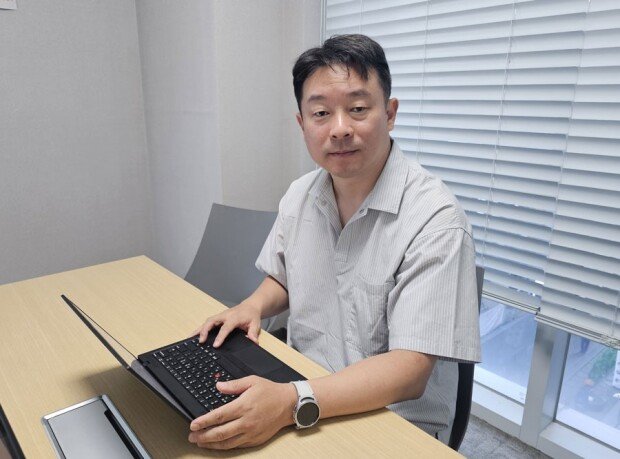
Hunter Shin, CEO of WYHIL / Source=IT dongA
Introducing artificial intelligence (AI) services to enhance corporate competitiveness is no longer optional—it is essential. Yet bringing AI into companies is not straightforward. Differences in employees’ AI proficiency often create gaps, while security concerns sometimes stall adoption altogether. If results vary widely depending on how each employee writes prompts, or if using external AI services risks leaking confidential information, companies face serious challenges.
WYHIL, founded in 2015 with Internet of Things (IoT) services, is an AI platform company created to solve precisely these problems. Today it provides a generative AI–based integrated business platform that strengthens both corporate AI utilization and security. In an interview, CEO Hunter Shin discussed the company’s technologies and vision.
– You worked at several major companies in Korea and abroad before founding WYHIL in 2015. What made you leave a stable career and start your own business?
I was originally an engineer and technology consultant. While working at Oracle Korea and LG Electronics, I noticed the biggest problem was the lack of collaboration between electronics and software. Decision-making was painfully slow. Having experienced both the field and management sides, I wanted to address this.
I started with IoT technology, aiming to integrate IoT, electronics, and software into new solutions. Later, we expanded into AI, where my field experience and know-how proved invaluable.
– Why did you shift from IoT in the early days to AI later on?
We did begin with IoT, but our core now is AI—especially generative AI. That doesn’t mean we’ve abandoned IoT. We continue experimenting with combining IoT infrastructure and AI at the edge, preparing for the coming era of “physical AI,” such as robotics.
– WYHIL emphasizes its range of technologies and services for applying AI in business. Could you explain this in detail?
Our flagship product is a unified platform that integrates multiple AI technologies. It is called crux, named after the Southern Cross constellation. Just as sai
lors once navigated by it, crux symbolizes guidance in AI. The core solution is crux:SINGLEPOINT.
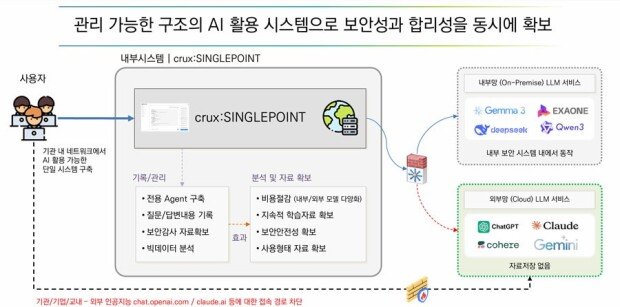
crux:SINGLEPOINT structure / Source=WYHIL
This solution tackles the security issues companies face when using external services like ChatGPT or Copilot. The idea is to unify all related processes through a single point of management.
While developing AI agents to automate corporate tasks, we saw how widely employees’ AI proficiency varied. Results depended heavily on which language model was used, how prompts were written, and what reference data was provided.
For instance, when reviewing contracts, a weaker model sometimes misinterpreted terms in the opposite way. Entrusting such critical tasks to individual skill was too risky.
That’s why crux:SINGLEPOINT embeds the right models, optimized prompts, and essential data so all employees can produce results of consistent quality. Its core value is raising and standardizing AI use across the organization.
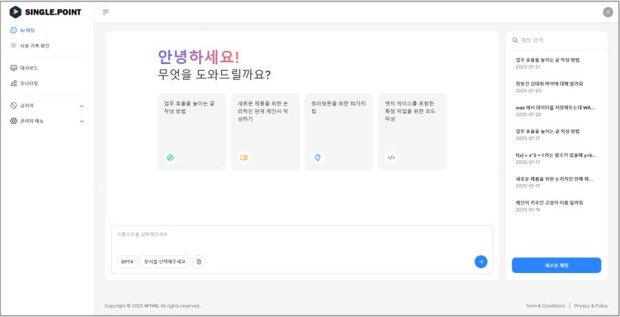
crux:SINGLEPOINT startup screen / Source=WYHIL
– I hear crux can be expanded flexibly. What other functions stand out?
One of the most important is RAG (Retrieval-Augmented Generation). It enables AI to search and generate documents based on internal company data. To support this, we built vector and similarity search capabilities and even developed crux:SEARCH as a separate product.
Unlike traditional index or keyword-based searches, it analyzes query intent and delivers semantically relevant results, while supporting multimedia such as video, image, and audio. This is a major driver for corporate digital transformation (DX).
– Cloud environments are convenient, while on-premises offers stronger security. Which does crux support?
Both are possible, but our current focus is on on-premises environments. Our goal is to install crux within secure corporate intranets, completely isolated from the cloud.
Many companies worry about data leakage when using AI. With crux, language models, platforms, and data handling all run internally, eliminating that risk. At the same time, we’ve also built ways to connect with external global services when needed, giving companies the option to integrate outside models securely.
– Have you applied crux in real-world cases? What was the response?
Our main targets are public, financial, and educational institutions, all cautious about cloud solutions.
In education, we worked with Chosun University’s LINC+ program to develop AI-powered expert and information search, along with a platform that enhances program operations.
We’ve also carried out numerous proof-of-concept (PoC) projects in public, financial, and logistics sectors.
At the Korea Credit Guarantee Fund, results were very positive. In MRO AI services, we ranked first in performance evaluations against competitors. YTN also ran a PoC with us and gave strong feedback. These experiences will drive further expansion.
– Competition in the AI market is fierce. What sets WYHIL apart?
Our greatest differentiator is our RAG technology. Through patents and in-house development, we’ve secured a wide range of modules. Our methods for acquiring and processing data for RAG are particularly unique.
We also excel in vector database management, which directly affects answer quality and overall AI performance. Our top rankings in PoCs came largely from strengths in resource optimization and vector management.
– Startups face even tougher competition because of their size. How do you overcome this?
Even though our technology has been recognized, some still question us due to our scale and staffing. To address this, we pursue OEM/ODM partnerships with larger firms. Currently, we are supplying through major companies like H Corp. and E Corp. We provide the technology, and they handle sales.
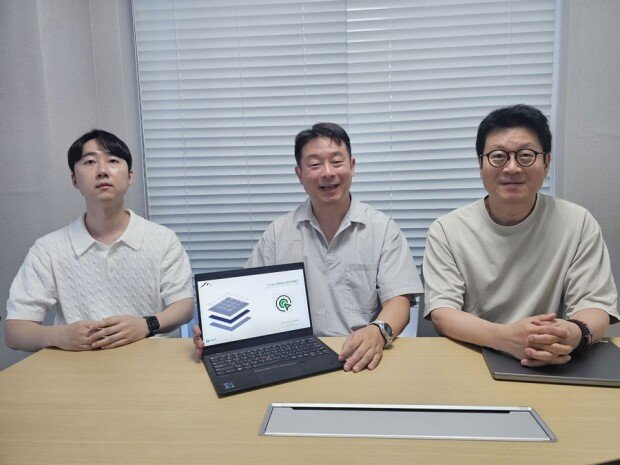
WYHIL executives / Source=IT dongA
– How was your experience with SeoulTech’s global collaboration program?
We were selected for the “MIRACLE” program with Oracle. It was our last chance, since companies older than 10 years cannot apply.
The program provided strong technical support. We gained access to Oracle DB expertise in vector management and received testing environments. SeoulTech supported us with equipment for closed-network on-premises testing, while Oracle allowed us to run our systems on Oracle Cloud.
Beyond technical support, partnering with Oracle has opened doors to overseas expansion.
– Speaking of overseas expansion, how far have you progressed?
We are actively pursuing global growth, particularly through Oracle’s networks in Japan and the U.S. We’re scheduled to visit Oracle Japan this December.
Our overseas model is SaaS-based, leveraging Oracle’s transformation into a cloud company. Alongside competitive markets like Japan and the U.S., we are also eyeing Southeast Asia, including Malaysia and Indonesia, where AI development is less advanced.
– Finally, what are your future plans and vision?
We expect further growth in the public, financial, and education markets next year. In education especially, demand is strong for solutions that improve AI understanding and effective use.
We are also pursuing GS certification and government procurement registration to supply to public institutions. With momentum for AI adoption growing in the public sector, the outlook is bright.
Though small, most of our staff are seasoned engineers. I still code myself. Today’s AI is not tomorrow’s AI—companies need partners who will evolve with them. If you’re looking for such a partner, we’d love to connect.
By Young-woo Kim (pengo@itdonga.com)
* This article was written with support from Seoul National University of Science and Technology.








 About Dong-A Ilbo