

Halon extinguishers fail in government battery fire
Halon extinguishers fail in government battery fire
Posted October. 01, 2025 07:51,
Updated October. 01, 2025 07:51
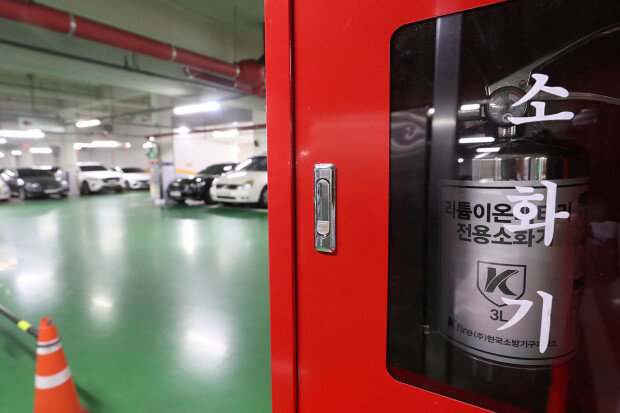
The fire at the National Information Resources Service that paralyzed South Korea’s national computer network occurred when staff tried to extinguish a lithium-ion battery blaze with halon extinguishers, which are ineffective against such fires. Their efforts failed, letting the fire spread. Although the government set standards for lithium battery extinguishers nine months ago, no products have met them, prompting calls to speed up development.
According to fire authorities, the fire started around 8:15 p.m. on September 26 on the fifth floor of NIRS’ headquarters in Daejeon, next to an uninterruptible power supply system. Staff initially tried halon extinguishers in the server room but failed. Firefighters arriving on the scene used the same method, yet flames flared again seven minutes later.
Halon extinguishers release halogen gas instead of powder, leaving no residue, making them suitable for spaces where data or cultural assets must be protected. However, they are ineffective against lithium battery fires. Thermal runaway, a chemical reaction that pushes temperatures above 1,000 degrees Celsius, cannot be stopped by halogen gas.
Specialized agents are needed to control thermal runaway, but no extinguishers have been certified by the National Fire Agency. In Korea, fire extinguishers must pass type approval and product inspections by the Korea Fire Institute before they can be sold, and no products have completed this process.
After frequent lithium battery fires, including a fatal June accident at the Arisel Factory in Hwaseong that killed 23 people, the Fire Agency issued certification standards for small lithium battery extinguishers in December. Nine months later, no products meet these standards. The guidelines cover household electronics and small devices, not large energy storage system batteries. A Fire Agency official said no international standards exist for agents that can stop thermal runaway, leaving submerging batteries in water as the only effective method.
Meanwhile, unverified products labeled as “lithium battery extinguishers” have flooded online markets. On September 30, dozens were found on major e-commerce sites, priced between 100,000 and 2 million won.
Some sellers claimed their products were optimized for lithium battery fires, while others cited deliveries to schools or public institutions. Online searches for “lithium battery extinguisher” jumped from zero before September 26 to 100 on September 29. The Fire Agency has seized 19 uncertified extinguishers this year and warned that marketing products as “battery-specific” without certification could be considered false advertising.
Confusion extends within the government. Last year, in the absence of standards and certified products, the Ministry of the Interior and Safety granted “disaster safety product certification” to a company’s lithium battery extinguisher, citing industrial promotion, while the Fire Agency focuses on public safety. Professor Lee Yong-jae of Kyungmin University stressed that, given the rising number of battery accidents, research funding, foreign product testing, and development of certified extinguishers should be prioritized.
전남혁기자 forward@donga.com


![“1000만원 줄 테니 나가달라”…집주인 제안, 받아도 될까 [집과법]](https://dimg.donga.com/c/138/175/90/1/wps/NEWS/IMAGE/2026/06/19/134130634.3.jpg)
![‘월급 50만원, 아파트는 4억’ 베트남…청년들 “그냥 평생 월세 살란다”[딥다이브]](https://dimg.donga.com/c/138/175/90/1/wps/NEWS/IMAGE/2026/06/19/134141662.1.png)
![오메가3, 뇌까지 도달했지만…치매 예방 효과 없었다 [노화설계]](https://dimg.donga.com/c/138/175/90/1/wps/NEWS/IMAGE/2026/06/19/134145199.3.jpg)



 About Dong-A Ilbo