

Robots boost efficiency, sustainable growth in Korean industry
Robots boost efficiency, sustainable growth in Korean industry
Posted September. 18, 2025 07:15,
Updated September. 18, 2025 07:15
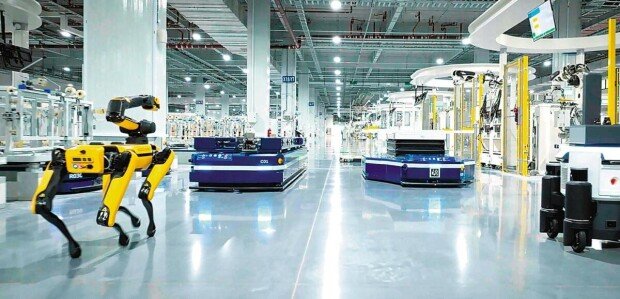
Manufacturing sites long reliant on human labor are rapidly transforming with artificial intelligence robots. From welding sparks in shipyards to assembly lines in car factories, “smart factories” with hundreds of precisely operating robots are becoming a reality.
Hyundai Motor and Kia on Sept. 17 unveiled advanced wireless communication technologies designed to operate smart factories with large-scale robot deployment.
The two companies developed the world’s first wireless connection terminals capable of handling both ultra-fast, low-latency Wi-Fi 6 and private ultra-high-speed 5G (P-5G) networks, and have filed patents for the technology in South Korea and the United States. Since late last year, these systems have been applied at Hyundai’s Ulsan plant and Hyundai Motor Group Metaplant America (HMGMA) in the U.S., supporting the stable operation of hundreds of production and logistics robots.
At Hyundai and Kia factory sites, advanced wireless communication-based robots such as automated guided vehicles (AGVs) and autonomous mobile robots (AMRs) are actively operating. More than 100 AGVs and AMRs have been deployed at Ulsan Plant 3, and 161 AMRs are in use at the HMGMA body plant. Because these robots must respond in real time to conditions on the factory floor rather than simply following preset routes, reliable wireless communication technology is essential.
The integrated devices, capable of switching networks, have resolved the problem of robots stopping work when communication failures occurred while using separate networks, the company said. “We plan to develop next-generation integrated devices based on Wi-Fi 7 by 2026 and install them in domestic and overseas factories,” a Hyundai Motor Group official added.
In the shipbuilding industry, a traditionally labor-intensive sector, robot adoption is also accelerating. On Sept. 15, HD Hyundai Samho signed a business agreement with HD Hyundai Robotics and LG CNS to develop humanoid robots and logistics automation technologies. The companies plan to expand shipyard automation by developing humanoid and autonomous mobile robots capable of performing a range of production activities, including welding, measurement, forming, and monitoring.
In the steel sector, POSCO has increased its use of robots to enhance safety in high-risk operations. In 2020, the company introduced automated coating process robots at its Gwangyang Steelworks.
According to a 2023 survey by the International Federation of Robotics, South Korea has 1,012 industrial robots per 10,000 manufacturing workers, the highest in the world. It far surpasses second-place Singapore, which has 770 robots per 10,000 workers.
The adoption of robots is gaining attention as an alternative to relocating production bases to low-wage countries to reduce labor costs. In its January report “Global Robotics Trends 2025,” the IFR noted that automation allows manufacturers to produce near their home countries or major consumer markets, alleviating labor shortages in manufacturing.
Research also suggests that robots can increase overall employment rather than simply replacing existing workers. A July report by the World Bank on the East Asia and Pacific region found that productivity gains from robot adoption expanded production, offsetting the employment displacement effects of automation. The report said robots can drive not only cost reductions but also sustainable industrial development.
Jae-Hyeng Kim monami@donga.com



![북한군 간호사에서 세계 누비는 사업가 되기까지[주성하의 북에서 온 이웃]](https://dimg.donga.com/c/138/175/90/1/wps/NEWS/IMAGE/2026/05/24/133981366.1.jpg)



 About Dong-A Ilbo