

PharmCADD: “Quantum Computing and AI-Integrated Simulator Will Revolutionize New Drug Development”
PharmCADD: “Quantum Computing and AI-Integrated Simulator Will Revolutionize New Drug Development”
Posted September. 15, 2025 13:40,
Updated September. 23, 2025 13:57
- PharmCADD is revolutionizing drug development by integrating quantum
computing and AI.
- Their platform, Pharmulator, predicts and simulates the physical and chemical
properties of compounds with high precision, enabling faster and more
accurate identification of new drug candidates.
- This innovative approach aims to overcome the challenges of traditional drug
development, which is time-consuming and costly.
Artificial intelligence (AI) is revolutionizing the drug development process. Discovering a new drug candidate, which once took years, can now be done in minutes with AI. Complex experimental tasks such as identifying drug candidates, predicting drug–target interactions, and estimating clinical success rates are also being resolved more quickly. As AI advances, drug development using it is accelerating. According to Markets and Markets, the AI-based drug development market is expected to grow from USD 1.86 billion (approximately KRW 2.582 trillion) in 2024 to USD 2.418 billion (approximately KRW 3.3567 trillion) in 2025.
With the addition of quantum computing, the potential of the drug development market is expanding even further. Quantum computing has overwhelming processing power, capable of solving molecular simulations in minutes that would take hundreds of years with conventional supercomputers. Combining quantum computing and AI is expected to significantly increase the success rate of drug development by precisely understanding molecular structures at the atomic level and predicting how drugs bind to proteins in the body.

PharmCADD, founded in 2019, is a biotech company focused on drug development by integrating quantum computing and AI. The company developed Pharmulator, which applies theories of physics and quantum mechanics to predict and simulate the physical and chemical properties of compounds with high precision.
Pharmulator helps understand how drug molecules interact with target proteins in the body, enabling accurate and rapid identification of new drug candidates. The company also owns AI Force Field technology, which reduces the time required for quantum calculations of small molecules from hours to less than a minute, and has developed drug toxicity prediction technology.
Exploring the Future of Drug Development through Quantum Computing and AI
“During the COVID-19 pandemic, I learned that Moderna was planning to use quantum computers to optimize mRNA vaccine sequences. At that time, I believed quantum computers could solve optimization problems that conventional computers could not. I became convinced that completing a drug design platform with quantum computing and AI would revolutionize drug development. I founded PharmCADD to show that these two technologies can dramatically accelerate and improve the success rate of new drug development,” said CEO Sang-wook Wu.
Wu began his startup with the idea of a “hybrid” computational architecture that combines the speed of AI with the optimization power of quantum computing. His strategy was to integrate high-performance computing (HPC) with quantum computing and solve increasingly complex problems step by step, beginning with those that can be addressed immediately.
Also serving as a professor in the Department of Physics at Pukyong National University, Wu has a distinctive background. After earning a bachelor’s degree in biochemistry at Yonsei University, he moved to theoretical physics for his master’s, and then earned a Ph.D. in physics at Iowa State University. He also worked in molecular and quantum dynamics and computational biophysics at the University of North Carolina at Chapel Hill. Drawing on this multidisciplinary expertise, Wu is presenting new solutions for drug development.
What PharmCADD pursues is technological innovation that combines quantum computing and AI. Rather than merely speeding up timelines, its goal is to raise the accuracy and reliability of in-silico drug development by fusing cutting-edge methods with solid fundamentals.
Wu said, “Traditional drug development takes an average of 15 years and costs astronomical amounts. PharmCADD aims to fundamentally solve these challenges using quantum computing and AI. To achieve this goal, every member of PharmCADD is dedicated to technology development with flexible thinking.”
Pharmulator: From Protein Structure Prediction to Drug Evaluation
PharmCADD has developed Pharmulator, a Software-as-a-Service (SaaS) platform for drug development that combines quantum computing and AI. Pharmulator integrates the entire process—from protein structure prediction and drug–target interaction simulation to ADME/T (absorption, distribution, metabolism, excretion, toxicity) evaluation. By incorporating quantum computing into AI analysis, PharmCADD addresses complex problems in drug development that even supercomputers struggle with, such as performing quantum mechanical calculations on numerous candidate compounds simultaneously or tackling the folding of disordered proteins.
Disordered proteins, which flexibly change shape without a fixed structure, are associated with neurodegenerative diseases such as Alzheimer’s and Parkinson’s. Unlike typical proteins that fold into three-dimensional structures, disordered proteins present unique challenges that Pharmulator seeks to solve.
Pharmulator operates in five parts: protein structure analysis, virtual screening, refinement using physics and quantum simulation, ADME/T evaluation, and new compound generation. All five support the discovery of viable drug candidates.
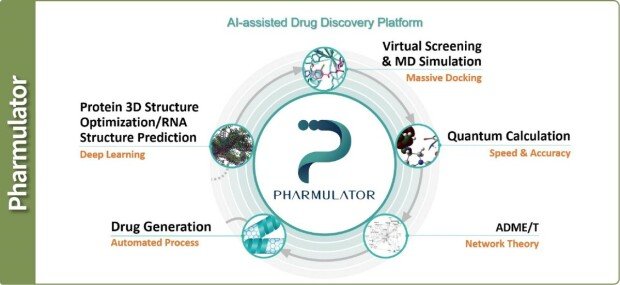
When a user requests analysis of a disease-related target protein, its three-dimensional structure is obtained. If a structure is already known, it is retrieved; if not, AI services such as AlphaFold are used to predict it. The first step is to identify the “binding pocket” where the drug will act.
Second, the target protein is matched against a library of millions of compounds stored on server clusters utilized by PharmCADD. Up to 12 million compounds can be screened per day to filter potential candidates. Wu compares this process to “finding a needle on the sands of Gwangalli Beach,” but AI drastically shortens the time required for the search.
The primary candidates are then refined through physical and quantum simulations. Molecular dynamics simulations with water molecules are used to mimic human physiological conditions and provide more accurate predictions of drug–protein binding. When analyzing features such as the electron distribution of a benzene ring, quantum chemical calculations based on the Schrödinger equation—rather than Newtonian mechanics—are employed to maximize accuracy.
No matter how effective a drug is, it cannot be used if it is toxic. Pharmulator therefore uses AI to predict liver toxicity, cardiac toxicity, and blood–brain barrier penetration. Once toxicity and other analyses are complete, the simulator proposes final candidates together with detailed information such as toxicity profiles and manufacturability.
Wu said, “The conventional drug development process must span an enormous molecular space, which makes computational complexity extremely high and extends time and cost. Our simulator integrates AI-based pattern recognition, molecular dynamics, and quantum computing algorithms to resolve structural problems and analyze proteins faster and more accurately.”
Wu likens ideal drug design to an orchestra. The idea is that harmonizing cutting-edge technologies—quantum computing and AI—with classical mathematics such as the Schrödinger equation can simultaneously revolutionize both the speed and the success rate of new drug development.
Challenges in Talent Acquisition and Technology Validation
Even as growth accelerates, PharmCADD has concerns. Wu points to securing top talent, improving data quality, and building equipment and infrastructure as key issues. Based in Busan, South Korea’s second-largest city, PharmCADD faces the reality that most quantum computing and AI specialists are concentrated in the Seoul metropolitan area. Wu emphasized the need for incentives that would allow talent to fully exercise their capabilities in regional cities such as Busan.
The advancement of quantum computing and AI technologies themselves is also a challenge. The completeness of AI models is proportional to the quality and quantity of data. “From a pharmaceutical company’s perspective, the challenge is both to secure validation at a level that can be trusted and to prove the practical applicability of quantum computing,” Wu said.
PharmCADD is building trust by presenting objective data and prospective validation results and by conducting diverse forms of joint research with pharmaceutical and biotech companies. It plans to expand collaborative validation studies to demonstrate Pharmulator’s effectiveness in real-world drug development. In addition, the company intends to speed up performance improvements by adopting the latest AI accelerators.
Building a Simulator Ecosystem with Pharmaceutical Companies
The value of a drug development platform is proven by real outcomes. PharmCADD distinguishes itself by producing systems that work in practice and deliver tangible results. Its achievements are already diverse. Selected for the “Quantum Computing-Based Quantum Gain Challenge Research Project” by the Ministry of Science and ICT, PharmCADD is developing quantum software technologies for innovative anticancer drugs.

PharmCADD was also selected for a global collaboration program operated by Seoul National University of Science and Technology (SeoulTech) and is now collaborating with IBM, a global leader in quantum computing. By leveraging IBM Quantum, PharmCADD is building expertise in running hybrid platforms for its simulators. SeoulTech has supported PharmCADD through industry–academia cooperation, tailored consulting, and access to research resources. Wu said, “The collaboration program between SeoulTech and IBM has greatly helped us strengthen our research capabilities and expand our global partnerships.”
Rather than replacing all data processing with quantum computers, PharmCADD envisions a practical “hybrid platform.” The goal is to combine the strengths of high-performance computing and quantum computing to secure both speed and accuracy. On this foundation, PharmCADD aims to collaborate with multiple pharmaceutical companies to develop new drugs and help countless patients.
By Hyung-seok Kang (redbk@itdonga.com)
* This article was written with support from Seoul National University of Science and Technology.
computing and AI.
- Their platform, Pharmulator, predicts and simulates the physical and chemical
properties of compounds with high precision, enabling faster and more
accurate identification of new drug candidates.
- This innovative approach aims to overcome the challenges of traditional drug
development, which is time-consuming and costly.
Artificial intelligence (AI) is revolutionizing the drug development process. Discovering a new drug candidate, which once took years, can now be done in minutes with AI. Complex experimental tasks such as identifying drug candidates, predicting drug–target interactions, and estimating clinical success rates are also being resolved more quickly. As AI advances, drug development using it is accelerating. According to Markets and Markets, the AI-based drug development market is expected to grow from USD 1.86 billion (approximately KRW 2.582 trillion) in 2024 to USD 2.418 billion (approximately KRW 3.3567 trillion) in 2025.
With the addition of quantum computing, the potential of the drug development market is expanding even further. Quantum computing has overwhelming processing power, capable of solving molecular simulations in minutes that would take hundreds of years with conventional supercomputers. Combining quantum computing and AI is expected to significantly increase the success rate of drug development by precisely understanding molecular structures at the atomic level and predicting how drugs bind to proteins in the body.
Sang-wook Wu, CEO of PharmCADD / Source=IT Donga
PharmCADD, founded in 2019, is a biotech company focused on drug development by integrating quantum computing and AI. The company developed Pharmulator, which applies theories of physics and quantum mechanics to predict and simulate the physical and chemical properties of compounds with high precision.
Pharmulator helps understand how drug molecules interact with target proteins in the body, enabling accurate and rapid identification of new drug candidates. The company also owns AI Force Field technology, which reduces the time required for quantum calculations of small molecules from hours to less than a minute, and has developed drug toxicity prediction technology.
Exploring the Future of Drug Development through Quantum Computing and AI
“During the COVID-19 pandemic, I learned that Moderna was planning to use quantum computers to optimize mRNA vaccine sequences. At that time, I believed quantum computers could solve optimization problems that conventional computers could not. I became convinced that completing a drug design platform with quantum computing and AI would revolutionize drug development. I founded PharmCADD to show that these two technologies can dramatically accelerate and improve the success rate of new drug development,” said CEO Sang-wook Wu.
Wu began his startup with the idea of a “hybrid” computational architecture that combines the speed of AI with the optimization power of quantum computing. His strategy was to integrate high-performance computing (HPC) with quantum computing and solve increasingly complex problems step by step, beginning with those that can be addressed immediately.
Also serving as a professor in the Department of Physics at Pukyong National University, Wu has a distinctive background. After earning a bachelor’s degree in biochemistry at Yonsei University, he moved to theoretical physics for his master’s, and then earned a Ph.D. in physics at Iowa State University. He also worked in molecular and quantum dynamics and computational biophysics at the University of North Carolina at Chapel Hill. Drawing on this multidisciplinary expertise, Wu is presenting new solutions for drug development.
What PharmCADD pursues is technological innovation that combines quantum computing and AI. Rather than merely speeding up timelines, its goal is to raise the accuracy and reliability of in-silico drug development by fusing cutting-edge methods with solid fundamentals.
Wu said, “Traditional drug development takes an average of 15 years and costs astronomical amounts. PharmCADD aims to fundamentally solve these challenges using quantum computing and AI. To achieve this goal, every member of PharmCADD is dedicated to technology development with flexible thinking.”
Pharmulator: From Protein Structure Prediction to Drug Evaluation
PharmCADD has developed Pharmulator, a Software-as-a-Service (SaaS) platform for drug development that combines quantum computing and AI. Pharmulator integrates the entire process—from protein structure prediction and drug–target interaction simulation to ADME/T (absorption, distribution, metabolism, excretion, toxicity) evaluation. By incorporating quantum computing into AI analysis, PharmCADD addresses complex problems in drug development that even supercomputers struggle with, such as performing quantum mechanical calculations on numerous candidate compounds simultaneously or tackling the folding of disordered proteins.
Disordered proteins, which flexibly change shape without a fixed structure, are associated with neurodegenerative diseases such as Alzheimer’s and Parkinson’s. Unlike typical proteins that fold into three-dimensional structures, disordered proteins present unique challenges that Pharmulator seeks to solve.
Pharmulator operates in five parts: protein structure analysis, virtual screening, refinement using physics and quantum simulation, ADME/T evaluation, and new compound generation. All five support the discovery of viable drug candidates.
Pharmulator, a drug development SaaS platform combining quantum computing and AI / Source PharmCADD
When a user requests analysis of a disease-related target protein, its three-dimensional structure is obtained. If a structure is already known, it is retrieved; if not, AI services such as AlphaFold are used to predict it. The first step is to identify the “binding pocket” where the drug will act.
Second, the target protein is matched against a library of millions of compounds stored on server clusters utilized by PharmCADD. Up to 12 million compounds can be screened per day to filter potential candidates. Wu compares this process to “finding a needle on the sands of Gwangalli Beach,” but AI drastically shortens the time required for the search.
The primary candidates are then refined through physical and quantum simulations. Molecular dynamics simulations with water molecules are used to mimic human physiological conditions and provide more accurate predictions of drug–protein binding. When analyzing features such as the electron distribution of a benzene ring, quantum chemical calculations based on the Schrödinger equation—rather than Newtonian mechanics—are employed to maximize accuracy.
No matter how effective a drug is, it cannot be used if it is toxic. Pharmulator therefore uses AI to predict liver toxicity, cardiac toxicity, and blood–brain barrier penetration. Once toxicity and other analyses are complete, the simulator proposes final candidates together with detailed information such as toxicity profiles and manufacturability.
Wu said, “The conventional drug development process must span an enormous molecular space, which makes computational complexity extremely high and extends time and cost. Our simulator integrates AI-based pattern recognition, molecular dynamics, and quantum computing algorithms to resolve structural problems and analyze proteins faster and more accurately.”
Wu likens ideal drug design to an orchestra. The idea is that harmonizing cutting-edge technologies—quantum computing and AI—with classical mathematics such as the Schrödinger equation can simultaneously revolutionize both the speed and the success rate of new drug development.
Challenges in Talent Acquisition and Technology Validation
Even as growth accelerates, PharmCADD has concerns. Wu points to securing top talent, improving data quality, and building equipment and infrastructure as key issues. Based in Busan, South Korea’s second-largest city, PharmCADD faces the reality that most quantum computing and AI specialists are concentrated in the Seoul metropolitan area. Wu emphasized the need for incentives that would allow talent to fully exercise their capabilities in regional cities such as Busan.
The advancement of quantum computing and AI technologies themselves is also a challenge. The completeness of AI models is proportional to the quality and quantity of data. “From a pharmaceutical company’s perspective, the challenge is both to secure validation at a level that can be trusted and to prove the practical applicability of quantum computing,” Wu said.
PharmCADD is building trust by presenting objective data and prospective validation results and by conducting diverse forms of joint research with pharmaceutical and biotech companies. It plans to expand collaborative validation studies to demonstrate Pharmulator’s effectiveness in real-world drug development. In addition, the company intends to speed up performance improvements by adopting the latest AI accelerators.
Building a Simulator Ecosystem with Pharmaceutical Companies
The value of a drug development platform is proven by real outcomes. PharmCADD distinguishes itself by producing systems that work in practice and deliver tangible results. Its achievements are already diverse. Selected for the “Quantum Computing-Based Quantum Gain Challenge Research Project” by the Ministry of Science and ICT, PharmCADD is developing quantum software technologies for innovative anticancer drugs.
Sang-wook Wu, CEO of PharmCADD / Source=IT Donga
PharmCADD was also selected for a global collaboration program operated by Seoul National University of Science and Technology (SeoulTech) and is now collaborating with IBM, a global leader in quantum computing. By leveraging IBM Quantum, PharmCADD is building expertise in running hybrid platforms for its simulators. SeoulTech has supported PharmCADD through industry–academia cooperation, tailored consulting, and access to research resources. Wu said, “The collaboration program between SeoulTech and IBM has greatly helped us strengthen our research capabilities and expand our global partnerships.”
Rather than replacing all data processing with quantum computers, PharmCADD envisions a practical “hybrid platform.” The goal is to combine the strengths of high-performance computing and quantum computing to secure both speed and accuracy. On this foundation, PharmCADD aims to collaborate with multiple pharmaceutical companies to develop new drugs and help countless patients.
By Hyung-seok Kang (redbk@itdonga.com)
* This article was written with support from Seoul National University of Science and Technology.



![[단독]조부 살해 20대女 “피 엄청 많이…빨리 와주세요” 119 신고](https://dimg.donga.com/c/138/175/90/1/wps/NEWS/IMAGE/2026/05/22/133978390.1.jpg)
![[사설]“김수현 녹취는 AI 조작”… 엄벌 없인 ‘악마적 범죄’ 더 판칠 것](https://dimg.donga.com/c/138/175/90/1/wps/NEWS/IMAGE/2026/05/22/133979690.1.jpg)



 About Dong-A Ilbo