

U.S. cuts Japan auto tariffs, Korea still waits
U.S. cuts Japan auto tariffs, Korea still waits
Posted September. 06, 2025 07:20,
Updated September. 06, 2025 07:20
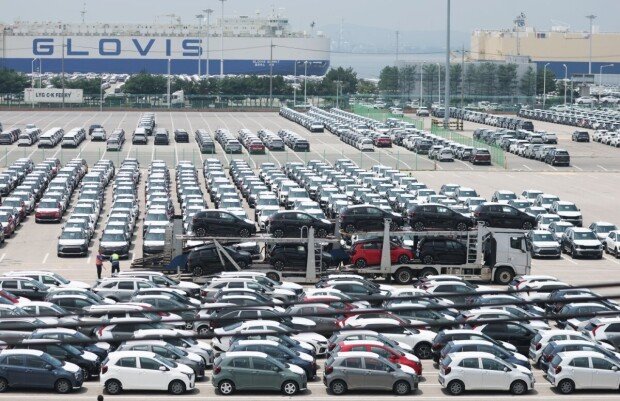
U.S. President Donald Trump on Sept. 4 local time signed an executive order implementing the U.S.-Japan trade deal, reducing tariffs on Japanese automobiles to 15 percent. South Korea, which also reached a trade agreement with Washington, continues to face a 25 percent auto tariff, raising concerns that Korean cars could lose price competitiveness.
The White House released the executive order to carry out the U.S.-Japan accord. “Under the agreement, the United States will impose a standard tariff of 15 percent on nearly all Japanese imports,” Trump said, adding that “separate tariffs will apply to automobiles, auto parts, aerospace products, generic drugs, and natural resources not produced domestically.”
In particular, the order said a revised tariff schedule lowering the auto duty from the current 27.5 percent, a 2.5 percent base duty plus a 25 percent product tariff, to 15 percent will be announced within seven days of the order’s publication in the Federal Register. Japan’s Kyodo News reported that the new 15 percent tariff on automobiles could take effect as early as next week.
Japan announced its trade deal with the United States on July 22, eight days ahead of South Korea, but grew frustrated when the reduced auto tariff was not applied immediately. After about six weeks, however, the executive order was issued, easing the tariff burden on one of Japan’s key exports.
South Korea reached an agreement with Washington on July 30 to lower mutual tariffs, including the auto tariff, to 15 percent. However, without an executive order, the 25 percent tariff still applies. The delay is estimated to cost Korea’s auto industry about 500 billion won in extra tariffs each month.
The order also said the reduced tariff would be applied retroactively to products imported after Aug. 7, with excess duties refunded. It authorized the U.S. commerce secretary to adjust the tariff rate on Japanese generic drugs, raw materials and precursors for generics, and certain natural resources to zero, depending on U.S. needs.
South Korean presidential spokeswoman Kang Yoo-jung said in a Sept. 5 briefing that the administration is not treating the U.S.-Japan deal as a benchmark for Korea. “It is not a matter of ‘Japan has completed it, so we will complete it too,’” she said. “Negotiators are seeking terms that best serve the national interest, and the outcome will come when that point is reached, not simply by rushing to finish quickly.”
Separately, U.S. President Donald Trump said on Sept. 4 that the United States will soon impose “fairly substantial” tariffs on semiconductors produced by companies that do not build factories in the country.
Woo-Sun Lim imsun@donga.com


![스쿼트 개수는 ‘하체 나이’ 지표… 연령별 기준 몇 개?[노화설계]](https://dimg.donga.com/c/138/175/90/1/wps/NEWS/IMAGE/2026/05/08/133884776.3.jpg)


 About Dong-A Ilbo