

SPHEREx produces first 102-band map of universe
SPHEREx produces first 102-band map of universe
Posted December. 20, 2025 09:09,
Updated December. 20, 2025 09:09
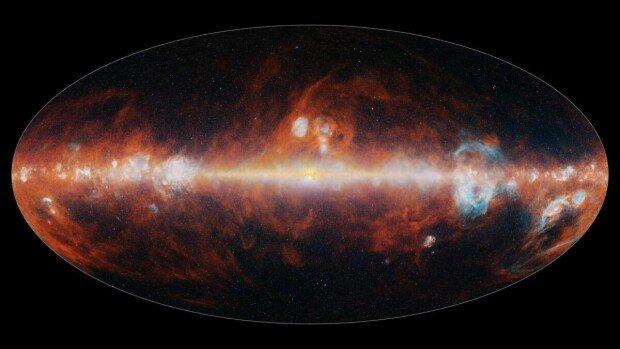
The Korea Aerospace Administration and the Korea Astronomy and Space Science Institute on Tuesday released the first full-sky map images captured by SPHEREx, a space telescope jointly developed with the U.S. National Aeronautics and Space Administration. The release marks the first time a complete map of the universe has been produced through spectroscopic observations of the entire sky using 102 infrared wavelengths.
SPHEREx began full-scale scientific observations on May 1, following its March 12 launch, and completed the mapping by surveying the entire sky over roughly six months. Because the infrared wavelengths detected by SPHEREx are invisible to the human eye, the images were generated by converting the data into visible colors. The resulting images depict infrared light emitted by stars in blue, green and white, hot hydrogen gas in blue, and cosmic dust in red.
SPHEREx orbits Earth about 14.5 times a day, crossing both the North and South poles and repeatedly passing over polar regions. During each orbit, the telescope captures roughly 3,600 images along circular bands of the sky. As Earth revolves around the sun, SPHEREx’s field of view gradually shifts as well. Repeating this process over six months allowed scientists to assemble a seamless 360-degree mosaic covering the entire sky.
SPHEREx observes the universe across 102 wavelength bands using specially designed linear spectral filters. Each wavelength carries distinct information about the physical properties of galaxies, stars, star-forming regions and other celestial objects. Dust clouds in the Milky Way, where stars and star formation are concentrated, emit strong light at certain wavelengths but little or none at others, making them difficult to detect without spectroscopic observations. Scientists expect the full-sky dataset from SPHEREx to support major research efforts into the history of the universe, the formation and evolution of galaxies, and the distribution of water and ice, which are considered essential ingredients for the origin of life.
The mission is overseen by NASA’s Jet Propulsion Laboratory, with data analysis involving 10 U.S. institutions and a research team led by Jung Woong-seop of the Korea Astronomy and Space Science Institute. The international research team plans to conduct three additional full-sky surveys during SPHEREx’s two-year primary mission. By combining these datasets, researchers will generate a three-dimensional integrated map with significantly improved measurement sensitivity. The resulting data will be released free of charge for use by scientists and the general public.
Kang Kyung-in, head of the Space Science and Exploration Division at the Korea Aerospace Administration, said, “Korean scientists are expected to play key roles not only in research on cosmic ice, a central focus of the mission, but also in studies of active galactic nuclei and small bodies in the solar system using observation data from the SPHEREx space telescope.”
장은지 jej@donga.com


![[천광암 칼럼]삼성 노조와 ‘야만인’의 과일 따는 법](https://dimg.donga.com/c/138/175/90/1/wps/NEWS/IMAGE/2026/05/03/133855899.1.jpg)
![‘카지노 옆 교회’ [횡설수설/김창덕]](https://dimg.donga.com/c/138/175/90/1/wps/NEWS/IMAGE/2026/05/03/133855896.1.jpg)
![[단독]‘구더기-장독’ 언급 나온 현장학습… 교사 96% “업무부담” 부정적](https://dimg.donga.com/c/138/175/90/1/wps/NEWS/IMAGE/2026/05/04/133856224.1.jpg)



 About Dong-A Ilbo