

Yune Inc.’s 'CARE ID’, a digital product passport solution, records the life of clothes.
Yune Inc.’s 'CARE ID’, a digital product passport solution, records the life of clothes.
Posted August. 21, 2025 13:58,
Updated August. 21, 2025 14:01
- Yune Inc.'s 'CARE ID' is a DPP solution that records and manages the entire
lifecycle of clothing, from production to disposal, aiming to promote sustainable
consumption and a circular economy in the fashion industry.
- The solution addresses the critical issue of excessive clothing waste, which
contributes significantly to global carbon emissions and resource depletion.
- By providing transparent information to consumers and preventing counterfeits,
CARE ID enhances brand credibility and consumer trust.
Clothes are made to be worn, but not all fulfill their purpose. Many are discarded after languishing in closets, while unsold inventory gathers dust in warehouses, only to be disposed of when the season changes to make way for new products.
According to McKinsey, a staggering 92 million metric tons of clothing are discarded globally each year. The greenhouse gas emissions from this process account for 10% of the world's total carbon emissions. This goes beyond an environmental burden, creating a critical problem of wasted resources, labor, and energy. This has led to calls for a fundamental change in the system where garments are thrown away, often without ever being used, contributing to severe pollution.

Yune Inc. was born from this critical awareness. The company argues that this vicious cycle can be broken by managing the entire lifecycle of clothing with data—from its creation to its disposal—and providing that information transparently to consumers. Yune’s flagship B2B solution, ‘CARE ID,’ is a digital care label solution that records and manages a product’s entire life. This solution targets the burgeoning Digital Product Passport (DPP) market, a system designed to digitize information across a product's value chain. Through CARE ID, Yune aims to foster sustainable consumption and promote a circular economy in fashion.
Aiming to Solve the Fashion Industry’s Structural Flaws
The inception of CARE ID traces back to the personal experiences of Yune's CEO, Him-chan Roh. During his high school years, he imported and sold used clothing, an experience that exposed him to the harsh reality of collection depots known as ‘clothing graveyards.’ This firsthand observation became the inspiration for his business. Initially, through a service called 'MintCollection,' he focused on the inventory and recycling challenges faced by producers.
However, Roh soon recognized a more complex, structural problem in the fashion industry: the excessive amount of waste relative to production volume. This led him to shift his focus upstream to the production phase. In the process, he became convinced of the necessity of a DPP system and pivoted his business model to CARE ID in 2023. "Through this pivot, our work evolved from a simple business into a sense of mission to solve a national challenge," Roh said. "We aim to contribute to realizing a circular economy and achieving carbon neutrality goals with our DPP solution."
CARE ID is a SaaS-based DPP solution that records and manages data throughout a product's entire lifecycle, from production and distribution to use, recycling, and disposal. Corporate customers input product data into the platform according to guidelines. Yune then verifies the accuracy of this data, using third-party auditors when necessary. The collected and verified data is linked to the product via a QR code and a digital signature for security.

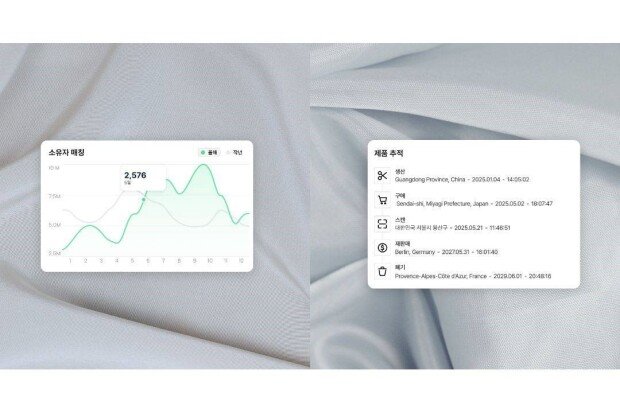
This system offers advantages to both corporates and consumers. Corporates can create a one-to-one data link between each product and its consumer, yielding valuable insights. This enables the collection and analysis of granular behavioral data for each product, such as the consumer's age, gender, and purchase region, as well as the timing of QR code scans, duration of use, resale or disposal points, repair history, and repurchase rates. Based on this data, corporates can design precise, customized strategies, such as offering repair services or supporting proper waste sorting.
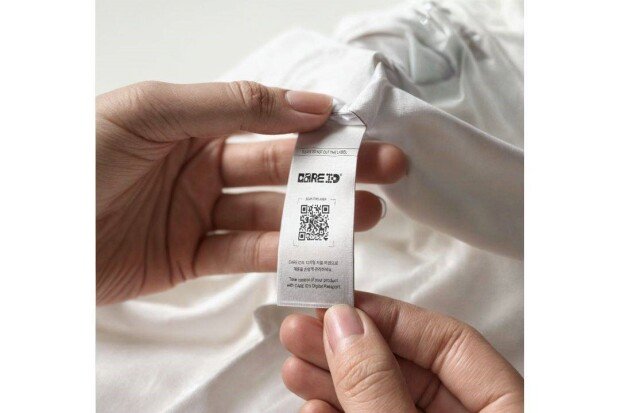
Consumers, in turn, can scan the QR code to access a detailed history of the product, including supply chain information, raw materials, production processes, and washing guides. A key differentiator for CARE ID is its ability to fundamentally block the distribution of counterfeits through a tamper-proof data design.
"Each product is matched one-to-one with a consumer, preventing attempts at duplication or forgery," Roh explained. "This provides a reliable digital authentication system, guaranteeing brand credibility and consumer protection." For example, if a product with CARE ID is linked to a secondhand marketplace, a simple QR scan can automatically register the transaction details, enhancing both convenience and trust.
Yune plans to maximize data traceability by NFC chips for permanent tracking and applying RFID to improve logistics efficiency. The company is also adopting AI to standardize unstructured data, continuously lowering the difficulty of data collection and processing. Furthermore, it intends to strengthen data integrity and reliability (by authenticating the identity of data providers) using blockchain technology.
Shifting Consumer Consciousness to Drive the DPP Market
Roh emphasizes that CARE ID's goal extends beyond just solving environmental issues. The European Union (EU) is set to phase in DPP requirements for all products, starting with the textile sector in 2027. Consequently, Korean companies entering the EU market must comply with these sustainability and eco-friendly regulations. "We saw the urgent need for DPPs, which are already becoming a reality in the global market," said Roh. "Large and small brands are particularly vulnerable to these regulatory changes. Yune's goal is to provide a solution that bridges this gap."
Noh identifies a shift in consumer consciousness as the primary engine for the DPP market's future growth. "With the recent rise in counterfeit goods, transparency in the fashion industry is no longer an option but a necessity," he stated. "We are entering an era where savvy consumers ask about a product's authenticity, origin, and history. If a brand cannot answer, it will lose trust."
He added, "In the past, corporates controlled information, but now consumers are actively demanding transparency and ethical production. As this paradigm shifts toward a consumer-driven market, the DPP has become more than a tool for regulatory compliance; it is an essential asset for building trust and ensuring brand survival."
Expanding Partnerships to Build a DPP Ecosystem
Yune launched its CARE ID solution in 2023 and secured Pre-Series A funding in 2024. As of 2025, it has partnered with over 200 domestic brands. Recently, it formed a consortium with 33 companies and institutions for a project to develop core technology for Fiber-to-Fiber (F2F) recycling of polyester composite fibers. The company's growth potential has also been recognized by the government, having been selected for the Ministry of Trade, Industry and Energy's (MOTIE) 'Innovation Premier 1000' program and as an AI voucher supplier by the National IT Industry Promotion Agency (NIPA). Starting in the second half of this year, Yune will also participate as a subcommittee member in the Ministry of Environment's council on the Extended Producer Responsibility (EPR) scheme.
This year, Yune gained a significant opportunity to advance onto the global stage through the 'Miracle Program,' a collaboration between the Seoul National University of Science and Technology (SeoulTech) and Oracle. "The program provided practical support for our expansion into overseas markets like North America, helping us discover new global partners," said Roh. "We also gained valuable startup operational know-how through SeoulTech's entrepreneurial infrastructure."
Buoyed by this support, Yune plans to lay the groundwork for international expansion this year. "Various reports, including one from Market Research Future, offer estimates for the DPP market size in 2030, with the average forecast at around 5 billion USD (approximately 6.9 trillion TRW)," Roh noted. "Yune aims to establish itself as Korea's leading DPP solution, catering to everyone from large corporations to small business owners, and accelerate its expansion across Asia." Over the next three years, the company also plans to expand beyond the textile and fashion industries into sectors such as beauty, furniture, and electronics.
To achieve this, Yune is first focusing on building an ecosystem. "A DPP is not a solution a single company can create. Collaboration with various innovative firms in Korea's circular economy—including reverse logistics providers, secondhand platform operators, textile recycling firms, and blockchain technology companies—is key," said Roh. "By 2026, we plan to complete our partnership network and establish ourselves as the core infrastructure for Korea's circular economy."
He concluded, "Right after founding the company, there was some external skepticism about our environmentally-focused business model. But as we've gradually earned recognition from the government and the industry, I feel we are proving our vision. We will strive to achieve a DX in the fashion and textile industry and create a tool that can lead global standards in the future."
By Ye-ji Kim (yj@itdonga.com)
* This article was written with support from Seoul National University of Science and Technology.
lifecycle of clothing, from production to disposal, aiming to promote sustainable
consumption and a circular economy in the fashion industry.
- The solution addresses the critical issue of excessive clothing waste, which
contributes significantly to global carbon emissions and resource depletion.
- By providing transparent information to consumers and preventing counterfeits,
CARE ID enhances brand credibility and consumer trust.
Clothes are made to be worn, but not all fulfill their purpose. Many are discarded after languishing in closets, while unsold inventory gathers dust in warehouses, only to be disposed of when the season changes to make way for new products.
According to McKinsey, a staggering 92 million metric tons of clothing are discarded globally each year. The greenhouse gas emissions from this process account for 10% of the world's total carbon emissions. This goes beyond an environmental burden, creating a critical problem of wasted resources, labor, and energy. This has led to calls for a fundamental change in the system where garments are thrown away, often without ever being used, contributing to severe pollution.
Him-chan Roh, CEO of Yune Inc. / source=IT dongA
Yune Inc. was born from this critical awareness. The company argues that this vicious cycle can be broken by managing the entire lifecycle of clothing with data—from its creation to its disposal—and providing that information transparently to consumers. Yune’s flagship B2B solution, ‘CARE ID,’ is a digital care label solution that records and manages a product’s entire life. This solution targets the burgeoning Digital Product Passport (DPP) market, a system designed to digitize information across a product's value chain. Through CARE ID, Yune aims to foster sustainable consumption and promote a circular economy in fashion.
Aiming to Solve the Fashion Industry’s Structural Flaws
The inception of CARE ID traces back to the personal experiences of Yune's CEO, Him-chan Roh. During his high school years, he imported and sold used clothing, an experience that exposed him to the harsh reality of collection depots known as ‘clothing graveyards.’ This firsthand observation became the inspiration for his business. Initially, through a service called 'MintCollection,' he focused on the inventory and recycling challenges faced by producers.
However, Roh soon recognized a more complex, structural problem in the fashion industry: the excessive amount of waste relative to production volume. This led him to shift his focus upstream to the production phase. In the process, he became convinced of the necessity of a DPP system and pivoted his business model to CARE ID in 2023. "Through this pivot, our work evolved from a simple business into a sense of mission to solve a national challenge," Roh said. "We aim to contribute to realizing a circular economy and achieving carbon neutrality goals with our DPP solution."
CARE ID is a SaaS-based DPP solution that records and manages data throughout a product's entire lifecycle, from production and distribution to use, recycling, and disposal. Corporate customers input product data into the platform according to guidelines. Yune then verifies the accuracy of this data, using third-party auditors when necessary. The collected and verified data is linked to the product via a QR code and a digital signature for security.
CARE ID homepage / source=Yune
This system offers advantages to both corporates and consumers. Corporates can create a one-to-one data link between each product and its consumer, yielding valuable insights. This enables the collection and analysis of granular behavioral data for each product, such as the consumer's age, gender, and purchase region, as well as the timing of QR code scans, duration of use, resale or disposal points, repair history, and repurchase rates. Based on this data, corporates can design precise, customized strategies, such as offering repair services or supporting proper waste sorting.
Consumers, in turn, can scan the QR code to access a detailed history of the product, including supply chain information, raw materials, production processes, and washing guides. A key differentiator for CARE ID is its ability to fundamentally block the distribution of counterfeits through a tamper-proof data design.
Consumers can scan the QR code to check detailed history and information / source=Yune
"Each product is matched one-to-one with a consumer, preventing attempts at duplication or forgery," Roh explained. "This provides a reliable digital authentication system, guaranteeing brand credibility and consumer protection." For example, if a product with CARE ID is linked to a secondhand marketplace, a simple QR scan can automatically register the transaction details, enhancing both convenience and trust.
Yune plans to maximize data traceability by NFC chips for permanent tracking and applying RFID to improve logistics efficiency. The company is also adopting AI to standardize unstructured data, continuously lowering the difficulty of data collection and processing. Furthermore, it intends to strengthen data integrity and reliability (by authenticating the identity of data providers) using blockchain technology.
Shifting Consumer Consciousness to Drive the DPP Market
Roh emphasizes that CARE ID's goal extends beyond just solving environmental issues. The European Union (EU) is set to phase in DPP requirements for all products, starting with the textile sector in 2027. Consequently, Korean companies entering the EU market must comply with these sustainability and eco-friendly regulations. "We saw the urgent need for DPPs, which are already becoming a reality in the global market," said Roh. "Large and small brands are particularly vulnerable to these regulatory changes. Yune's goal is to provide a solution that bridges this gap."
Noh identifies a shift in consumer consciousness as the primary engine for the DPP market's future growth. "With the recent rise in counterfeit goods, transparency in the fashion industry is no longer an option but a necessity," he stated. "We are entering an era where savvy consumers ask about a product's authenticity, origin, and history. If a brand cannot answer, it will lose trust."
He added, "In the past, corporates controlled information, but now consumers are actively demanding transparency and ethical production. As this paradigm shifts toward a consumer-driven market, the DPP has become more than a tool for regulatory compliance; it is an essential asset for building trust and ensuring brand survival."
Expanding Partnerships to Build a DPP Ecosystem
Yune launched its CARE ID solution in 2023 and secured Pre-Series A funding in 2024. As of 2025, it has partnered with over 200 domestic brands. Recently, it formed a consortium with 33 companies and institutions for a project to develop core technology for Fiber-to-Fiber (F2F) recycling of polyester composite fibers. The company's growth potential has also been recognized by the government, having been selected for the Ministry of Trade, Industry and Energy's (MOTIE) 'Innovation Premier 1000' program and as an AI voucher supplier by the National IT Industry Promotion Agency (NIPA). Starting in the second half of this year, Yune will also participate as a subcommittee member in the Ministry of Environment's council on the Extended Producer Responsibility (EPR) scheme.
This year, Yune gained a significant opportunity to advance onto the global stage through the 'Miracle Program,' a collaboration between the Seoul National University of Science and Technology (SeoulTech) and Oracle. "The program provided practical support for our expansion into overseas markets like North America, helping us discover new global partners," said Roh. "We also gained valuable startup operational know-how through SeoulTech's entrepreneurial infrastructure."
example of CARE ID service / source=Yune
Buoyed by this support, Yune plans to lay the groundwork for international expansion this year. "Various reports, including one from Market Research Future, offer estimates for the DPP market size in 2030, with the average forecast at around 5 billion USD (approximately 6.9 trillion TRW)," Roh noted. "Yune aims to establish itself as Korea's leading DPP solution, catering to everyone from large corporations to small business owners, and accelerate its expansion across Asia." Over the next three years, the company also plans to expand beyond the textile and fashion industries into sectors such as beauty, furniture, and electronics.
To achieve this, Yune is first focusing on building an ecosystem. "A DPP is not a solution a single company can create. Collaboration with various innovative firms in Korea's circular economy—including reverse logistics providers, secondhand platform operators, textile recycling firms, and blockchain technology companies—is key," said Roh. "By 2026, we plan to complete our partnership network and establish ourselves as the core infrastructure for Korea's circular economy."
He concluded, "Right after founding the company, there was some external skepticism about our environmentally-focused business model. But as we've gradually earned recognition from the government and the industry, I feel we are proving our vision. We will strive to achieve a DX in the fashion and textile industry and create a tool that can lead global standards in the future."
By Ye-ji Kim (yj@itdonga.com)
* This article was written with support from Seoul National University of Science and Technology.








 About Dong-A Ilbo