

U.S. pressure mounts ahead of Lee-Trump summit
U.S. pressure mounts ahead of Lee-Trump summit
Posted August. 21, 2025 07:31,
Updated August. 21, 2025 07:31
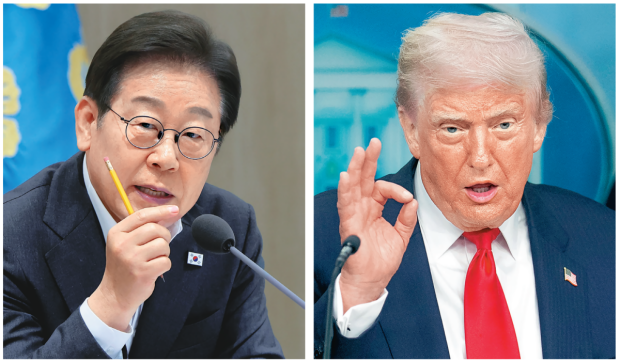
With five days remaining before the first South Korea-U.S. summit between President Lee Jae-myung and U.S. President Donald Trump on Aug. 25, Washington is ramping up pressure. After expanding tariffs on steel and aluminum, the United States announced plans to demand equity stakes from semiconductor companies, including South Korean firms, that received subsidies for investments in the U.S. Although tariff negotiations between the two countries have concluded, economic and security demands continue to mount, making the summit a crucial test that could shape the course of the Lee administration’s foreign policy. Analysts warn that as Trump pursues a stronger version of “America First” than in his first term, the outcome of the talks could carry far-reaching consequences for bilateral relations.
U.S. Commerce Secretary Howard Lutnick said on Aug. 19 local time that the U.S. government is considering acquiring equity stakes in semiconductor companies that receive subsidies under the CHIPS Act to build factories in the country, Reuters reported. This raises the possibility that Washington could demand shares from Samsung Electronics or SK hynix, which have agreed to accept subsidies for their semiconductor investments in the U.S. The Trump administration is negotiating with Intel to provide $10 billion in subsidies in exchange for a 10 percent stake. If the government secures ownership, it could use it to influence further investment expansion in the country.
The South Korean presidential office is bracing for the possibility that Trump may make unexpected demands on investment or security during the summit and has launched an all-out effort to prepare. “We are preparing for various scenarios to respond to Trump’s style,” a senior government official said on Aug. 20. “Because President Trump deals in concrete figures, the negotiations will not be easy.” According to government sources, Seoul is preparing for the possibility that Trump could use tariffs and the U.S. troop presence in South Korea as leverage to press for greater investment and unexpected terms related to alliance modernization. “The amount of investment in the United States may increase,” Presidential Policy Chief Kim Yong-bum told reporters the same day. “Negotiations are not over until they are truly over.”
Former senior officials who took part in summits during Trump’s first term warned that the risks have grown significantly in his second term, stressing the need for a thorough risk-avoidance strategy. Cho Yoon-je, former South Korean ambassador to the United States, said, “We must be prepared to demonstrate with numbers that South Korea can be a strong partner in revitalizing U.S. manufacturing,” adding, “Spontaneous demands by President Trump should be accommodated flexibly but deferred to working-level discussions.” Choi Jong-kun, a former first vice foreign minister and now professor of political science and international studies at Yonsei University, said, “While it is important to deliver achievements that Trump can showcase, strategic ambiguity should be maintained on issues such as alliance modernization.”
Hoon-Sang Park tigermask@donga.com

![전국 누비던 허영만도 못 피한 낙상…예방의 핵심은 ‘근육’[노화설계]](https://dimg.donga.com/c/138/175/90/1/wps/NEWS/IMAGE/2026/06/18/134135614.3.jpg)



 About Dong-A Ilbo