

Corca, "Here comes your AI co-researcher."
Corca, "Here comes your AI co-researcher."
Posted August. 13, 2025 10:57,
Updated August. 13, 2025 11:04
- Corca is a Korean startup focused on bridging the gap in AI adoption by
developing solutions based on Large Language Models (LLMs).
- Their 'Moonlight,' an AI colleague for research, and 'Trace,' an AI secretary for
personal schedule management.
- Corca aims to transform life and work with AI, targeting both B2B and B2C
sectors globally.
In an era where ‘AI’ is the word on everyone's lips, many individuals and companies still find themselves unable to reap its benefits. Startup Corca, led by CEO Young-hyun Chung, is on a mission to close this gap.
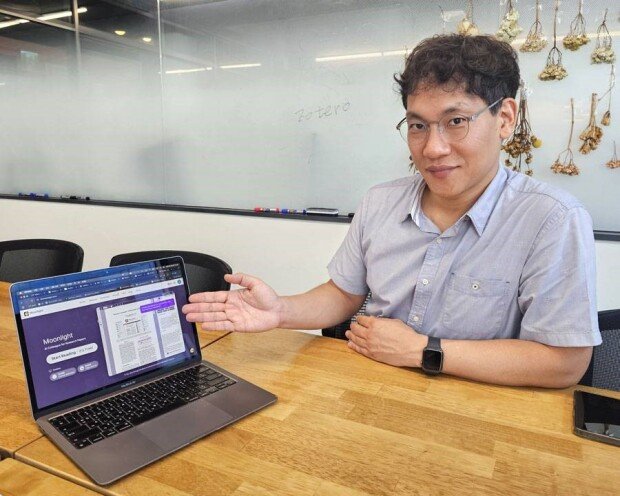
Under the vision of ‘Transforming Life and Work with AI,’ Corca is developing solutions based on Large Language Models (LLMs). Its flagship products include 'Moonlight,' an AI colleague that assists with research, and 'Trace,' an AI secretary for personal schedule management. We sat down with Chung to discuss the future of AI productivity that Corca envisions.
- The company name 'Corca' is quite unique. What does it mean? We're also curious about why you founded an AI startup.
"I have always worked on projects for people, organizations, and companies that are left out of the benefits of technological advancement. Before founding Corca, I worked on helping people with disabilities using technology and served as a professor at New York University Shanghai (NYU Shanghai).
I returned to Korea due to the COVID-19 pandemic. I then started a project to solve corporate problems using AI, and its success was so significant that it led to the founding of the company in 2021. At the time, I was managing an AI adoption project for a major retail company and saw the reality that while everyone stressed the importance of AI, they weren't actually able to utilize it. This inspired me to focus on bridging that gap.
For reference, 'Corca' is derived from 'orca.' It embodies our goal to become like the orca—an apex predator in the marine ecosystem that does not harm humans."
- What are the key features of Corca's core solutions, and what specific problems can they solve?
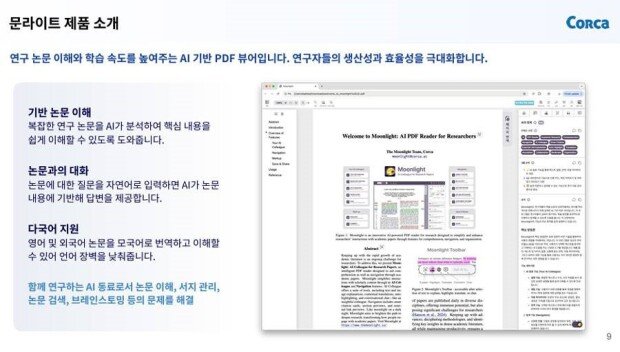
"We are creating solutions that were impossible in the past but are now achievable thanks to generative AI. The first of our flagship products is 'Moonlight.' It's an AI PDF reader for researchers that explains the content of academic papers and helps them understand the material faster and more deeply, effectively reducing the time spent on research. You can think of it as an AI research colleague.
The second is 'Trace,' an AI-powered calendar. When you input your schedule in everyday language or even with a picture, the AI automatically fills in the details and provides context-aware notifications, acting as a hyper-personalized scheduling assistant. You can manipulate the calendar just by talking to it as you would to a secretary, saying things like, 'Move this appointment to tomorrow.'"
- PDF readers and calendar apps existed before. What makes Corca's solutions different?
"We have integrated numerous features that are only possible with generative AI. Moonlight alone possesses many capabilities that were virtually impossible with traditional PDF readers. For example, the 'Auto-Highlight' feature has the LLM read the paper before the researcher and highlight the important sections.
It can also pre-read reference papers and advise on their relationship to the main paper or whether they are worth reading. You can also ask for general information about the paper in a conversational format. It goes beyond a simple tool to act as a true research colleague or agent."
- Who is using Corca's solutions? How are they being utilized, and what results have they achieved?
"Moonlight was developed with the goal of advancing human civilization through technology. It is widely used in educational settings, including by undergraduate and graduate students and professors, and has a high adoption rate in government-funded research institutes.
On the 30th of last month, a satellite services company purchased Moonlight. This company works in satellite terminals, space technology, and both LEO and GEO satellites. I believe our clients are contributing to the advancement of science and technology in incredibly diverse fields such as mathematics, biology, and space.
In terms of growth, Moonlight's revenue increased four-fold in Q4 of last year and 5.8-fold in Q2 of this year compared to Q1. It's growing very rapidly, and we are targeting a three-fold increase for Trace this third quarter.
Moonlight is already being used by users in nearly 100 countries. We have confirmed its active use by researchers in various nations, including the United States, China, Japan, and across Europe."
- We heard you participated in a global corporate collaboration program organized by SeoulTech. What specific help did you receive?
"Through a project with Seoul National University of Science and Technology (SeoulTech) and Amazon Web Services (AWS), we were able to participate in 'IVS,' a startup conference in Kyoto, Japan, in July. The following week, we visited the AWS headquarters in Tokyo.
IVS is one of Japan's largest and oldest startup events. There, we conversed with people from the startup ecosystem and networked with VC representatives. We are currently conducting follow-up meetings with people we met there and are building partnerships for our entry into the Japanese market. It was incredibly helpful, and we plan to expand on this to achieve tangible results."
- Running a startup is difficult. The AI industry is especially competitive. How are you overcoming these challenges?
"The most difficult part is keeping up with the rapid pace of AI development. The emergence of many AI tools has disrupted traditional developer and planner roles, and the concentration of investment in a few famous AI companies is also a challenge.
Organizational structures are also changing significantly, and we are reorganizing our own structure to adapt. In some ways, we are treading a path that has never been taken before, so taking on these challenges and risks is the hardest part.
There are also personnel issues. Highly skilled individuals often start their own one-person companies. To compete, we must offer a better environment, which means creating a workplace that fosters challenge and growth and has a transparent compensation system. That’s why we provide all employees, both developers and non-developers, with unlimited access to paid AI services that can cost over $200 per month."
- What are your plans? What kind of solutions can we expect?
"We are actively conducting research and development in the LLM and AI fields. Our goal is to use the data we gather from the front lines of the AI industry to create products that are truly helpful to people.
Furthermore, we are aggressively pursuing overseas markets. Our two launched products were available globally from day one. We are approaching markets like Japan, China, and Europe from various angles to penetrate both B2B and B2C sectors.
Lastly, we are creating various solutions for individuals and companies in today's world who are still not benefiting from the advancements in AI. Ultimately, we hope our products will leave a small footprint that contributes to the progress of human civilization."
By Young-woo Kim (pengo@itdonga.com)
* This article was written with support from Seoul National University of Science and Technology.
developing solutions based on Large Language Models (LLMs).
- Their 'Moonlight,' an AI colleague for research, and 'Trace,' an AI secretary for
personal schedule management.
- Corca aims to transform life and work with AI, targeting both B2B and B2C
sectors globally.
In an era where ‘AI’ is the word on everyone's lips, many individuals and companies still find themselves unable to reap its benefits. Startup Corca, led by CEO Young-hyun Chung, is on a mission to close this gap.
Young-hyun Chung, CEO of Corca / source=IT dongA
Under the vision of ‘Transforming Life and Work with AI,’ Corca is developing solutions based on Large Language Models (LLMs). Its flagship products include 'Moonlight,' an AI colleague that assists with research, and 'Trace,' an AI secretary for personal schedule management. We sat down with Chung to discuss the future of AI productivity that Corca envisions.
- The company name 'Corca' is quite unique. What does it mean? We're also curious about why you founded an AI startup.
"I have always worked on projects for people, organizations, and companies that are left out of the benefits of technological advancement. Before founding Corca, I worked on helping people with disabilities using technology and served as a professor at New York University Shanghai (NYU Shanghai).
I returned to Korea due to the COVID-19 pandemic. I then started a project to solve corporate problems using AI, and its success was so significant that it led to the founding of the company in 2021. At the time, I was managing an AI adoption project for a major retail company and saw the reality that while everyone stressed the importance of AI, they weren't actually able to utilize it. This inspired me to focus on bridging that gap.
For reference, 'Corca' is derived from 'orca.' It embodies our goal to become like the orca—an apex predator in the marine ecosystem that does not harm humans."
- What are the key features of Corca's core solutions, and what specific problems can they solve?
"We are creating solutions that were impossible in the past but are now achievable thanks to generative AI. The first of our flagship products is 'Moonlight.' It's an AI PDF reader for researchers that explains the content of academic papers and helps them understand the material faster and more deeply, effectively reducing the time spent on research. You can think of it as an AI research colleague.
”Moonlight’ is AI PDF reader based on AI / source=IT dongA
The second is 'Trace,' an AI-powered calendar. When you input your schedule in everyday language or even with a picture, the AI automatically fills in the details and provides context-aware notifications, acting as a hyper-personalized scheduling assistant. You can manipulate the calendar just by talking to it as you would to a secretary, saying things like, 'Move this appointment to tomorrow.'"
- PDF readers and calendar apps existed before. What makes Corca's solutions different?
"We have integrated numerous features that are only possible with generative AI. Moonlight alone possesses many capabilities that were virtually impossible with traditional PDF readers. For example, the 'Auto-Highlight' feature has the LLM read the paper before the researcher and highlight the important sections.
It can also pre-read reference papers and advise on their relationship to the main paper or whether they are worth reading. You can also ask for general information about the paper in a conversational format. It goes beyond a simple tool to act as a true research colleague or agent."
- Who is using Corca's solutions? How are they being utilized, and what results have they achieved?
"Moonlight was developed with the goal of advancing human civilization through technology. It is widely used in educational settings, including by undergraduate and graduate students and professors, and has a high adoption rate in government-funded research institutes.
On the 30th of last month, a satellite services company purchased Moonlight. This company works in satellite terminals, space technology, and both LEO and GEO satellites. I believe our clients are contributing to the advancement of science and technology in incredibly diverse fields such as mathematics, biology, and space.
In terms of growth, Moonlight's revenue increased four-fold in Q4 of last year and 5.8-fold in Q2 of this year compared to Q1. It's growing very rapidly, and we are targeting a three-fold increase for Trace this third quarter.
Moonlight is already being used by users in nearly 100 countries. We have confirmed its active use by researchers in various nations, including the United States, China, Japan, and across Europe."
- We heard you participated in a global corporate collaboration program organized by SeoulTech. What specific help did you receive?
"Through a project with Seoul National University of Science and Technology (SeoulTech) and Amazon Web Services (AWS), we were able to participate in 'IVS,' a startup conference in Kyoto, Japan, in July. The following week, we visited the AWS headquarters in Tokyo.
IVS is one of Japan's largest and oldest startup events. There, we conversed with people from the startup ecosystem and networked with VC representatives. We are currently conducting follow-up meetings with people we met there and are building partnerships for our entry into the Japanese market. It was incredibly helpful, and we plan to expand on this to achieve tangible results."
- Running a startup is difficult. The AI industry is especially competitive. How are you overcoming these challenges?
"The most difficult part is keeping up with the rapid pace of AI development. The emergence of many AI tools has disrupted traditional developer and planner roles, and the concentration of investment in a few famous AI companies is also a challenge.
Organizational structures are also changing significantly, and we are reorganizing our own structure to adapt. In some ways, we are treading a path that has never been taken before, so taking on these challenges and risks is the hardest part.
There are also personnel issues. Highly skilled individuals often start their own one-person companies. To compete, we must offer a better environment, which means creating a workplace that fosters challenge and growth and has a transparent compensation system. That’s why we provide all employees, both developers and non-developers, with unlimited access to paid AI services that can cost over $200 per month."
- What are your plans? What kind of solutions can we expect?
"We are actively conducting research and development in the LLM and AI fields. Our goal is to use the data we gather from the front lines of the AI industry to create products that are truly helpful to people.
Furthermore, we are aggressively pursuing overseas markets. Our two launched products were available globally from day one. We are approaching markets like Japan, China, and Europe from various angles to penetrate both B2B and B2C sectors.
Lastly, we are creating various solutions for individuals and companies in today's world who are still not benefiting from the advancements in AI. Ultimately, we hope our products will leave a small footprint that contributes to the progress of human civilization."
By Young-woo Kim (pengo@itdonga.com)
* This article was written with support from Seoul National University of Science and Technology.

![[단독]“거부도 못해” 요양병원 ‘콧줄 환자’ 8만명](https://dimg.donga.com/c/138/175/90/1/wps/NEWS/IMAGE/2026/03/02/133450041.2.jpg)






 About Dong-A Ilbo