

Court nominee opposes expanding judicial review system
Court nominee opposes expanding judicial review system
Posted July. 22, 2025 07:59,
Updated July. 22, 2025 07:59
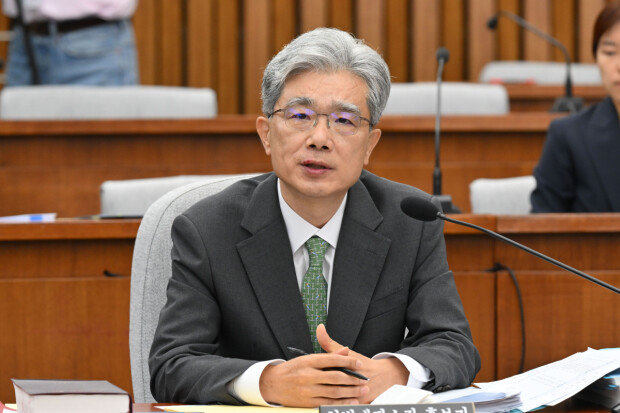
Kim Sang-hwan, nominee for president of South Korea’s Constitutional Court, said the proposed introduction of “judicial constitutional complaints” should be carefully reviewed, taking into account not only its advantages but also the potential drawbacks. His comments are seen as a call for caution on a proposal led by the Democratic Party to allow constitutional challenges against court rulings.
At a confirmation hearing before the National Assembly on Sunday, Kim said, “Whether to adopt a system that permits constitutional complaints against court decisions is ultimately a matter for the public and the National Assembly to decide.” He added, “However, the negative aspects of such a system, effectively introducing a fourth tier of judicial review, must be considered alongside any potential benefits.”
The Democratic Party has pushed to amend the Constitutional Court Act to allow such appeals. If implemented, the system would allow constitutional complaints against Supreme Court rulings, which many legal scholars argue would effectively create a four-tier judiciary. In written responses submitted prior to the hearing, Kim noted, “It is difficult to deny that the system would, in practice, function as a fourth instance, delaying final decisions and potentially increasing related costs.”
Kim also commented on the idea of expanding the number of Supreme Court justices, saying, “Even if an increase is needed to handle cases more efficiently, decisions about how many to add and when must be approached with great caution.” The Democratic Party had proposed increasing the number of Supreme Court justices from the current 14 (including the chief justice) to 30 after President Lee Jae-myung took office, but has since put the plan on hold. On the issue of presidential self-pardons, Kim said, “It would be difficult for such actions to gain public legitimacy.”
During the hearing, opposition lawmakers questioned Kim’s political neutrality. People Power Party lawmaker Seo Beom-soo pointed to Kim’s dissenting opinion that favored acquittal in a 2020 Supreme Court case involving then-Gyeonggi Governor Lee Jae-myung, now president, regarding allegations of violating election law over comments related to his brother’s involuntary hospitalization. Seo said, “There is public criticism that this appointment is either a reward or the result of lobbying.” Kim replied, “I am always mindful of and cautious about such concerns,” and emphasized that he has no personal ties to President Lee.
A full session of the National Assembly will review and vote on Kim’s appointment on Monday. If approved, President Lee will formally appoint him. Should he take office, Kim would become the first Constitutional Court president in 12 years with prior experience as a Supreme Court justice, following Lee Kang-kook, who served from 2007 to 2013.
김자현 기자 zion37@donga.com




![하루 방귀 몇 번이 정상일까? 가장 많이 뀌는 시간대는…[건강팩트체크]](https://dimg.donga.com/c/138/175/90/1/wps/NEWS/IMAGE/2026/06/12/134098245.3.jpg)



 About Dong-A Ilbo