

Korea plans $520 billion semiconductor industry expansion
Korea plans $520 billion semiconductor industry expansion
Posted December. 11, 2025 08:24,
Updated December. 11, 2025 08:24
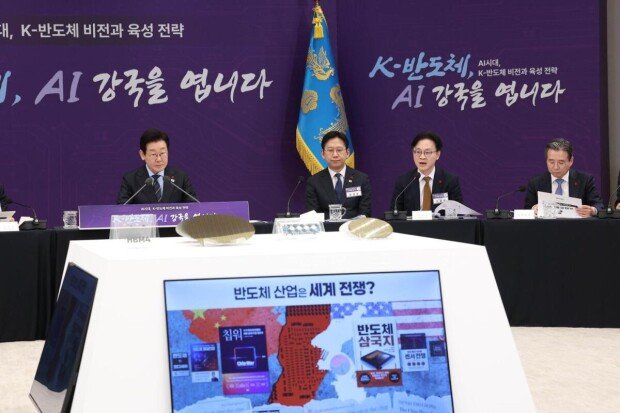
The South Korean government plans to invest 700 trillion won, about $520 billion, by 2047 to expand the domestic fabless semiconductor industry tenfold. The initiative is designed to secure South Korea’s technological edge beyond memory chips as the global economy shifts further into the artificial intelligence era.
Kim Jung-kwan, minister of trade, industry and energy, unveiled the strategy at the “K-Semiconductor Vision and Development Strategy Briefing” held at the presidential office in Yongsan, Seoul, with President Lee Jae-myung presiding. Under the plan, the government will support the construction of 10 additional semiconductor fabrication plants by 2047, laying the groundwork for what it says will become the world’s largest semiconductor cluster.
The plan also calls for maintaining South Korea’s lead in memory technologies such as high-bandwidth memory while channeling greater resources into research and development of AI-focused chips, including neural processing units and processing-in-memory products. Through this two-track strategy, the government aims to elevate South Korea into the world’s top two semiconductor powerhouses.
President Lee also reiterated that the administration may ease the country’s separation of financial and industrial capital rule to facilitate large-scale investment in advanced sectors such as AI and semiconductors. “In industries that demand massive capital, the current regulations can impede growth,” Lee said. “We are preparing practical measures that uphold the principle of separation, and the work is nearly complete.” According to officials, the presidential office is considering regulatory adjustments through revisions to the Strategic Industries Act or the Semiconductor Act, or by introducing special legislation.
During the briefing, Lee called on senior executives from Samsung Electronics, SK hynix, and other major chipmakers to help promote balanced regional growth. “I hope companies will look toward the southern regions, which have abundant renewable energy, and invest in building new industrial ecosystems there,” he said. His comments were widely seen as urging private-sector participation in the government’s plan to establish a southern semiconductor belt connecting Gwangju, Busan, and Gumi in North Gyeongsang Province, which is a project designed to advance both the chip industry and regional development.
윤다빈 기자 empty@donga.com






 About Dong-A Ilbo