

Petroglyphs at Bangucheon named UNESCO World Heritage
Petroglyphs at Bangucheon named UNESCO World Heritage
Posted July. 14, 2025 07:53,
Updated July. 14, 2025 07:53
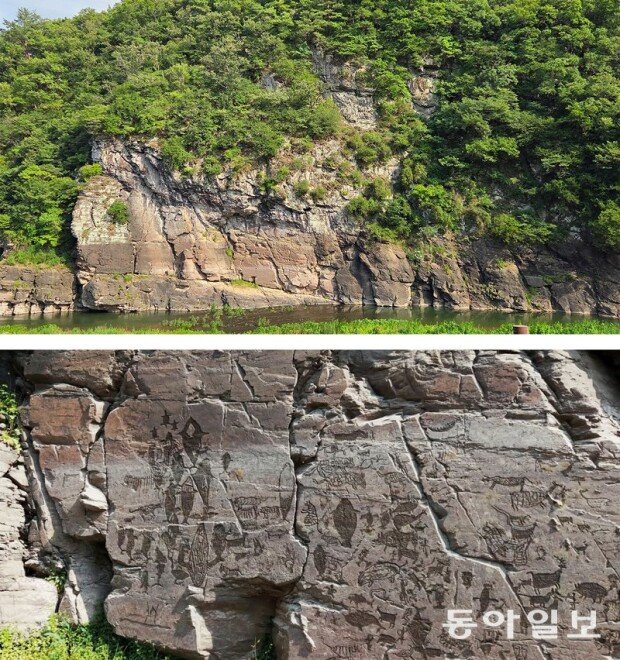
At around 4 p.m. on July 10, sunlight slanted across the rock face in Daegok-ri, Ulsan’s Ulju County, gradually revealing engravings of whales, turtles, tigers, and deer. These prehistoric artworks, carved between 3,000 and 8,000 years ago, began to glow in the afternoon light. Through a telescope, figures of hunters drawing bows and animals behind fences appeared as if they might come to life.
“There are 57 whales, both large and small. You can even distinguish species like gray and humpback whales,” said Jeon Ho-tae, an emeritus professor at the University of Ulsan, who has studied the Bangudae petroglyphs for more than 30 years. He noted that the rock face, measuring 4.5 meters high and 8 meters wide, contains as many as 353 distinct carvings.
“You can see whales with harpoons in their bodies and canoe-shaped boats. These scenes vividly capture how ancient people risked their lives to hunt whales for survival.”
The “Petroglyphs along the Bangucheon Stream” were officially inscribed as a UNESCO World Heritage Site on July 12 (local time) at the 47th session of the World Heritage Committee held in Paris. The designation covers two key sites: the Bangudae Petroglyphs and the Cheonjeon-ri Inscriptions and Petroglyphs. The committee praised the listing as a “masterpiece rooted in exceptional observation and creativity” that depicts the rare theme of whale hunting, calling it “a unique testament to the enduring tradition of petroglyphs spanning thousands of years.”
The inclusion comes 15 years after the site was added to the tentative list in 2010. At the time, the surrounding willow trees were waist-high; now, they tower several meters. Kim, a docent who has worked there for 18 years, said, “After the inscription was recommended in May, we’ve seen up to 700 visitors a day on weekends.” Another guide, Hwang, noted a sharp rise in international visitors, including tourists who travel exclusively to visit World Heritage Sites.
Roughly two kilometers from Bangudae lies the Cheonjeon-ri site, which can be reached in about 10 minutes by car or a little over an hour on foot via a hiking trail. A large rock measuring 2.7 meters high and 9.8 meters wide near a fossilized dinosaur footprint is engraved with over 600 images, including geometric patterns, mounted warriors, and animal pairs. The mounted figures are believed to be associated with the spread of horseback culture in Silla between the 4th and 6th centuries.
An inscription carved into the lower part of the rock also holds historical significance. It records that in the year 525, Sabuji Galmunwang, the brother of King Beopheung of Silla, along with a group of royal officials, named the valley “Seoseokgok” (Valley of Writing on Stone). Professor Jeon explained, “The fact that Silla royalty, Hwarang warriors, and monks visited this remote area to leave inscriptions may suggest they sought divine blessings.”
With Bangucheon’s petroglyphs now on the World Heritage list, attention is turning to how best to preserve their beauty and intricate detail. The World Heritage Committee recommended formalizing the role of local communities and residents in the management system.
“Unlike other petroglyph sites that are remote or restricted, this one is relatively accessible and has been damaged several times,” Professor Jeon warned. “Like the Alta petroglyphs in Norway, we need to form local partnerships to ensure year-round monitoring and protection.”
The listing brings South Korea’s total number of UNESCO World Heritage Sites to 17. Starting with the inscription of Seokguram Grotto and Bulguksa Temple in 1995, the list now includes 17 sites, including 15 cultural heritage sites such as the Royal Tombs of the Joseon Dynasty (2009) and the Gaya Tumuli (2023), and two natural heritage sites.
President Lee Jae-myung welcomed the designation, saying, “It is now a heritage that humanity must preserve together, beyond just South Korea.” He added, “We must ensure the preservation and management meet international standards and explore ways for it to contribute to the local economy.”
울산=이지윤 기자 leemail@donga.com








 About Dong-A Ilbo