

Dementia diagnoses surge among elderly married couples
Dementia diagnoses surge among elderly married couples
Posted July. 01, 2025 07:52,
Updated July. 01, 2025 07:52
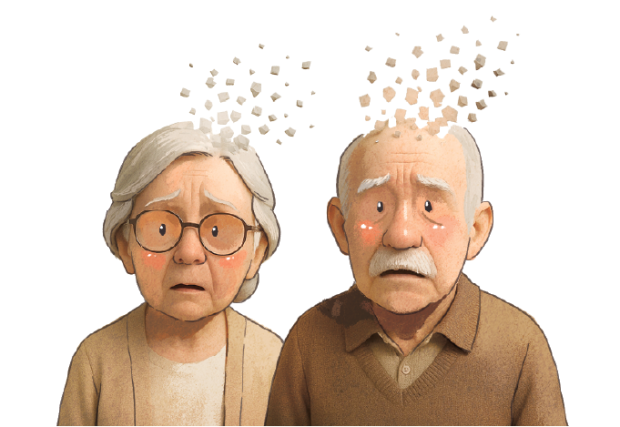
“Where’s the kitchen?”
When a 76-year-old woman, surnamed Lee, heard her husband ask this question in April last year, her heart sank. He had simply wanted her to move the meal tray to the kitchen, as usual, but he couldn’t remember where it was. Her 81-year-old husband, Na, was soon diagnosed with Alzheimer’s disease. The news was especially devastating because Lee herself had been diagnosed with early-stage dementia four years earlier.
“It felt like my world was falling apart,” Lee said during an interview at Samsung Medical Center in Seoul’s Gangnam District on June 19. “My own memory is fading, and now my husband has dementia, too. How are we supposed to keep going?”
As South Korea becomes a super-aged society, with 20 percent of its population now over the age of 65, the number of elderly couples in which both spouses have dementia is rising sharply. According to data obtained by The Dong-A Ilbo from the National Health Insurance Service, the number of "companion dementia" patients, defined as those who are the second person in a household to be diagnosed, rose from 2,857 in 2019 to 5,327 in 2023. That marks an 86 percent increase over four years. Most of these cases involve elderly married couples.
These couples often experience severe disruptions to daily life as both spouses gradually lose their memory. Some have narrowly avoided house fires, while others struggle to visit the hospital on their own. In in-depth interviews conducted this month with three such couples and their adult children, many said, “Everyday life itself is painful because there’s no one to properly care for us.”
Research also indicates that when one spouse develops dementia, the likelihood of the other doing so may double. Experts are urging the government to expand support. “We urgently need tailored systems that can strengthen elderly-to-elderly care,” said Chung Jae-hoon, a professor of social welfare at Seoul Women’s University.
이채완 기자 chaewani@donga.com





 About Dong-A Ilbo