

Lee tells business leaders: Economy comes first
Lee tells business leaders: Economy comes first
Posted June. 14, 2025 07:02,
Updated June. 14, 2025 07:02
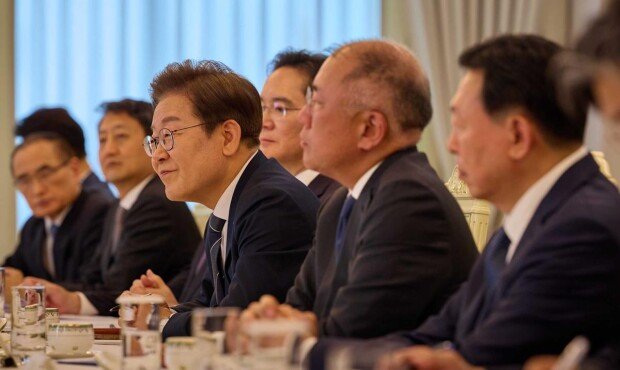
President Lee Jae-myung met with South Korea’s top business leaders on Friday, underscoring his commitment to economic revitalization and corporate support. It marked his first formal meeting with business representatives since taking office nine days ago.
“Ultimately, the key to people’s livelihoods is the economy, and the core of the economy is the corporate sector,” Lee said during a roundtable at the presidential office. “The government’s most important role is to actively support and cooperate so that companies can contribute to economic growth and successfully run their businesses,” he added, pledging full backing for the private sector.
Lee stressed that his top priority over the next five years would be reviving the economy. “If we revitalize the economy, the public will regard my presidency as a success,” he told participants, according to several attendees.
The roundtable brought together the heads of the country’s five largest conglomerates: Samsung Electronics Chairman Lee Jae-yong, SK Group and Korea Chamber of Commerce and Industry (KCCI) Chairman Chey Tae-won, Hyundai Motor Group Chairman Chung Eui-sun, LG Group Chairman Koo Kwang-mo, and Lotte Group Chairman Shin Dong-bin.
Also in attendance were leaders of major economic organizations: Federation of Korean Industries Chairman Ryu Jin, Korea Enterprises Federation Chairman Sohn Kyung-shik, Korea International Trade Association Chairman Yoon Jin-sik, KBIZ Korea Federation of SMEs Chairman Kim Ki-moon, and Federation of Middle Market Enterprises of Korea Chairman Choi Jin-sik.
Addressing trade policy, Lee emphasized a pragmatic and flexible approach. “We will respond decisively to current challenges,” he said, referring to South Korea–U.S. trade issues. Presidential spokesperson Kang Yu-jung added that Lee and U.S. President Donald Trump had agreed during a June 6 phone call to pursue a swift, mutually satisfactory resolution on tariff concerns, with working-level talks set to accelerate.
Lee also pledged to cut red tape and create a more business-friendly environment. “We plan to boldly eliminate unnecessary regulations that only serve administrative convenience,” he said, reaffirming his goal of regulatory rationalization. On his first day in office, Lee had announced a shift to a “negative-list” regulatory system, which permits all corporate activity unless explicitly prohibited by law.
Responding to calls for inter-Korean economic cooperation, Lee noted the recent halt in North Korean loudspeaker broadcasts following South Korea’s own suspension. “This kind of atmosphere is necessary,” he said. “We will proceed step by step, starting with actions close at hand.”
Business leaders voiced support for Lee’s agenda. “If the public and private sectors join forces under the president’s leadership, we can definitely overcome the current economic crisis,” said Samsung Chairman Lee Jae-yong. “Samsung will faithfully carry out its planned domestic investments and hiring.”
“We in the business community will work closely with the government to seek solutions,” said SK Chairman Chey Tae-won. “I’m sure both the president and the new administration are giving much thought to coordinating trade and industrial policies.”
Hoon-Sang Park tigermask@donga.com





 About Dong-A Ilbo