

Brain drain threatens South Korea’s scientific competitiveness
Brain drain threatens South Korea’s scientific competitiveness
Posted May. 28, 2025 07:54,
Updated May. 28, 2025 07:54
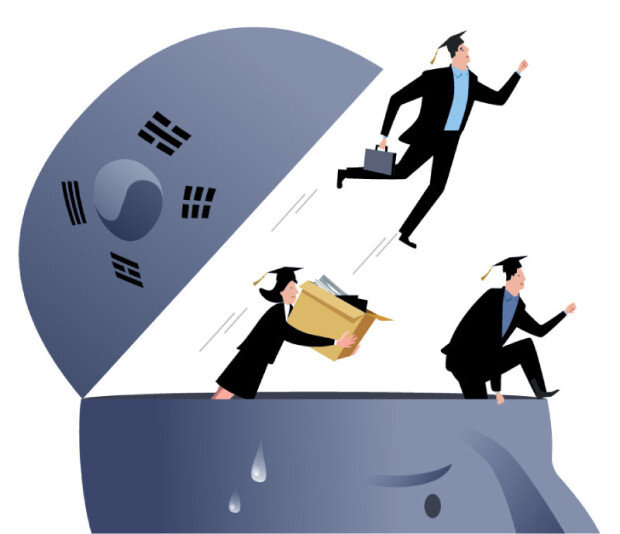
Amid intensifying global competition for scientific talent, a growing number of South Korea’s top researchers are either working abroad or actively considering overseas offers, raising alarm about a brain drain that the country appears unprepared to stop.
A survey by The Dong-A Ilbo of 200 members of the Korean Academy of Science and Technology found that 61.5 percent (123 scientists) had received offers from foreign institutions. Of those, 42 percent (52 individuals) said they had accepted or were seriously considering them. Among the 77 respondents who had not received such offers, 83 percent (64) said they would give serious consideration if approached.
The findings underscore a troubling trend: more than half of the nation’s top scientists are either abroad or willing to leave, threatening South Korea’s long-term competitiveness in science and technology.
China was the most frequent recruiter, cited by 82.9 percent of those who had received offers. The United States followed at 26.8 percent, with Singapore third at 10.6 percent. (Respondents could name more than one country.)
Motivations varied by age group. Younger scientists aged under 54 pointed to significantly better working conditions abroad, including higher salaries, improved facilities, and more robust research funding. Older researchers, particularly those nearing or past retirement, cited the lack of institutional support in South Korea for continuing academic work later in life.
As the U.S.-China rivalry in science and technology intensifies, foreign institutions are increasingly customizing recruitment strategies to the individual needs of researchers. “China, in particular, has a deep understanding of Korea’s situation,” said Kim Geun-soo, a physics professor at Yonsei University. “They offer shockingly high salaries and generous grants to younger faculty, and provide stable, long-term positions to senior scientists looking to continue their work.”
Observers warn that unless South Korea strengthens support for its researchers, both financially and institutionally, it risks losing key talent to global competitors.
최지원기자 jwchoi@donga.com

![[사설]당 대표의 ‘기괴한 알박기’에 꼼짝 못 하는 국민의힘](https://dimg.donga.com/c/138/175/90/1/wps/NEWS/IMAGE/2026/06/29/134205596.1.jpg)

![[횡설수설/장원재]日 월드컵 감독은 고졸 비주류](https://dimg.donga.com/c/138/175/90/1/wps/NEWS/IMAGE/2026/06/29/134205606.1.jpg)




 About Dong-A Ilbo