

Hyundai says IONIQ 5 battery holds up after 580,000 Km
Hyundai says IONIQ 5 battery holds up after 580,000 Km
Posted May. 02, 2025 07:23,
Updated May. 02, 2025 07:23
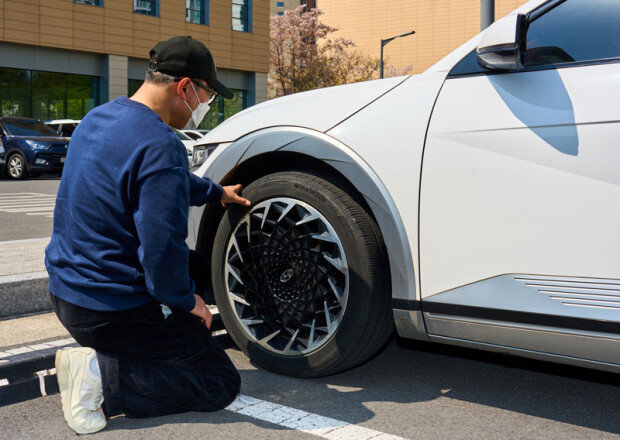
Hyundai Motor said an IONIQ 5 electric SUV driven 580,000 kilometers over nearly three years has retained battery performance within the normal range. The company said the result shows Hyundai's batteries remain durable even under extreme driving conditions.
On Thursday, Hyundai said it collected and analyzed a long-range IONIQ 5 owned by Lee Young-heum, 46, a sales representative who drove daily between the Seoul metropolitan area and other regions. After the analysis, Hyundai replaced the vehicle’s battery free of charge. When collected last July, the car — purchased in November 2021 — had logged 580,000 kilometers, marking the highest mileage recorded for an IONIQ 5. Lee reported no mechanical failures or part replacements during that time.
The analysis showed the battery retained 87.7% of its original capacity, well within the normal performance range. Considering that cars are typically retired after about 200,000 kilometers of driving, Hyundai said the results demonstrate the battery’s resilience under extreme use.
"Hyundai and Kia electric vehicles are developed based on the most extreme conditions," said Yoon Dal-young, lead researcher at Hyundai. "We aim to meet performance standards much stricter than warranty requirements, and the 87.7% remaining life matches predictions from our internal battery lifespan models."
Lee’s IONIQ 5 has now reached 660,000 kilometers in total mileage. Hyundai estimated that, compared to driving a gasoline-powered vehicle over the same distance, Lee saved about 30 million won, or $22,000, in operating costs. Based on the average gasoline price of 1,702 won per liter over the past three years and the Tucson’s fuel efficiency of 13.9 kilometers per liter, fuel costs would have totaled about 80 million won. In contrast, charging costs for the IONIQ 5 — which averages 4.6 kilometers per kilowatt-hour — were estimated at around 50 million won.
김형민기자 kalssam35@donga.com




![[오늘의 운세/7월 2일]](https://dimg.donga.com/c/138/175/90/1/wps/NEWS/IMAGE/2026/07/02/134221102.1.jpg)



 About Dong-A Ilbo