

North Korea launches 5,000-ton Aegis-style destroyer
North Korea launches 5,000-ton Aegis-style destroyer
Posted April. 28, 2025 07:50,
Updated April. 28, 2025 07:50
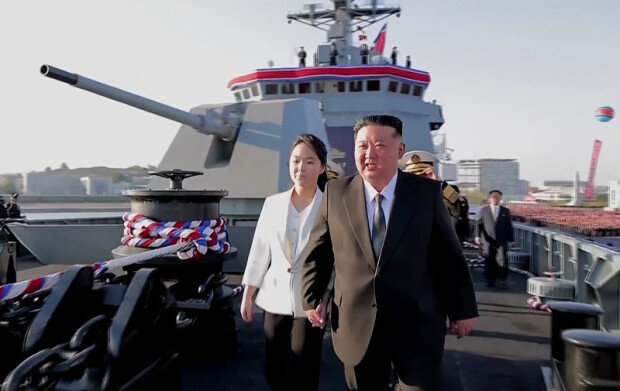
North Korea has held a launching ceremony for a new 5,000-ton multi-purpose destroyer, dubbed the "North Korean Aegis destroyer," with leader Kim Jong Un in attendance. This marks the first time the North has unveiled a large destroyer capable of conducting integrated combat operations. Given Kim’s indication that the destroyer could carry nuclear warhead-equipped missiles, experts warn it could pose a new nuclear threat to the United States and South Korea.
The Rodong Sinmun reported on April 26 that the launching ceremony for the new destroyer took place at the Nampo Shipyard on April 25, commemorating the founding anniversary of the Korean People's Revolutionary Army. Last month, North Korea released photos showing Kim inspecting two destroyers under construction at the shipyard, and this vessel appears to be one of them. North Korea named the ship "Choe Hyon Ho," after Choe Hyon, a guerrilla fighter who fought alongside Kim Il Sung. "Ho" is a Korean term commonly attached to ship names.
Kim attended the ceremony with his daughter, Ju Ae, and declared in a speech that "the launch of this destroyer has opened a breakthrough for the modernization of our naval forces." He claimed the ship is equipped with systems to enhance capabilities against aerial, maritime, submarine, and ballistic missile threats, as well as with offensive weapons, including supersonic strategic cruise missiles and tactical ballistic missiles for striking land targets. If true, this indicates the destroyer could intercept a range of attacks while also launching nuclear strikes, given North Korea’s past claims that its strategic and tactical missiles can carry nuclear warheads.
Experts analyzing released photos identified 74 vertical launching systems (VLS) aboard the ship, indicating it could fire a variety of missiles. Of these, about 40 appear large enough to accommodate ballistic or cruise missiles.
Kim also emphasized plans to construct more combat vessels of this class next year, aiming to achieve "blue-water operational capability" and build the "strongest naval force." South Korean military authorities are watching closely, noting the possibility that North Korea could accelerate destroyer and submarine construction with technical assistance from Russia.
Despite these developments, most analysts agree that North Korea’s naval power remains vastly inferior to that of South Korea and the U.S. navies. South Korea alone operates three Sejong the Great-class Aegis destroyers (7,600 tons each), each equipped with more than 100 VLS cells. In addition, the three even more powerful King Jeongjo-class (8,200-ton) Aegis destroyers are scheduled to begin deployment, starting with the first ship at the end of this year. The U.S. Navy’s Aegis destroyers are considered the most advanced in the world. Lim Eul-chul, a professor at Kyungnam University’s Institute for Far Eastern Studies, said the possibility of nuclear armament is aimed at exerting psychological and strategic pressure on South Korea, the United States, and Japan, while blue-water capabilities suggest an intention to influence the Pacific power balance through cooperation with China and Russia. "It is also a means to boost internal unity by showcasing military achievements despite ongoing economic hardships," he said.
Kim further said, "The second signal for strengthening naval power will be the construction of a nuclear-powered submarine." North Korea had previously released images of Kim inspecting the construction site of a "nuclear-powered strategic guided-missile submarine," fueling speculation that Pyongyang may have received key technologies from Russia in exchange for troop deployments. However, South Korean military assessments suggest it would be virtually impossible for North Korea to complete a nuclear-powered submarine capable of extended underwater operations and surprise nuclear attacks in the short term.
Attention is also drawn to Kim's mention of operating the Choe Hyon Ho in a "mid-line maritime zone." Previously, North Korea had ignored the Northern Limit Line (NLL), established in the West and East Seas, instead emphasizing its self-proclaimed "security line" south of the NLL. North Korea’s reference to a "mid-line maritime zone" marks the first time such a concept has been mentioned, raising concerns that Pyongyang may soon stage provocations around the NLL in an attempt to assert a new maritime boundary.
Hyo-Ju Son hjson@donga.com






 About Dong-A Ilbo