

Over 1.12 million K-beauty fakes found in 2024
Over 1.12 million K-beauty fakes found in 2024
Posted February. 25, 2025 07:55,
Updated February. 25, 2025 07:55
As K-beauty continues its global success, with South Korea's cosmetics exports hitting a record high of $10.2 billion last year (up 20.6% year-on-year), the industry is grappling with a growing counterfeit problem. Imitation products are rampant on Chinese e-commerce platforms such as AliExpress and Temu, raising concerns that these low-quality counterfeits could damage consumer perception of Korean beauty brands.
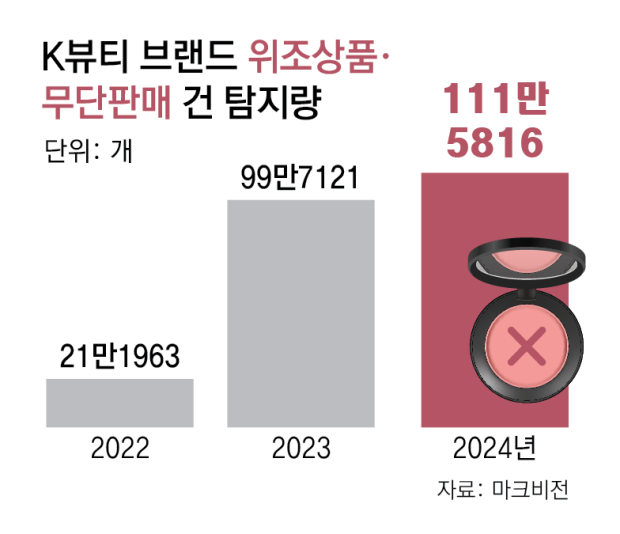
AI-based brand protection firm MarqVision identified 1,115,816 suspected counterfeit K-beauty products across more than 1,500 online sales platforms in 80 countries last year. However, only 88,392 cases were officially reported by cosmetic companies and subsequently removed. The number of suspected counterfeit items has steadily increased, from 211,963 in 2022 to 997,121 in 2023.
Popular overseas K-beauty brands such as Anua, Beauty of Joseon, TIRTIR, and Biodance are working with private firms like MarqVision to detect counterfeit products while also conducting their own continuous monitoring efforts. A representative from The Founders, the distributor of Anua, stated, "Counterfeit products have been discovered in the Middle East, the U.S., and China. In the second half of last year, authorities in Zhaoqing, China, uncovered a factory producing more than 2,100 fake versions of Anua's signature Heartleaf Cleansing Oil."
TIRTIR, which gained prominence on Amazon with its "Red Cushion" product, has implemented barcode stickers on its packaging to authenticate genuine products. A company representative explained, "We continuously monitor design theft and counterfeit sales, taking legal action when necessary."
Similarly, the skincare brand SKIN1004 has integrated product authentication technology and educates consumers on counterfeit detection via social media. Meanwhile, dedicated K-beauty enthusiasts are also playing a role in combating counterfeits by creating content on how to distinguish fake products, advising others to "check the lid shape" or "look for differences in texture."
E-commerce platforms claim to take a firm stance against counterfeits, but enforcement remains challenging. As most platforms operate as open marketplaces, they typically remove listings of illegal products upon detection and require sellers to provide evidence of authenticity.
An AliExpress spokesperson noted, "We are strengthening counterfeit monitoring through AI technology and actively collaborating with regulatory agencies and businesses worldwide." However, an industry insider admitted, "Despite our efforts, we lack sufficient manpower, and some sellers cleverly mix genuine and fake products, making detection difficult."
Experts suggest a collaborative approach since many K-beauty leaders are small to mid-sized enterprises with limited resources to combat counterfeiting. A beauty brand representative remarked, "Currently, each company bears the cost of tracking and taking action against counterfeits independently. A shared system for counterfeit detection or information-sharing among brands could significantly improve enforcement efficiency."
이민아기자 omg@donga.com


![“1000만원 줄 테니 나가달라”…집주인 제안, 받아도 될까 [집과법]](https://dimg.donga.com/c/138/175/90/1/wps/NEWS/IMAGE/2026/06/19/134130634.3.jpg)
![‘월급 50만원, 아파트는 4억’ 베트남…청년들 “그냥 평생 월세 살란다”[딥다이브]](https://dimg.donga.com/c/138/175/90/1/wps/NEWS/IMAGE/2026/06/19/134141662.1.png)



 About Dong-A Ilbo