

ElectroWater, "We will lead innovation in water treatment like Tesla does”
ElectroWater, "We will lead innovation in water treatment like Tesla does”
Posted February. 21, 2025 11:09,
Updated April. 11, 2025 08:00
According to data from Fortune Business Insights, the global water treatment market grew from $323.32 billion (approximately 470.27 trillion won) in 2023 to $346.41 billion (approximately 503.85 trillion won) in 2024. By 2030, it is projected to grow by 50% to $536.41 billion (approximately 780.21 trillion won). The cost of obtaining clean water is steadily increasing, driven by issues such as climate change and pollution. This underscores the necessity of focusing on efficient water treatment solutions.
ElectroWater is a startup company dedicated to overcoming the limitations of existing water treatment technologies through electricity-based solutions. They are focusing on business based on their proprietary technology for large-capacity flow electrode ion adsorption. Furthermore, they plan to expand their scope of application to various electric water treatment technologies, including ▲ electrical coagulation ▲ electrical oxidation ▲ electrical disinfection.
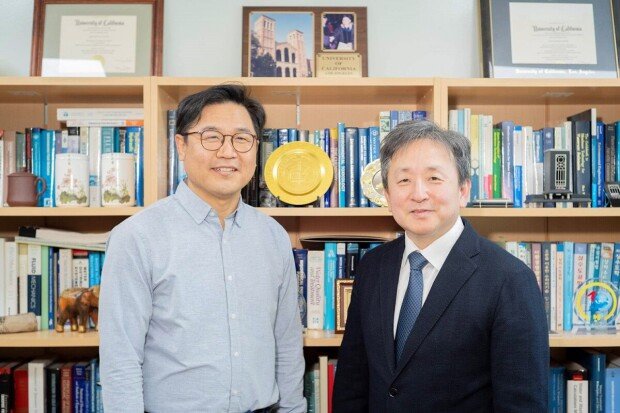
Hyeon-Cheol Heo, CEO of ElectroWater(left), and Seung-Gwan Hong, CTO(right)
Two experts have come together to pioneer a new concept in the water treatment market
Hyeon-Cheol Heo, CEO of ElectroWater, and Seung-Gwan Hong, CTO, first met as student and professor at Korea University. This encounter eventually led to the founding of their business. It is also noteworthy that both are veterans with extensive knowledge and expertise in the field of water treatment. Heo has accumulated practical experience through his work at Toray Advanced Materials Korea, the Seoul Waterworks Research Institute, and Hyorim Industry. Hong is a scholar who has held positions as a professor at the University of Central Florida, a professor in the Department of Architectural, Social, and Environmental Engineering at Korea University, the director of the Korea University graduate school of Energy Technology, and the head of the technology development research team for low-energy seawater desalination plants in the Middle East.
The reason for Hong’s joining as CTO is particularly intriguing. He said, "as a scholar and educator, I have made numerous efforts to create foundational knowledge in the environmental field and to cultivate talent. While I have achieved many academic successes, my desire for innovation in future water treatment technology continues to grow." In other words, the aspiration to implement the knowledge and skills he envisioned before the end of his career has led him to embark on the path of entrepreneurship.
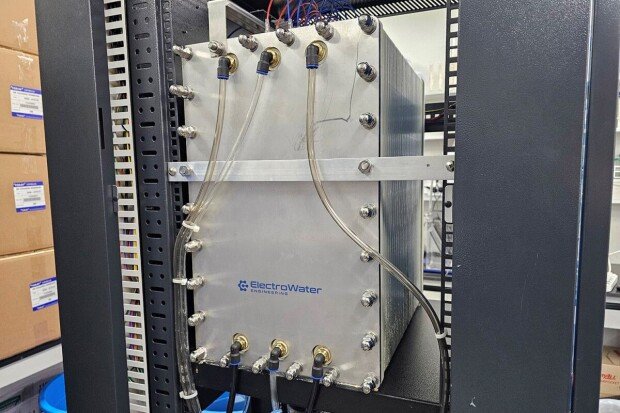
FCDI water treatment system developed by ElectroWater
ElectroWater has proposed an electrochemical water treatment process integrated with renewable energy. While the transition to renewable energy is underway due to climate change, it is important to note that low power sources are dispersed, in contrast to centralized power plants. The technology that has emerged from this consideration is the FCDI (Flow Electrode Capacitive Deionization System).
FCDI uses the principle that ions move between the anode and cathode when current is passed through water. Negative ions migrate to the anode, while positive ions move to the cathode. These separated ions are then selectively filtered through an ion permeable membrane. It is advantageous in terms of energy efficiency because only the ions can be attracted to each other for separation and concentration, leaving the water unchanged.
The latest advanced water treatment methods use membrane filters, including reverse osmosis. Pressure is required to remove pollutants from water using filters with fine pores, which consumes a significant amount of energy. ElectroWater operates with low currents of less than 1A, resulting in exceptional energy-saving benefits.
ElectroWater selected activated carbon to enhance the effectiveness of water treatment. While activated carbon adsorbs substances based on molecular weight, it does not adsorb ions such as sodium, calcium, and chloride. However, they discovered that applying electricity to activated carbon transforms it into a supercapacitor, endowing it with the ability to adsorb ions. Consequently, they initiated the development of a water treatment system that integrates two principles: ion permeability and supercapacitor technology.
CEO Heo stated, "The ability to selectively separate and concentrate ions indicates that this technology could be utilized in the resource and seawater industry in the future. We are also applying this technology to the recovery of lithium from secondary batteries. However, most research and development is currently being conducted using small-scale test equipment developed by research institutes, it has not been commercialized yet. We have successfully developed a large-capacity module that is applicable at the commercial stage and has already been launched in the market."
Dreaming of Tesla in the water treatment industry
ElectroWater will initially target markets that require ion removal with electric-powered water treatment equipment. They will focus on areas that are easily accessible and do not demand large capacities. Key examples include the removal of groundwater hardness and desalination for the supply of agricultural and industrial water. Additionally, it will encompass the domestic smart-farm sector and the overseas water softener facility market. The pricing will be reduced to 60% to 70% of the cost of existing water treatment systems to enhance competitiveness.
Heo, who has extensive overseas experience, plans to concentrate his efforts on international markets, including Southeast Asia. He stated, "In Vietnam's Mekong Delta, when there is no rain, seawater rises and becomes unsuitable for drinking. We will deploy electro-water treatment equipment there to remove the salt, enabling Vietnamese to drink clean water."
ElectroWater was able to develop next-generation water treatment equipment and target overseas markets thanks to the support of Korea University's initial startup package program. Since its inception, ElectroWater has collaborated closely with Korea University's Crimson Startup Support Foundation, receiving a range of assistance that includes customized mentoring programs, domestic and international investment activities (IR), demo-day preparation, and connections to investor meetings. Heo stated, "The meticulous support of Crimson Startup Support Foundation has greatly contributed to ElectroWater's growth and visibility. Above all, the numerous connections with foreign investors have been instrumental in attracting investment."
ElectroWater aspires to be the Tesla of the water treatment industry. Just as Tesla transformed the market paradigm by introducing innovative electric vehicles, they express their determination to lead market innovation with its next-generation water treatment system. To achieve this goal, they will continuously improve the performance of the water treatment system. Hong said, "We consider the current water treatment module to be version 1.0. We will keep incorporating better theories and technologies and upgrade it to version 2.0 and version 3.0, just as Tesla consistently enhances its performance and capabilities." Heo added, "Unlike in Korea, the overseas water treatment market is growing and developing around small and medium-sized engineering companies. We aim to evolve into an engineering company that encompasses everything from new technologies to materials and manufacturing."
By Hyung Seok Kang (redbk@itdonga.com)







 About Dong-A Ilbo