

Buddha’s story hidden in Daeungjeon of Beomeosa Temple
Buddha’s story hidden in Daeungjeon of Beomeosa Temple
Posted February. 20, 2023 07:34,
Updated February. 20, 2023 07:34
Visitors to a Buddhist temple, whether they are a believer or a mere traveler, may with no exception take a look around Daeungjeon, the main building of the temple. However, few are likely to get a profound grasp of the spirits of pure land Buddhism and Buddha’s soul engraved in every single stone step. “Bulgukto Spirit at Daeungjeo,'' published by Beomeosa Sungbo Museum, shares detailed stories of Daeungjeon, a place open to anyone but often left vaguely understood.
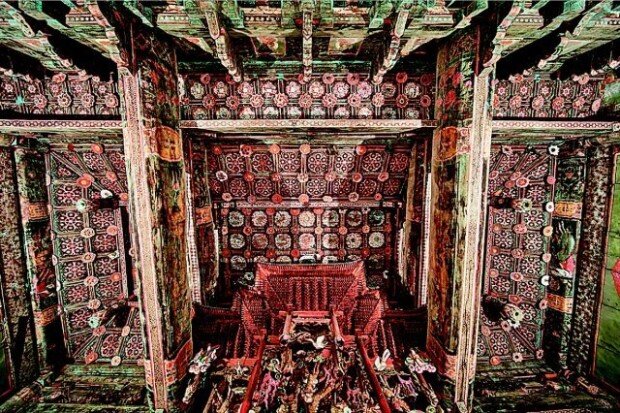
Built in 1602, Daeungjeon of Beomeosa Temple is one of the oldest wooden structures in the Busan area. Figures of dragons, phoenixes, cranes, clouds, and flying devas hanging under the roof above the Buddha's statue represent the heavenly world visualized based on imagination. Daeungjeon, which means a "great hero,” is a gabled architecture that serves the Buddha. The gable roof of Daeungjeon looks more humble than the roof part of Bojeroo, which is situated right in front of the main building. Nevertheless, it stands more triumphantly and confidently than the latter as the gabled architecture has an outstanding presence thanks to the geographically desirable and harmonious arrangements of the gongpo, a bracket with more than two bracket wings; wall paintings decorating the inner and outer parts of the four sides; column systems; and ceiling parts.
The gable roof, also referred to as the matbae jibung, is one of the simplest forms. The main buildings in places have the hip-and-gable roof, also known as the paljak jibung, while auxiliary facilities are equipped with the gable roof. Given the significance of Daeungjeon, the paljak jibung might have been the best fit. However, understandably, it was right before the Japanese invasions of Korea, commonly known as the Imjin War, when the temple's main building was built in 1602. In the severely afflicted Dongrae area, the matbae jibung was applied to most temples, which were established around then because it was the more affordable option than the paljak jibung. This book also explains how the Sumidan, the front altar of the main hall, as well as ornamental objects helps pursue the tradition of enshrining the object of worship; and in what way this religious ritual altar demonstrates the values of the times.
Chin-Ku Lee sys1201@donga.com








 About Dong-A Ilbo