

Rival Authors
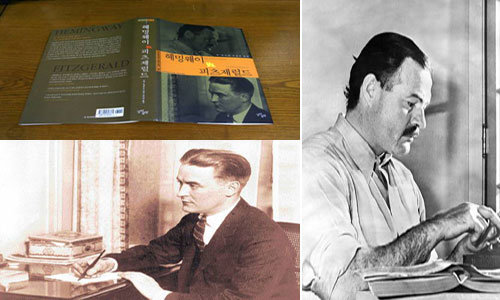
If you were asked to choose the greater writer between F. Scott Fitzgerald, the author of The Great Gatsby, and Ernest Hemingway, the author of A Farewell to Arms, you would find the question ridiculous. Still, some might venture to answer that it is Hemingway because he received the Nobel Prize in Literature. Others might raise major objections, saying that Random House listed The Great Gatsby as the second best novel of the 20th century, and Hemingways The Sun Also Rises and A Farewell to Arms as the 45th and the 74th, respectively.
However, the two writers held views of each other, different from those held by their observers. This book that depicted the friendship and rivalry of the two writers provides an answer to the question asked above. Hemingway is the greater one among the two.
Why is it Hemingway?
In stark contrast to Fitzgerald, who was fair-haired and skinny, stood at 172cm and weighed less than 65kg, Hemingway was dark-haired and handsome, and 180cm-tall at 85kg. Moreover, Hemingway was charismatic beyond imagination. Everyone, men and women, young and old, liked him. But Fitzgerald was very awkward in relating to fellow men in particular. He used to turn other men into heroes, which often made it uncomfortable for both parties.
For readers who are familiar with these two writers works, it would be quite easy to imagine Hemingway as a macho type and Fitzgerald as more like a metro sexual type. Yet, the two had strikingly a lot in common. Both of them came from middle-class families in the Midwest. Both of them held antipathy toward their parents. They both drew literary inspiration from broken relationships in younger years. Interestingly, both relied heavily on alcohol.
When they first met in Paris in 1925, on the surface, Fitzgerald, who was four years older than Hemingway, was more famous. Though a dropout, Fitzgerald attended Princeton and built a certain amount of reputation as a writer. In contrast, Hemingway, a high school graduate, just published a single short story thanks to Fitzgeralds strong recommendation.
Nonetheless, Hemingway was the one who always exuded confidence, and Fitzgerald was the one who always tried to win the heart of Hemingway. Fitzgerald appeared so desperate that those around them even said, To the eyes of grownup men, Fitzgeralds admiration for Hemingway was almost embarrassing.
Hemingway, who felt uncomfortable with Fitzgeralds upper-class aesthetic appreciation, expressed his uneasiness by mounting personal attacks on Fitzgeralds snobbish aspects.
The relationship between them can be characterized by Hemingway being harsh and Fitzgerald suffering. It was Hemingway who brought their friendship to an end. Despite Hemingways decision to break off their friendship, Fitzgerald, in his later years, acknowledged Hemingways talent. He said, I will no longer write. Ernest made all my works useless.
The author, who heads the Hemingway Society, implies his criticism in his book that Hemingway was a cruel, selfish person. And yet, the two are both great writers in that their competition, intensified by the existence of each other, left a rich literary legacy. The book reminds readers of the old saying that art is long; life is short. (The original version was published under the title Hemingway vs. Fitzgerald in 1999.)
confetti@donga.com

![북한군 간호사에서 세계 누비는 사업가 되기까지[주성하의 북에서 온 이웃]](https://dimg.donga.com/c/138/175/90/1/wps/NEWS/IMAGE/2026/05/24/133981366.1.jpg)





 About Dong-A Ilbo