

Uri Economic Reforms Draw Skepticism
Uri Economic Reforms Draw Skepticism
Posted August. 12, 2006 10:21,
I just dont get it, Mr. A, a senior member of Koreas business community I met on August 11, said almost to himself with a bitter smile. His expression revealed how the business community must have felt when they found out that all of the accused business leaders were denied a special August 15 Liberation Day pardon, contrary to their expectations.
It is extremely hard for us to put complete trust in the ruling partys verbal assurances. It is of less importance whether we are hopeful that there will be a boom or the ruling party pledges regulatory reforms. Unless we have a reasonable degree of certainty about the future, we do not invest. But the security risk is getting bigger as disputes erupt over the return of wartime operational control...
Along with the disappointment after the announcement of the special pardon, disagreements between the administration and the ruling Uri Party over regulatory reforms put on the verge of collapse the Korean version of the New Deal Policy. It has been proposed by Kim Geun-tae, Uri Party chairman, in response to sluggish corporate investment.
In addition to the economic factors that fuel uncertainty of businesses, President Roh Moo-hyun remarked, The date for the return of wartime operational control might be moved up. The business community frets that the situation might heighten investment risk.
Spreading Pessimism over Kim Geun-taes Proposal
The ruling party and major economic interest groups resolved to promote investment and create jobs. They also agreed that their resolve must be put into action by granting pardons to business leaders, keeping the interest rate unchanged, abolishing the equity investment cap with no conditions attached, and formulating protective measures against hostile M&A attempts. Still, the agreement has yet to prove itself helpful with investments or the creation of jobs.
The business community is particularly displeased with the list of August 15 special pardons because almost all of the business leaders who asked for a pardon were denied it.
The Korea Chamber of Commerce and Industry (KCCI) made its disappointment public through an official commentary on August 11. It said, It is regretful that the requests by five major organizations representing the business community were not fully taken into consideration of the government concerning the Liberation Day pardon. It is particularly disappointing that nearly all of the prominent business figures, who have contributed significantly to economic growth and their own organizations, were not included in the special pardon.
The Federation of Korean Industries (FKI) adopted a reticent strategy to express their displeasure, which was condensed into a single-line comment, It is deeply regrettable.
One senior member at one of the five business lobbying groups remarked accusingly, They shouldve kept in mind that one of the purposes of the special pardon is to revitalize the economy. It is absolutely unfair to grant pardons to those who were involved in bribery and deny the same privilege to those who are, in fact, victims of unreasonable practices.
It is rumored among some business leaders that Cheong Wa Dae granted fewer pardons than initially planned as a retaliation against the ruling party leadership because it skipped consultation with the government before introducing the New Deal Policy.
The Fair Trade Commission is pursuing the ban on cross shareholding as an alternative to the equity investment cap. If enacted, the ban will require Koreas largest conglomerates to sell their stakes among their affiliates, which would put an end to their corporate governance as it is now. Though the business leaders maintain that an abolition of the limits on equity investments will free up 14 trillion won for investment, their argument sounds less well grounded.
Divided over the Deregulation
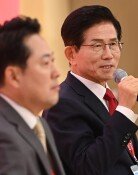
On August 9, Uri Party Chairman Kim met the representatives from the FKI and declared, The ruling party will exercise its legislative power to accommodate many of the deregulatory requests from the business community.
However, President Roh expressed his disapproval to this by pointing out, Kim made such remarks without discussion. The pro-president politicians in the ruling party raised their voices to support the president. They protested, saying, The public pledge is designed to revive the economy not for the working class, but for the wealthy (or chaebols). Meanwhile, those in the business circle are quite skeptical about the governing partys legislative power Kim mentioned during their meeting.
Another business leader did not hide his disappointment by saying, It is rather irresponsible for the ruling party to start a dialogue with business interests without securing full authority over deregulation. It shouldve first gone through consultations with Cheong Wa Dae, government ministries and opponents within the party.
Under the circumstances, heads of major conglomerates are giving a second thought to their meetings with Chairman Kim on a one-to-one basis. An executive from one of the four largest corporations said, The discussion is under way whether its appropriate to meet the leader of the ruling party at this point.
Return of the Wartime Operational Control and Growing Investment Risk-
An increasing number of business people are wringing their hands over the presidents remarks on the return of wartime operational control at an earlier date.
Observers point out that the president helped raise investment risk by mentioning the operational control issue when the investment environment is already in bad shape. Currently, outflows of direct investment are on the steep rise while foreign direct investment into the country remains static.
A CEO emphatically said, We could draw large amounts of investment despite the security situation on the peninsula because of our security alliance with U.S., as corporate investors inside and outside the country make their investment decisions based on the stability on the peninsula enabled by the presence of the USFK, not on Koreas own defense capabilities.
sunshade@donga.com

![[사설]‘33년 적자’ 공무원연금, 개혁 더는 못 미룬다](https://dimg.donga.com/c/138/175/90/1/wps/NEWS/IMAGE/2026/04/28/133831177.1.jpg)


 About Dong-A Ilbo