

Feast
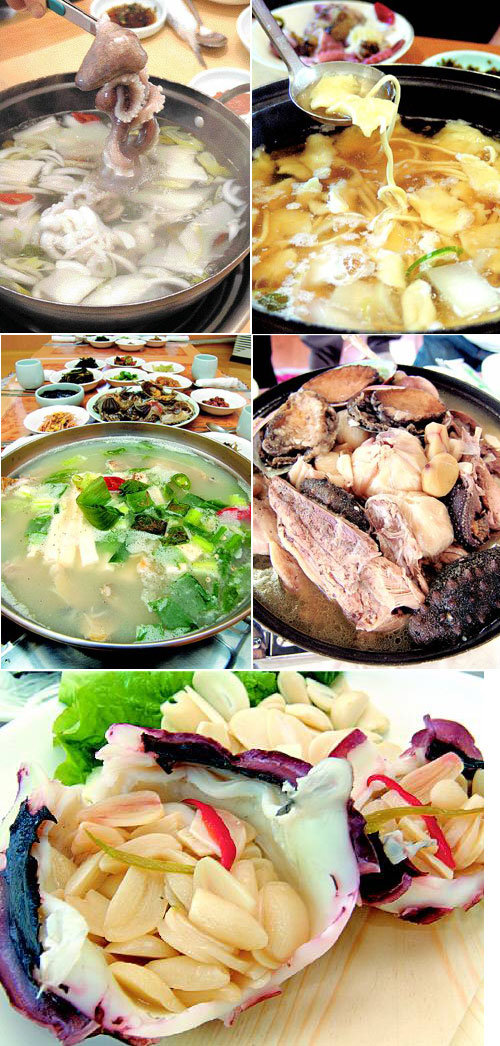
The mouth is happy in Taean, South Chungcheong Province. There is such a great variety of food that even if the heavens came crashing down they wouldnt run out of customers. In January: fish, mullet, oyster, angler. In February: flounder and clams. In March: clam and icefish. In April: mollusks and greenling. In May: squid and crab. Theres something all year long.
In June, Taean squid and octopus are in season. Taean has the most variety in octopus. Mokpos thin-armed raw octopus, Yeongam (Dokcheon)s galnak soup, Muans octopus attack (eating live octopus with a dipping sauce of makgeolri (rice wine), vinegar and soy sauce), and spicy fried octopus of Mugyo-dong, Seoul are popular.
Taeans versions of octopus are gourd flesh octopus and wheat soup octopus. Right now is the spawning season for octopus where it lays its eggs and finishes its short one-year life. At the same time, thin armed octopus season begins. Gourd flesh octopus involves boiling the octopus in the clear liquid that comes out of the inside of the gourd to make a soup. This refreshing soup is unforgettable. Would it have worked elsewhere besides Taean?
Milguk (wheat soup) involves making sujebi (clear soup with wheat flakes) using octopus soup broth. It was a dish developed after the barley hump, infusing recently harvested wheat from the farm with the nourishment of octopus during a difficult period.
At the entrance of the Wonbuk-myeon, Taean, Samgeori Hanushikgwan is a popular restaurant for Wonbuk gourd flesh octopus soup. Owner Cho Gyu-su says, After eating the gourd flesh octopus soup, we serve milguk by inserting noodles and sujebi into the boiling soup, adding, The secret of the gourd flesh octopus soup is that each house uses its own octopus and soup, but there are many places that use imported octopus, so it is recommended to eat it near the sea. A single portion is 13,000won (for 1.5 big octopi).
In Taean they have many styles of land and sea folk dishes. The most famous is the Six-piece garlic. This dish was at first edged out by the Seosan six-piece garlic, but now has earned its own reputation. Its origins are as follows.
The origin of the Seosan six-piece garlic is Taean. In 1989, before Taean was elevated to a county, because it was affiliated with the Seosan district, it was known as Seosan garlic. The Taean 6-piece garlic cooking festival that begins on June 16 is an event that will publicize Taean as the origin of six-piece garlic. This was Taean county official Song Sook-hyuns explanation. Six-piece garlic began harvesting June 10.
Next to the Mongsanpo swimming beach, is Mongdaepos Mongdae Fish House. Here they stuff squid belly full of garlic and serve steamed garlic squid. Its not on the menu so you have to order it separately. At Samgwanghoi town (Naeri), a restaurant located in northern Taean peninsula, they put in six-piece garlic in heaps and boil it together with abalone, sea cucumber, roots and boiled chicken to make Jeongye soup.
Jeongye soup is a native dish developed by a community consisting of Taeans county officials for Eating Heaven Taean. Taste of the soup is second to none, but more attention is paid to its high-quality nutrition coming from garlic, white root, and jujubes combined with the chicken, abalone, and sea cucumber. It is necessary to reserve the dish two hours in advance. One pot (including abalone with a 500g market price of 50,000 won) is 100,000 won.
Seung-Ha Cho summer@donga.com




![“늙은 혈액 줄기세포 젊어졌다”…역노화 단서 발견 [노화설계]](https://dimg.donga.com/c/138/175/90/1/wps/NEWS/IMAGE/2026/05/15/133931603.3.jpg)



 About Dong-A Ilbo