

Lee orders safeguards for leveraged ETFs
Lee orders safeguards for leveraged ETFs
Posted July. 16, 2026 08:29,
Updated July. 16, 2026 08:29
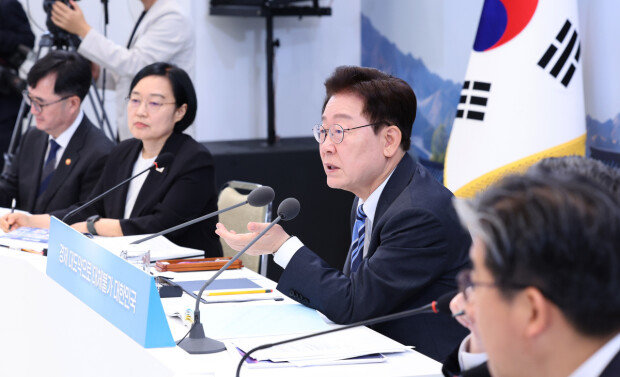
President Lee Jae-myung on Wednesday ordered financial authorities to swiftly draw up safeguards for single-stock leveraged exchange-traded funds tied to Samsung Electronics and SK hynix after the products came under scrutiny for amplifying volatility in South Korea's benchmark Kospi index.
During a policy briefing by the Ministry of Economy and Finance and other government agencies, Lee asked Financial Supervisory Service Gov. Lee Chan-jin, "It seems many investors have taken heavy losses because of the Samsung Electronics and SK hynix ETFs." Lee Chan-jin replied, "As the market regulator, I fully accept responsibility." He had said last month that he regretted not doing more to prevent the products from reaching the market. Lee also urged Korea Exchange Chairman Jeong Eun-bo to move quickly, saying the ETFs had become a growing source of market instability.
Lee said measures that are clearly necessary to stabilize the stock market should be implemented without delay, even in the face of resistance. At the same time, he urged regulators to move cautiously on more contentious proposals, warning that newly introduced rules can produce unintended consequences if they are rushed into place.
The heightened scrutiny follows sharp swings in SK hynix, one of the underlying stocks for the leveraged ETFs. The chipmaker plunged 15.37 percent on July 13, its steepest one-day decline since listing on the main stock market nearly three decades ago, before rebounding 8.83 percent two days later. The volatility was especially striking given that SK hynix, the Kospi's second-largest listed company, accounts for about a quarter of the benchmark index's market capitalization.
Financial regulators and the Korea Exchange are discussing rule changes that would raise the minimum deposit required to trade single-stock leveraged ETFs from the current 10 million won. They are also weighing stricter investor education requirements through the Korea Financial Investment Association, including extending the mandatory two-hour course or introducing additional training.
The Kospi closed at 7,284.41 on Wednesday, up 427.58 points, or 6.24 percent, from the previous session. The benchmark regained the 7,000 level after three trading days and climbed as high as 7,424.18 during the session. Heavy buying by foreign and institutional investors triggered a buy-side sidecar, which temporarily suspended program buy orders, at about 9:06 a.m. It was the 36th such trading curb this year.
Lee also described strengthening South Korea's capital market as a key national priority. "Real estate still accounts for far too large a share of the country's assets. That's an outdated model," he said. "Few advanced economies concentrate so much of their wealth in property."
Lee said too much capital remains locked in real estate instead of being channeled into productive investment, distorting resource allocation and weighing on economic growth. "Redirecting capital into productive investment is one of our most important tasks," he said.
Hoon-Sang Park tigermask@donga.com





 About Dong-A Ilbo