

AI subtitle glasses transform musicals
AI subtitle glasses transform musicals
Posted July. 16, 2026 08:27,
Updated July. 16, 2026 08:27
"My beloved, my music."
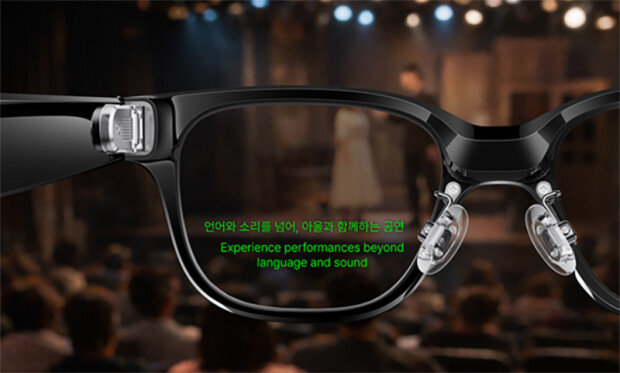
The lyrics appeared before my eyes the moment the opening number of Beethoven began Tuesday at the Sejong Center for the Performing Arts' Grand Theater in central Seoul. The words floated inside a pair of AI-powered subtitle glasses.
Unlike conventional subtitle screens, the captions never obscured the performers. I could follow the lyrics without taking my eyes off singer and actor Park Hyo-shin, who plays Beethoven, catching every expression and gesture as the story unfolded. Understanding the meaning of each song in real time also made it easier to connect with the characters' emotions. During intermission, foreign theatergoers carrying AI subtitle glasses were a common sight throughout the auditorium and lobby.
South Korea's musical industry is increasingly turning to AI subtitle glasses to attract overseas audiences. The technology recognizes actors' dialogue and songs, then projects preloaded subtitles onto the lenses at precisely the right moment. In the past, audiences had to shift their gaze to subtitle screens beside the stage, and later to tablet devices introduced in the 2010s. The glasses keep both the performance and the subtitles in the same field of view, allowing theatergoers to stay immersed in the production while following every line.
The technology was originally developed to help people with hearing impairments enjoy live performances. More recently, however, it has found a growing audience among international visitors. With a handheld controller, users can switch seamlessly between Korean, English, Japanese and Chinese subtitles.
The glasses are also affordable and easy to rent, costing about 15,000 won per performance. They are now available at major musical venues that draw large numbers of overseas visitors, including the Sejong Center for the Performing Arts, Charlotte Theater and Blue Square. Productions featuring stars with strong international followings tend to generate the highest demand, said Shin Soo-kyung, head of theater operations at NOL Theatre, which operates Blue Square. International students in South Korea have also become a growing source of demand, she said.
The numbers underscore that trend. Of those who rented the glasses for Beethoven, which opened June 9, 77.3 percent selected foreign-language subtitles, compared with 22.7 percent who chose Korean. Japanese ranked first at 31.6 percent, followed by English at 25.7 percent and Chinese at 20 percent. Kim Byung-jun, general manager at Expert I&C, developer of the AI subtitle glasses Owl, said demand extends beyond visitors from Japan, China and Taiwan to travelers from English-speaking countries. "More foreign visitors to Seoul are choosing live performances as part of their evening plans," he said.
Some in the industry believe the technology could also strengthen the global reach of Korean musicals. Overseas interest has continued to grow since Maybe Happy Ending captured six Tony Awards on Broadway last June. AI subtitle glasses could allow Korean casts to perform in Korean while giving international audiences immediate access to the dialogue and lyrics.
The technology still has room for improvement. During the performance, the subtitles occasionally appeared a split second ahead of or behind the dialogue. The glasses could also become uncomfortable over the course of a full-length production. Even so, Lee Soo-jung, a manager at Lotte Cultureworks, which operates Charlotte Theater, said the technology holds significant promise despite still being in its early stages. "As the subtitles become more accurate and the glasses lighter, I expect they'll be used much more widely in Korean musicals," she said.
이호재 기자 hoho@donga.com







 About Dong-A Ilbo