

Government trims petroleum price cap
Government trims petroleum price cap
Posted June. 27, 2026 08:25,
Updated June. 27, 2026 08:25
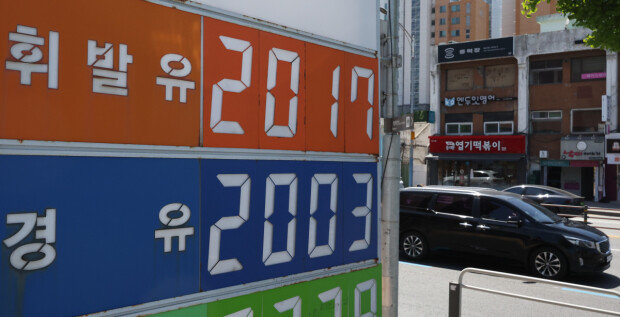
As global oil prices have retreated to levels seen before the Middle East conflict, the South Korean government will lower its ceiling on petroleum prices for the first time in three months. The price cap itself, however, will remain in place because of lingering uncertainty in the Middle East. The government is also freezing electricity, gas and other major utility rates for the second half of the year while setting aside 1 trillion won for discounts on agricultural, livestock and fisheries products in a broad push to contain inflation.
Deputy Prime Minister and Finance Minister Koo Yun-cheol unveiled the measures on June 26 after chairing an emergency economic policy meeting and a special interagency task force on consumer prices at the Government Complex Seoul. "After weighing lower global oil prices, the burden on households and fiscal conditions, we decided to lower the petroleum price ceiling while keeping the system in place until retail fuel prices stabilize," Koo said.
The Ministry of Trade, Industry and Energy said the ceiling for all major fuel products would be cut by 150 won per liter. Effective at midnight on June 27, the maximum prices will be set at 1,784 won per liter for gasoline, 1,773 won for diesel and 1,380 won for kerosene. Because the ceiling governs the prices refiners charge gas stations, retail pump prices are expected to ease into the 1,800 won-per-liter range by late this month or early next month. According to the Korea National Oil Corp., the nationwide average retail gasoline price stood at 2,005.97 won per liter on June 26.
The move reflects easing concerns over global oil supplies and growing expectations that shipping through the Strait of Hormuz will continue to normalize. As of 8 a.m. on June 25, Brent crude futures traded at $73.14 a barrel, almost back to their prewar level of $72.48, while U.S. West Texas Intermediate crude fell below $70 a barrel. The government expects the 150 won-per-liter reduction to help keep consumer inflation below 3% in the coming months.
Electricity, gas and other major public utility rates will remain unchanged through the second half of the year. The government also plans to hold down increases in local public charges, including water, sewage and public transportation fares.
The government aims to keep consumer inflation below 3% in the second half of the year. Even so, the inflation outlook remains challenging. The won continues to trade above 1,500 per U.S. dollar, while consumer prices in the previous month were up 3.1% from a year earlier.
세종=정순구 soon9@donga.com








 About Dong-A Ilbo