

Yuji Sakamoto on stories and mystery
Yuji Sakamoto on stories and mystery
Posted June. 19, 2026 08:36,
Updated June. 19, 2026 08:36
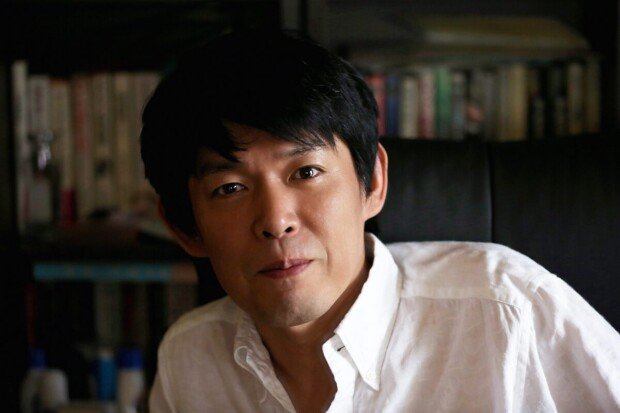
On June 7, the curtain came down on a play at Yeonwoo Theater in Seoul's Jongno District. It was a modest production that ran for just 10 days, yet every performance sold out. Many theatergoers came not because they recognized the title, "Again, Here?," but because of the playwright behind it. The work was written by Yuji Sakamoto, one of Japan's most acclaimed screenwriters.
Sakamoto, 59, gained international recognition in 2023 when he won the Best Screenplay Award at the Cannes Film Festival for director Hirokazu Kore-eda's film "Monster." In Japan, however, he had long been a star writer. He first captured public attention with the hugely popular drama "Tokyo Love Story" in 1991. In South Korea, too, dramas and films he wrote, including "Crying Out Love, in the Center of the World" (2004), "Mother" (2010) and "We Made a Beautiful Bouquet" (2021), have attracted devoted audiences.
Sakamoto is also an accomplished playwright, though that side of his career is less widely known. The Seoul production was made possible after Alma Publishing released the script for "Again, Here?" in January. Ahn Ji-mi, the publisher's CEO and a longtime admirer of Sakamoto's work, proposed translating the play after seeing it performed in Japan in 2018.
In a recent written interview with The Dong-A Ilbo, Sakamoto said the proposal came as a surprise. "Even in Japan, plays are rarely published as books," he said. "I believe translating foreign works reflects a society's cultural maturity, so the project deepened my admiration for Korean culture."
"Again, Here?" is set at an aging gas station. The story begins when Nemori arrives to tell Chikasugi, the station's young manager and his half brother, about a medical accident involving their father.
The play does not give up its secrets easily. Rather than relying on dramatic plot developments, it gradually reveals its characters' pasts and hidden truths through conversation. Remarks and actions that initially seem difficult to understand recur throughout the story, requiring audiences to follow the dialogue long before they fully grasp the characters. It is a technique Sakamoto also employed in works such as "Monster."
Sakamoto said the approach reflects his view of storytelling. "I don't like works that explain who a character is the moment they appear," he said. "Nor do I think that's my job as a writer."
"Of course, I know that approach can make a work less accessible. But I don't want to write in a way that feels disconnected from reality. In life, we come to understand people gradually. Thinking you've understood someone the moment you meet them doesn't mean you've truly come to know them. There should also be room for the possibility that fully understanding another person is impossible. As a creator, I find not understanding more interesting than understanding."
Since the 1990s, Sakamoto has written numerous scripts for staged readings and short theatrical productions. "Again, Here?" is his first full-length play, written at the request of a longtime friend.
"A friend of mine who is also a theater director used to ask me every time we went out for drinks to write a play for him," Sakamoto said. "He'd been saying it since we were in our 20s. I always brushed him off, but one night, when I was in a particularly good mood, I ended up agreeing."
The response was lighthearted, but Sakamoto said he had long regarded playwriting as work he hoped to pursue throughout his life. For someone whose career has focused largely on film and television, theater offers a rare opportunity to connect directly with audiences. He had hoped to travel to South Korea to attend the production but was unable to do so because he was working on a new manuscript.
"It has been one of my biggest disappointments recently," he said. "I hope I can visit Korea in the near future."
Sakamoto has long expressed affection for South Korea. He is an enthusiastic admirer of director Hong Sang-soo and has repeatedly shown interest in collaborating with Korean artists. In April, he traveled to South Korea with his mother. When asked about his connection to Korea, he recalled a childhood memory.
"I was about seven years old when my family went to the beach. My father stopped at a rest area and accidentally bought a cassette tape of Korean music. I suppose today people would call it trot.
"Then we got caught in a severe traffic jam, and for more than six hours we listened to Korean songs we couldn't understand over and over again.
"As a child, I hated it. But I've never forgotten that time. Songs filled with emotion, sung in a language that felt completely unfamiliar. Even now, Korean culture doesn't feel global to me. It feels more like a deeply rooted emotion."
김태언 beborn@donga.com

![전국 누비던 허영만도 못 피한 낙상…예방의 핵심은 ‘근육’[노화설계]](https://dimg.donga.com/c/138/175/90/1/wps/NEWS/IMAGE/2026/06/18/134135614.3.jpg)
![[속보]단 한번의 수비 실책…멕시코전 아쉬운 0-1 패배](https://dimg.donga.com/c/138/175/90/1/wps/NEWS/IMAGE/2026/06/19/134142389.1.jpg)




 About Dong-A Ilbo