

AI transforms public safety and welfare
AI transforms public safety and welfare
Posted May. 29, 2026 08:25,
Updated May. 29, 2026 08:25
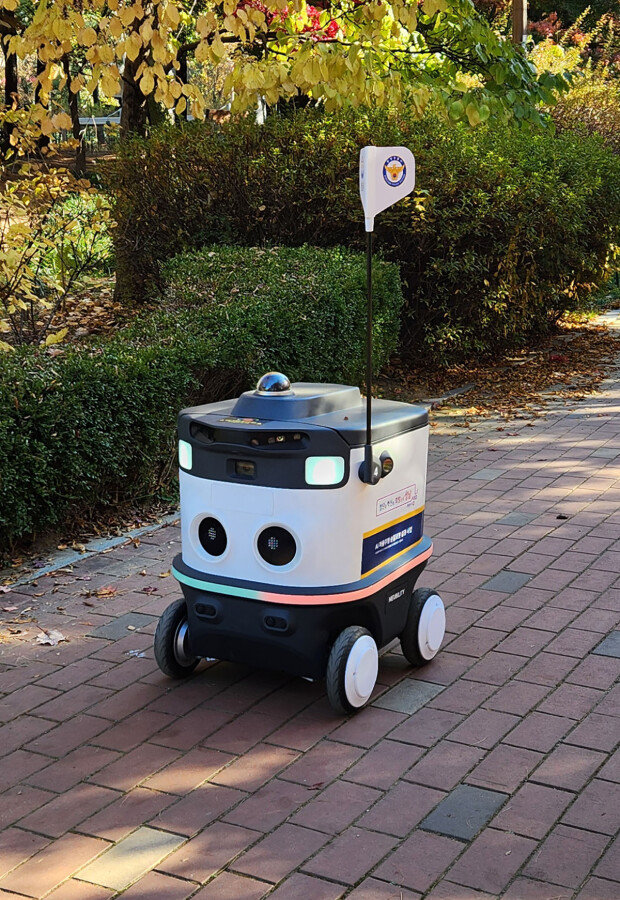
“Seeing a robot patrol a dark park at night actually made me feel safer. It’s comforting to know it can immediately report dangerous situations,” said Lee Soo-hyun, a resident of Seongnam.
“I went to Ilwol Arboretum, and the robot explained the plants while guiding us around. My children loved it,” said Won Jun-hyuk, a Suwon resident.
Artificial intelligence and robotics are steadily weaving themselves into daily life across Gyeonggi Province. Once largely associated with repetitive industrial tasks, AI-powered services are now taking on broader public roles, helping improve safety, welfare and everyday convenience for residents. Seongnam has introduced a smart safety system centered on autonomous AI patrol robots.
Four robots are currently operating at Yatap Culture Park, Yuldong Park, Seohyeon Station Plaza and Pangyo Station Plaza. Moving independently through parks and public plazas, the robots monitor their surroundings in real time, detect potential hazards and send information directly to a control center.
At Yuldong Park, the robots patrol a 450-meter section near the management office and roughly 2.5 kilometers of walking trails surrounding Bundang Reservoir. At Seohyeon Station Plaza and Pangyo Station Plaza, they cover designated sections of 150 meters and 140 meters respectively, operating daily from 4 a.m. until midnight.
Kim Man-geun, head of the video information team at Seongnam’s Smart City Division, said the program is drawing attention as a smart public safety service designed to prevent crime during late-night hours and reduce security blind spots.
In August, Seongnam plans to launch the country’s first AI-powered “smart porter robot” at Moran Traditional Market.
After users scan a QR code, the robot follows them through the market carrying up to 20 kilograms of goods. Equipped with augmented reality navigation, it can also guide shoppers through the market’s maze-like alleys to specific stores. Officials expect the service to improve mobility for elderly residents and shoppers carrying heavy bags.
Suwon has also been expanding AI guide robot services at public offices and cultural facilities. At City Hall, a civil service robot named “Saero” provides administrative information and interpretation services in nine languages.
At Ilwol Arboretum, a docent robot named “Ilwori” accompanies visitors through the gardens, explaining plant species and guiding them along exhibition routes.
Kim Yeon-hee, a homemaker visiting the arboretum, said the experience captivated her children. “My kids were fascinated listening to the robot explain the plants while following it around,” she said. “It felt more interactive than an ordinary tour, so our whole family enjoyed it even more.”
Yongin is operating a senior health care service that combines AI with Internet of Things technology.
AI analyzes data collected from wearable activity trackers and glucose monitors, while health professionals provide tailored consultations based on the results. The service is seen as helping reduce care gaps for seniors living alone and other vulnerable residents.
Hwaseong has broadened the use of robotics in welfare and rehabilitation services. In 2019, the city became the first in South Korea to introduce robot-assisted rehabilitation programs at a welfare center for people with disabilities. The program uses fixed walking robots, wearable robotic walking aids and upper-body rehabilitation robots to support therapy and physical rehabilitation training.
The city has also recently established a customized robotic rehabilitation center. In January, Hwaseong jointly published a “robot rehabilitation clinical guideline” with a local welfare center for people with disabilities, part of a broader effort to strengthen the professionalism and standardization of rehabilitation services.
Hyun Byung-cheon, director general of Gyeonggi Province’s Future Growth Industry Bureau, said AI and robotics are expected to move beyond pilot projects and become core public services that improve safety, welfare and everyday convenience for residents.
이경진 lkj@donga.com







 About Dong-A Ilbo