

Warsh takes Fed helm amid inflation fears
Warsh takes Fed helm amid inflation fears
Posted May. 25, 2026 08:16,
Updated May. 25, 2026 08:16
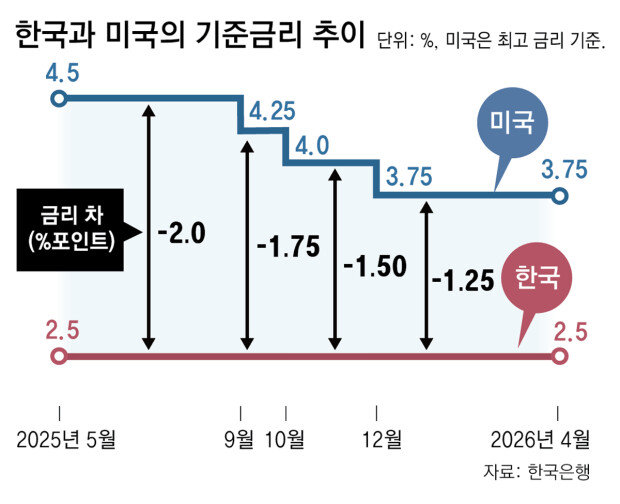
Expectations of higher interest rates are gaining ground in the United States and South Korea as inflation concerns intensify following the conflict with Iran and Kevin Warsh begins his tenure as chair of the U.S. Federal Reserve.
While U.S. President Donald Trump has continued to advocate lower rates to support economic growth, investors increasingly expect the Fed to move in the opposite direction as elevated oil prices raise the risk of persistent inflation.
Attention is also turning to the Bank of Korea's Monetary Policy Board meeting on May 28, where policymakers are expected to signal a firmer stance on inflation at the first rate-setting meeting chaired by Gov. Shin Hyun-song. Warsh begins term stressing Fed independence
According to the Financial Times and other media reports, Warsh took the oath of office at the White House on May 22 and formally began his term as Fed chair.
"The Federal Reserve's mission is to promote price stability and maximum employment," Warsh said. "If we pursue those goals with wisdom, clarity, independence and determination, inflation will remain low and growth will remain strong."
Trump said he hoped Warsh would operate independently and restore confidence in the central bank. At the same time, he reiterated his preference for lower rates. "We want to stop inflation, but we don't want to stop greatness," Trump said. "When the economy is booming, sometimes you should simply let it keep booming."
● Markets shift sharply toward rate hikes
Investors have largely abandoned expectations of rate cuts this year. According to CME Group's FedWatch tool on May 24, markets assigned a 32.1% probability that the federal funds rate would remain at its current range of 3.5% to 3.75% through year-end.
The probability of one or more rate increases stood at 67.9%, including a 42.5% chance of a quarter-point hike. Markets also assigned a 0.4% probability to cumulative increases of up to one percentage point. The probability of a rate cut was zero. The shift has been swift. On April 24, markets saw a 38.1% chance of a rate cut and only a 0.6% probability of a rate increase.
Analysts attribute the change largely to concerns that prolonged conflict between the United States and Iran could keep energy prices elevated. With the Strait of Hormuz remaining vulnerable to disruption, inflation risks have moved back to the forefront of market concerns. The change in expectations has pushed long-term government bond yields higher across major economies.
According to the Korea Center for International Finance, the yield on the 30-year U.S. Treasury reached 5.20% on May 19 before easing to 5.09% on May 21. It was the first time since July 2007 that the yield had exceeded 5%.
Japan's 30-year government bond yield climbed to 4.03%, the highest level since the security was first issued in 1999. Thirty-year yields in Britain and Germany rose to 5.64% and 3.31%, their highest levels in 27 years and 14 years, respectively. Fed officials have also begun signaling concern about inflation.
Speaking in Frankfurt on May 22, Federal Reserve Governor Christopher Waller said further rate increases could not be ruled out if inflation failed to ease.
At the Federal Open Market Committee meeting last month, three of the 12 members dissented in favor of a more hawkish policy stance.
● Bank of Korea faces growing pressure
Expectations of tighter monetary policy are also building in South Korea. Few economists expect the Bank of Korea to raise rates immediately at its May 28 meeting given economic uncertainty and the approaching election. Even so, analysts expect policymakers to adopt more hawkish language if rates are left unchanged.
Senior Deputy Governor Ryoo Sang-dai signaled that possibility on May 3. "The time has come to stop thinking about rate cuts and start considering rate increases," Ryoo told reporters.
Strong growth in the semiconductor sector has supported the economy while inflation remains elevated, reinforcing expectations that the central bank may eventually begin raising rates.
Kim Ji-man, an analyst at Samsung Securities, said the upcoming meeting would likely serve as a signal of future tightening rather than the start of action. "This meeting is likely to prepare markets for higher rates," Kim said. "The first increase is more likely to come in August."
홍석호 기자 will@donga.com




 About Dong-A Ilbo