

Study links protein to brain health gains
Study links protein to brain health gains
Posted April. 28, 2026 08:10,
Updated April. 28, 2026 08:10
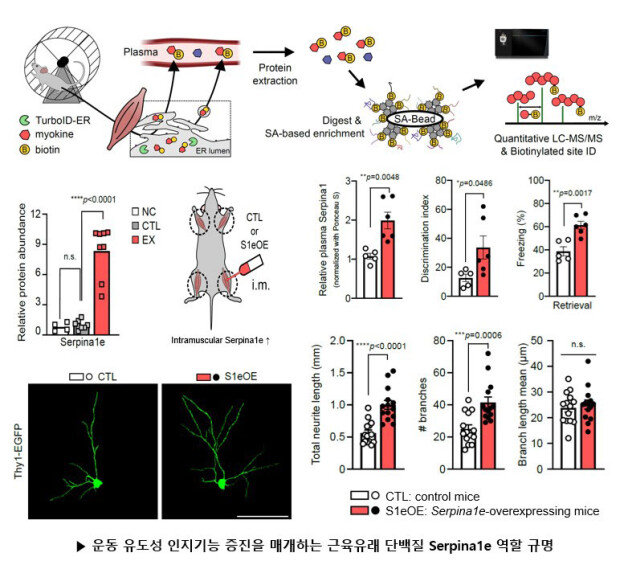
Exercise boosts brain activity and cognitive function, but it is not always feasible for people with limited mobility due to aging or illness. South Korean researchers say they have identified a biological pathway that could help preserve brain function without physical activity, offering a potential route for new drug development.
A joint team led by Park Hyung-ju of the Korea Brain Research Institute and Kim Jong-seo, a professor of biological sciences at Seoul National University, said it has identified a muscle-derived protein, Serpina1e, and clarified how it enhances cognitive function.
Focusing on the muscle-brain axis, in which muscles and the brain communicate through biochemical signals, the researchers used advanced mass spectrometry to analyze secreted molecules at the molecular level. They found that levels of Serpina1e rose significantly in the blood of mice after four weeks of exercise.
The study showed that the protein can cross the blood-brain barrier, the brain’s protective shield against harmful substances. Once it reaches the hippocampus, a region central to memory, Serpina1e increases the expression of brain-derived neurotrophic factor, or BDNF, and promotes the regeneration of nerve cells, improving cognitive performance.
In experiments, mice that did not exercise but received the protein showed increased neuron growth in the hippocampus and improved cognitive function, comparable to those that exercised. When the protein was suppressed through genetic modification, exercise failed to produce cognitive gains.
Park said the findings identify a pathway in which a muscle-derived protein travels through the bloodstream, crosses the blood-brain barrier and acts directly on the hippocampus. He said he hopes the research will lead to new treatments for cognitive decline. The study was published in Nature Communications.
Jae-Hyeng Kim monami@donga.com

![달걀 하루 몇 개까지 괜찮을까?…핵심은 ‘이것’[건강팩트체크]](https://dimg.donga.com/c/138/175/90/1/wps/NEWS/IMAGE/2026/04/27/133818891.3.jpg)
![[알립니다]만성폐쇄성폐질환과 폐고혈압](https://dimg.donga.com/c/138/175/90/1/wps/NEWS/IMAGE/2026/04/24/133800812.4.jpg)





 About Dong-A Ilbo