

North Korea, Russia deepen ties on Kursk anniversary
North Korea, Russia deepen ties on Kursk anniversary
Posted April. 27, 2026 08:03,
Updated April. 27, 2026 08:03
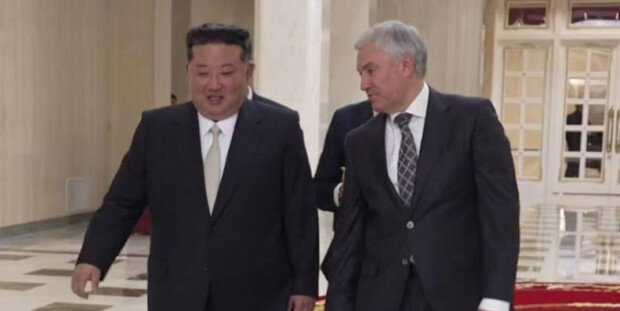
As North Korea and Russia mark what they call the first anniversary of the “liberation of Kursk,” Vyacheslav Volodin, speaker of Russia’s lower house of parliament and a close aide to President Vladimir Putin, visited North Korea on April 25. The trip comes amid rapidly deepening ties between Pyongyang and Moscow, as speculation grows that North Korean leader Kim Jong Un could travel to Russia ahead of its Victory Day on May 9.
Analysts say the expanding high-level exchanges may also be aimed at signaling to Washington and Beijing ahead of a planned U.S.-China summit on June 14-15, reinforcing Russia’s role as a key strategic partner for North Korea.
● Putin ally visits Pyongyang for Kursk anniversary
Russia’s TASS news agency reported on April 26 that Volodin met Kim Jong Un during his visit, delivering greetings and congratulations from Putin and expressing gratitude for North Korea’s support in the Kursk operation.
Volodin arrived in Pyongyang the previous day at the invitation of North Korea’s Supreme People’s Assembly and the Ministry of National Defense, leading an official delegation. He was received at the airport by Choe Ryong Hae, chairman of the Supreme People’s Assembly Standing Committee.
The visit centers on the first anniversary of what Moscow and Pyongyang call the “liberation of Kursk.” The Kursk region in southwestern Russia, bordering Ukraine, has been one of the most intense battlefields in the Russia-Ukraine war. After temporarily losing control of parts of the region, Russia announced on April 26 last year that it had fully retaken Kursk and disclosed for the first time that North Korean troops had taken part in the operation.
North Korea followed a day later, declaring the “victorious conclusion” of the operation. The Russian delegation, including Volodin, is expected to attend the opening of a memorial honoring North Korean soldiers killed in the fighting, known as the “Memorial Hall of Battle Merit.”
Before Volodin’s visit, several senior Russian officials had already traveled to North Korea, including Natural Resources Minister Alexander Kozlov, Health Minister Mikhail Murashko, and Interior Minister Vladimir Kolokoltsev.
Kozlov and Murashko took part in a groundbreaking ceremony for a Russia-North Korea friendship hospital in the Wonsan Kalma coastal tourist zone and held working-level talks on cooperation on April 22. Kolokoltsev met North Korean Public Security Minister Pang Tu-sep on April 21 to discuss law enforcement cooperation.
A South Korean Unification Ministry official said it is unusual for three Russian ministers to visit North Korea at the same time, describing it as part of broader, across-the-board bilateral engagement.
Experts say the coordinated visits by senior Russian officials are likely intended to send a broader diplomatic message to both the United States and China.
Park Won-gon, a professor of North Korean studies at Ewha Womans University, said Kim Jong Un has a political incentive to publicly emphasize the strength of ties with Russia. He added that the timing of the visits carries symbolic significance amid a complex global environment, including the ongoing Iran-related conflict.
● Russia’s Victory Day raises prospect of Kim visit
Against the backdrop of deepening ties, speculation is also growing that Kim Jong Un could visit Russia for its Victory Day celebrations on May 9, marking the Soviet Union’s defeat of Nazi Germany in World War II.
Putin invited Kim during his 2024 visit to Pyongyang and again at China’s Victory Day event in September last year, but Kim has yet to make a reciprocal visit to Russia.
If Kim were to travel to Russia ahead of the June U.S.-China summit, analysts say it could have notable implications for regional dynamics in Northeast Asia. A potential visit by Chinese President Xi Jinping could also revive last year’s high-profile display of alignment, when the leaders of North Korea, China and Russia appeared together during China’s Victory Day events.
Du Jin-ho, head of the Eurasia Center at the Korea Institute for National Strategy, said Russia appears to be working to bring both Chinese and North Korean leaders into its diplomatic orbit as part of an effort to strengthen a multipolar bloc. He added that a repeat of last year’s trilateral appearance would underscore that alignment more visibly.
Meanwhile, Kim Jong Un visited a military unit on April 25 to mark the 94th anniversary of the founding of the Korean People’s Revolutionary Army, an anti-Japanese guerrilla force. He encouraged troops at a mechanized infantry division in the western region and observed a mortar firing drill.

![“1000만원 줄 테니 나가달라”…집주인 제안, 받아도 될까 [집과법]](https://dimg.donga.com/c/138/175/90/1/wps/NEWS/IMAGE/2026/06/19/134130634.3.jpg)



 About Dong-A Ilbo