

US limits intel sharing after Seoul disclosure
US limits intel sharing after Seoul disclosure
Posted April. 17, 2026 09:01,
Updated April. 17, 2026 09:01
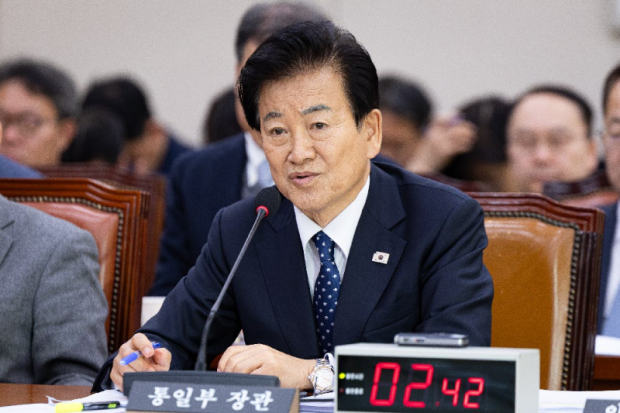
The United States has scaled back parts of its intelligence sharing on North Korea with Seoul after Unification Minister Chung Dong-young publicly cited a suspected nuclear facility in Kusong, heightening concerns about coordination between the allies.
U.S. officials delivered strong objections through multiple channels following Chung’s remarks last month. The site in Kusong, North Pyongan Province, had been referenced in reports by U.S. think tanks and media, but had not been formally confirmed by South Korea-U.S. intelligence authorities.
A South Korean official said at the time that Kusong had appeared in open-source materials, including a 2016 report by the Institute for Science and International Security. The report indicated that early centrifuge research and development may have taken place near Banghyon Air Base, about 45 kilometers west of the Yongbyon nuclear complex. While the air base is located in Kusong, the report did not explicitly name the city.
Unlike plutonium production at Yongbyon’s 5-megawatt reactor, which requires large reprocessing facilities that are relatively easy to detect, highly enriched uranium production can be carried out in smaller, often underground facilities that are much harder to identify. North Korea has disclosed such sites only twice, in September 2024 and January last year, without revealing their locations. South Korea-U.S. intelligence authorities assessed those visits as taking place in Kangson and Yongbyon, respectively.
Given the opaque nature of Pyongyang’s nuclear program, South Korea-U.S. authorities have closely tracked suspected enrichment facilities across the country. Officials said Washington reacted sharply to the first public mention of Kusong by a senior South Korean official.
A source familiar with the matter said the United States had already signaled its intent to reduce intelligence sharing. Another intelligence source said some information gathered through reconnaissance assets appears to have been withheld. While Seoul is working to expand its own surveillance capabilities under a plan to deploy five military reconnaissance satellites by 2027, it continues to rely heavily on U.S. intelligence.
Analysts say the latest tensions reflect broader differences that have surfaced between the allies across a range of issues. Chung has previously taken positions that diverge from Washington on North Korea policy, including the South Korea-U.S. working group, sanctions and legislation related to the Demilitarized Zone.
Differences have also emerged this year over joint military activities, including U.S. Forces Korea air drills in the West Sea, the scale of combined exercises and the redeployment of U.S. troops from the Korean Peninsula to the Middle East following the U.S.-Iran conflict. Communication between the two sides over those troop movements has also been uneven, according to officials.
Kyu-Jin Shin newjin@donga.com

![[속보]트럼프 “이란과 14일 합의 서명”…혁명수비대 “절대 없을 것”](https://dimg.donga.com/c/138/175/90/1/wps/NEWS/IMAGE/2026/06/14/134105551.1.jpg)





 About Dong-A Ilbo