

Police intensify crackdown on intersection blocking
Police intensify crackdown on intersection blocking
Posted April. 08, 2026 08:50,
Updated April. 08, 2026 08:50
“Why am I the only one being stopped when I entered on a green light?”
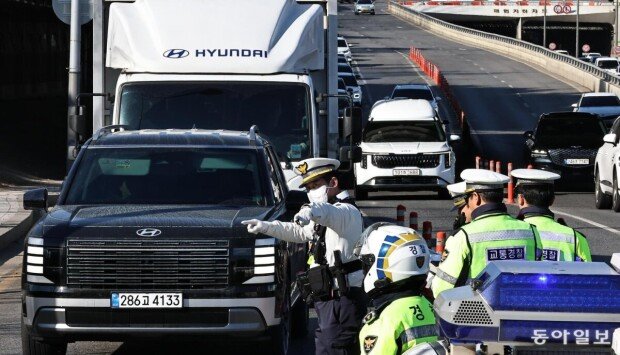
At about 8:20 a.m. Monday at a three-way intersection near Yonsei University in Seoul’s Seodaemun District, a man in his 60s driving a white sport utility vehicle pulled over at a police officer’s signal and protested. “Shouldn’t the cars in front of me and behind me be cited as well?” he said.
The driver had entered the intersection before the light turned red, but traffic ahead was already backed up, blocking cross traffic. Police cited him for causing gridlock and issued a 40,000-won fine despite his repeated objections.
The Seoul Metropolitan Police Agency conducted a one-hour crackdown starting at 8 a.m. at 45 major intersections and road entry and exit points across the city, including areas near Yonsei University, Sincheon Interchange in Songpa District and Yangjae Interchange in Seocho District. The operation focused on gridlock driving and unsafe merging during the morning commute.
At the Yonsei University intersection, congestion worsened as vehicles attempting left turns blocked other lanes, leaving buses and taxis stuck in traffic. Near Yangjae Interchange, drivers trying to merge were seen clashing with others unwilling to yield. Officers stood in the roadway with illuminated batons, repeatedly directing violators to pull over.
Most drivers accepted the citations, saying they had followed the car ahead and missed the signal. Others argued the situation was unavoidable and insisted they had not run a red light.
A highway bus driver cited for cutting into a left-turn lane near Yangjae Interchange while heading toward central Seoul challenged the enforcement.
“With so many vehicles coming straight from Gwacheon, merging into the left-turn lane is unavoidable,” the driver said. “Is it fair to penalize that? If we do not merge, we would be stuck on the road all day. Fuel costs are high, and if I earn 170,000 won a day and get fined, there is little left.”
During the roughly one-hour crackdown, authorities recorded 358 violations, including 231 cases of illegal merging and 91 cases of gridlock driving. That works out to about six violations per minute. Of those, 243 resulted in on-site fines, while 115 drivers received warnings.
The operation was part of the Seoul Metropolitan Police Agency’s “Seoul Traffic Redesign Project.” Over the five months from Nov. 3 last year to March 30, police recorded 23,825 cases of gridlock driving and illegal merging, up 139.4 percent from 9,953 cases during the same period a year earlier.
Experts say such violations not only disrupt traffic flow but also increase the risk of secondary accidents, underscoring the need for continued enforcement. According to the Korea Road Traffic Authority’s traffic accident analysis system, 10,246 intersection-related accidents involving violations such as illegal merging and gridlock driving were recorded in 2024, resulting in 31 deaths and 15,069 injuries.
Lee Soo-bum, a professor of transportation engineering at the University of Seoul, said sustained enforcement is essential to reduce the risk of follow-on crashes.
고진영 goreal@donga.com

![북한군 간호사에서 세계 누비는 사업가 되기까지[주성하의 북에서 온 이웃]](https://dimg.donga.com/c/138/175/90/1/wps/NEWS/IMAGE/2026/05/24/133981366.1.jpg)


 About Dong-A Ilbo