

Stealth warships develop from early aircraft designs
Stealth warships develop from early aircraft designs
Posted April. 04, 2026 09:17,
Updated April. 04, 2026 09:17
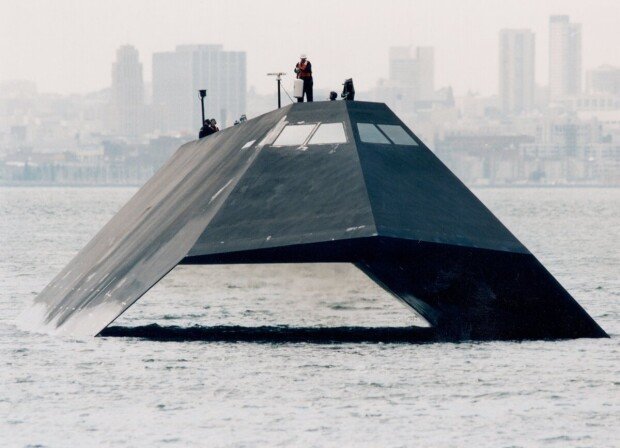
A defense industry that has produced stealth aircraft, long dubbed “ghosts in the sky,” since the 1970s has also spent decades extending that technology to the sea. From the early days of stealth aviation, contractors pursued parallel research into warships and submarines.
Lockheed Martin applied the angular design principles of the F-117 Nighthawk to naval platforms, creating the experimental vessel Sea Shadow. Constructed from flat, triangular panels, the ship closely resembled the faceted shape of the F-117.
Avoiding detection at sea requires more than reducing radar visibility. Surface ships must also contend with sonar, which tracks targets using sound waves. Tests in acoustic facilities found that scale models of the Sea Shadow reflected sound at roughly one-thousandth the level of conventional vessels. Although it never saw combat, the ship’s design helped shape the foundations of modern stealth warships. Its core concepts continue to inform platforms such as the Zumwalt-class destroyer.
Ships are less constrained by aerodynamics than aircraft, giving designers greater freedom to adopt angular forms that deflect detection. This is evident in the Visby-class corvette developed by Saab. The vessel’s exterior is dominated by flat, triangular surfaces, with almost no curves. Its main gun is hidden within the hull and revealed only when in use. To reduce its infrared signature, engine exhaust is cooled by mixing it with outside air before being released.
The most effective form of maritime stealth is the submarine, which operates beneath the surface. Conventional submarines, however, must surface at intervals because their engines require air. Most diesel-electric submarines recharge their batteries on the surface, then switch to battery power underwater. Each resurfacing exposes them to detection through heat, noise and visual tracking.
That limitation has driven countries to pursue nuclear-powered submarines. These vessels can generate electricity without surfacing, allowing them to remain submerged for long periods. They can also use surplus power to convert seawater into fresh water for the crew.
In South Korea, discussion of nuclear-powered submarines gained momentum after talks at the Asia-Pacific Economic Cooperation summit in Gyeongju in October last year. During the meeting, President Lee Jae-myung asked U.S. President Donald Trump to permit the supply of nuclear submarine fuel. Trump responded positively, prompting further debate over whether South Korea should move forward with such a program.
Won-Joo Lee takeoff@donga.com


![하루 방귀 몇 번이 정상일까? 가장 많이 뀌는 시간대는…[건강팩트체크]](https://dimg.donga.com/c/138/175/90/1/wps/NEWS/IMAGE/2026/06/12/134098245.3.jpg)
![소음 막는 방음벽, 주민들이 “없애달라” 요구하는 이유는[부동산 빨간펜]](https://dimg.donga.com/c/138/175/90/1/wps/NEWS/IMAGE/2026/06/11/134096845.1.jpg)



 About Dong-A Ilbo